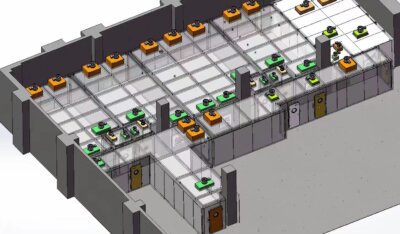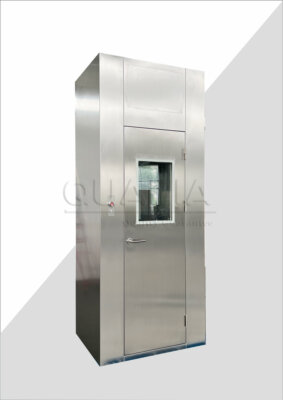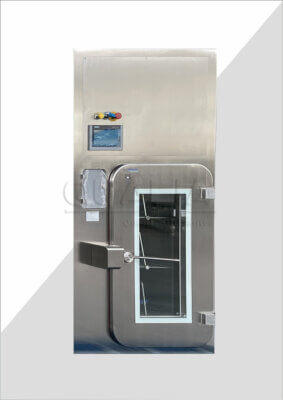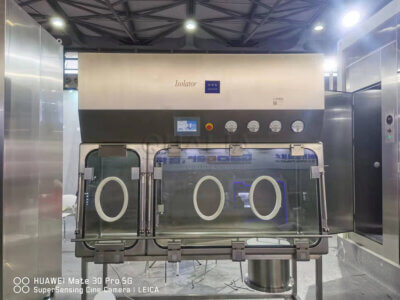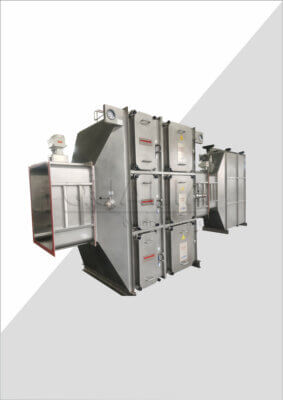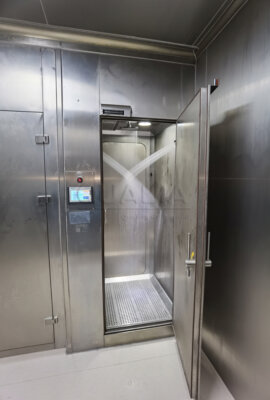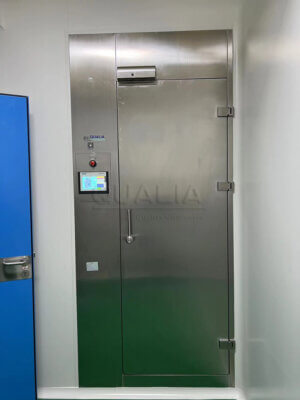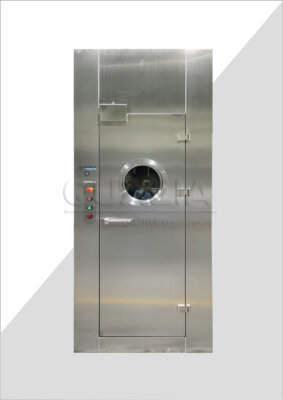
Selecting the wrong VHP configuration at procurement stage rarely announces itself immediately — the consequences surface months later as premature generator wear, cycle inconsistency, and a revalidation burden that no one budgeted for. A facility that commits to a portable unit without modelling its weekly cycle schedule or room volume may find itself mid-project facing a configuration change that triggers full decontamination protocol re-validation, adding cost and schedule delay that a clearer upfront specification would have prevented. The decision is not simply a capital question: it encodes labour commitments, throughput constraints, and validation consequences that persist across the equipment’s operational life. Understanding where each configuration breaks down — and at what frequency and volume thresholds the trade-off shifts — is what allows procurement and engineering teams to avoid locking in the wrong answer early.
Portable Versus Fixed VHP Decontamination
The practical gap between portable and fixed VHP configurations is most visible in what happens between cycles, not during them. With a non-piped portable generator, the unit must remain inside the room throughout the aeration phase. Until aeration is complete and the room is re-entered safely, the generator cannot be moved, serviced, or redeployed. For a facility running a single room on an occasional schedule, this constraint is manageable. For one running multiple spaces with overlapping decontamination windows, it becomes a throughput bottleneck that compounds across every cycle the facility runs.
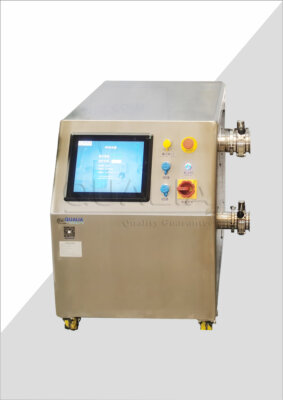
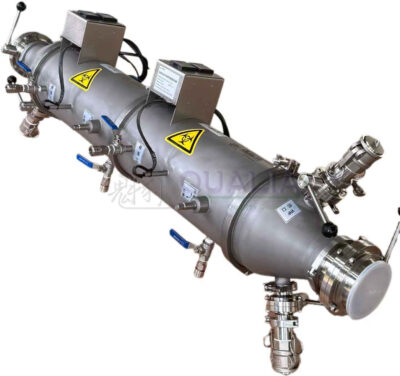
Piped portable generators change this calculus meaningfully: because vapour is delivered through insulated polymer piping rather than from a unit sitting inside the space, the generator can be stationed outside the room and redeployed to a second enclosure while the first aerates. This ability to overlap cycles is a genuine operational advantage over non-piped portable units, though it does not eliminate the manual labour of fan placement, which remains a per-cycle requirement across both portable sub-types. Fixed integrated systems remove that recurring setup burden entirely — no fans to place, no generator to move, no per-cycle preparation beyond initiating the cycle.
Each configuration carries a distinct labour profile at the per-cycle level, and the difference scales directly with frequency.
| Фактор | Portable (Non-Piped) | Portable (Piped) | Fixed (Integrated) |
|---|---|---|---|
| Manual fan placement | Required each cycle | Required each cycle | Не обов'язково |
| Generator location during aeration | Inside room; prolongs cycle and prevents redeployment | Outside room; ready for immediate redeployment | Fixed outside; continuous operation without moving |
| Ability to overlap cycles | Неможливо. | Yes – redeploy generator to another enclosure while first room aerates | Yes – multi-port distribution allows simultaneous or sequential cycles |
| Labour effort per cycle | Highest (manual transport, placement, and removal) | Moderate (generator moves between rooms) | Lowest (no per-cycle setup; minimal operator intervention) |
The operational consequence of generator location during aeration is worth stating plainly: non-piped portable units introduce a hard constraint on cycle throughput that is rarely visible in a purchasing decision but becomes operationally significant as soon as a facility begins running decontamination at more than occasional intervals. The labour advantage of integrated systems is an engineering trade-off, not a regulatory requirement — but it compounds quickly in high-frequency environments.
Volume Thresholds for Portable vs Fixed Systems
Vapour output capacity is the first boundary that determines which configuration is technically appropriate. Portable generators — whether piped or non-piped — typically deliver between 10 and 30 grams per minute of hydrogen peroxide vapour. That output is adequate to achieve the vapour concentration needed for decontamination in spaces up to approximately 200 m³. Beyond that volume, sustaining sufficient concentration becomes increasingly difficult without either an extended conditioning phase or a higher-output system.
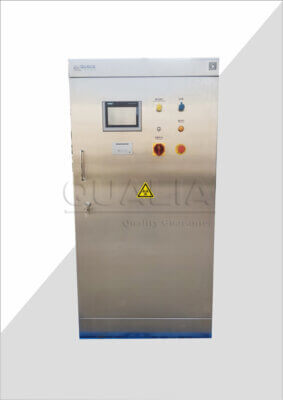
The 200 m³ and 250 m³ figures used here are design thresholds drawn from equipment capability inputs rather than regulatory limits. They function as decision triggers: at or below 200 m³, a standalone portable unit is technically feasible; between 200 m³ and 250 m³, a piped portable configuration with manifold distribution can extend effective reach — up to hundreds of feet using insulated polymer pipes — giving access to larger or more distant spaces that a self-contained unit could not reliably serve. Above 250 m³, or where cycle frequency also exceeds four cycles per week, a fixed multi-port system capable of delivering more than 50 g/min becomes the more defensible technical and economic choice.
The piping reach of portable-with-piping configurations is an operational capability, not a standardised specification, and its effectiveness depends on insulation quality, pipe routing, and the specific generator unit in use. It expands the addressable footprint of a portable investment, but it does not resolve the output ceiling.
| Тип системи | Vapour Output (g/min) | Max Room Volume | Piping Reach | Decision Threshold |
|---|---|---|---|---|
| Portable (standalone) | 10–30 | Up to 200 m³ | Limited to generator location | Adequate for small single-enclosure applications |
| Portable with piping | 10–30 | Extended beyond 200 m³ (via remote piping and manifold distribution) | Hundreds of feet using insulated polymer pipes | Enables larger or distant spaces but still constrained by generator output |
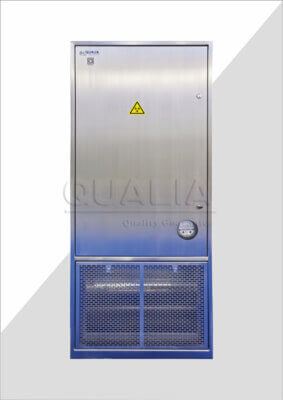
| Fixed multi-port | >50 | Over 250 m³ with cost advantage | Extensive fixed piping network | Lower per-cycle cost when room exceeds 250 m³ or schedule exceeds 4 cycles/week |
A common procurement error is treating the volume threshold as the only decision variable and overlooking cycle frequency. A room of 180 m³ that requires daily decontamination presents a different equipment problem than a room of 180 m³ decontaminated once a month — volume gets a portable unit through the door, but frequency determines whether it survives the schedule.
Cycle Frequency Impact on Equipment Selection
Cycle frequency is the planning criterion that most often determines which configuration is appropriate — and the one most often under-specified at procurement. At two or fewer cycles per week, a portable unit operates within a stress envelope where wear rates are manageable and cycle-to-cycle consistency is generally maintainable. Above four cycles per week, the picture changes: non-piped portable generators running at that frequency accumulate mechanical stress, and cycle results can become inconsistent before any outward sign of failure appears. By the time a facility identifies the pattern, the generator is already degraded and the cycle data may need to be reviewed.
The threshold between three and four cycles per week is where the decision becomes genuinely contested. A piped portable unit is workable in this band — overlapping cycles reduce downtime — but the manual labour of fan placement and generator repositioning becomes a recurring operational load. An integrated fixed system begins to show a measurable labour advantage at this frequency, and that advantage is not trivial across a multi-year operational horizon. Estimates of thousands of hours in cumulative labour savings relative to portable alternatives represent an order-of-magnitude planning figure rather than a validated benchmark, but they are directionally sound for high-frequency integrated operation and worth incorporating into a total cost of ownership model.
| Cycle Frequency Band | Portable (Non-Piped) | Portable (Piped) | Fixed (Integrated) |
|---|---|---|---|
| ≤2 cycles per week | Acceptable; minimal equipment stress | Acceptable; moderate labour | Not cost-justified for low frequency |
| 3–4 cycles per week | Risk of premature generator wear and inconsistent cycle results | Workable but involves significant manual labour | Labour advantage begins; suitable for schedules approaching daily use |
| >4 cycles per week | Not recommended; stresses equipment | Not recommended; labour escalates | Strongly recommended; lowest per-cycle cost and consistent results |
| Labour over operational life | Highest cumulative labour | Moderate cumulative labour | Saves thousands of hours compared to portable alternatives |
For teams evaluating a portable VHP generator for a facility with an uncertain or growing decontamination schedule, the honest planning question is not what frequency the facility runs today but what it is likely to run at peak. If that answer approaches four cycles per week, the procurement decision should be made in the context of what a configuration change mid-project would cost, not just what the unit costs now.
Capital Cost Comparison of VHP Configurations
Fixed integrated VHP systems carry a higher upfront investment than portable alternatives — not just in equipment cost but in the installation effort required: dedicated utility connections, fixed piping, and often structural or HVAC integration that adds both time and capital before the first cycle runs. Portable units, by contrast, can be deployed with minimal facility modification, which makes them attractive in capital-constrained procurement decisions or for facilities with a genuinely low and stable cycle frequency.
The hidden trade-off is that the lower purchase price of a portable unit does not eliminate recurring costs — it relocates them into per-cycle labour. Manual fan placement, generator transport, and setup time are required for every cycle across the equipment’s operational life. At low cycle frequency, this recurring cost is modest and unlikely to close the gap with a fixed installation. At high cycle frequency, it accumulates into a significant operational burden. Whether this offsets the capital difference depends on the specific labour rates, facility context, and cycle schedule — it cannot be stated as a universal rule, but it should be modelled rather than assumed.
A total-cost-of-ownership framework is the appropriate tool here. A facility running two cycles per week over five years faces a very different labour accumulation than one running daily cycles. The procurement decision should map the full cost profile across that projected schedule before treating the lower purchase price of a portable unit as an economic advantage. In many high-frequency scenarios, the fixed system is financially competitive before accounting for consistency advantages — but only if the analysis includes the full per-cycle labour cost of the portable alternative.
Validation Requirements When Switching Configurations
The validation consequence of a configuration change is the downstream risk that facilities most consistently underestimate at procurement. Switching from a portable to a fixed VHP system mid-project does not simply require a commissioning check — it triggers re-validation of the decontamination protocol, because the delivery mechanism, vapour distribution pattern, and cycle parameters have materially changed. Biological indicator studies must be repeated at worst-case locations, and the results must confirm that the new configuration achieves the accepted lethality standard before it can be used in production.
That standard, grounded in ISO 14937, requires a log 6 reduction in Geobacillus stearothermophilus spore count — the organism used as a biological indicator for VHP sterilisation processes because of its established resistance profile. This is the lethality criterion that re-validation must satisfy, and it applies whether the configuration change is from portable to fixed, fixed to portable, or any substantive modification to delivery parameters. It is not a site-specific interpretation; it reflects the accepted testing framework for vapour-phase sterilisation processes.
Compounding this, the MHRA has flagged the inherent fragility of VHP processes — cycle performance can be sensitive to small changes in temperature, humidity, and vapour distribution, making false-positive biological indicator results a genuine risk during validation. Using replicate biological indicators — typically three at each worst-case location — and calculating the most probable number of surviving spores rather than relying on a single pass/fail indicator is a practitioner-level approach that reduces validation uncertainty. It is not a universal regulatory mandate, but it reflects the kind of evidence quality that is difficult to challenge under audit.
The single most effective mitigation for recertification cost and schedule risk is a well-constructed User Requirement Specification developed before configuration selection. A process-oriented URS that defines key performance requirements — vapour output, cycle time, room volume, frequency, and aeration targets — forces the configuration decision to be made against explicit operational criteria rather than against a purchase price. Facilities that skip this step and later need to change configuration do not just face revalidation costs; they face them under time pressure, when the project is already committed to a schedule that does not accommodate the delay. For further context on sub-type selection within portable configurations, the Type II vs Type III comparison covers the capability distinctions that affect which portable option best fits a given application.
The configuration decision for VHP equipment is ultimately a lifecycle question that the capital budget alone cannot answer. Room volume sets the technical envelope; cycle frequency determines whether that envelope is sustainable; and the validation framework locks in the consequences of changing your mind later. Facilities that model all three before committing — rather than optimising for purchase price in isolation — consistently avoid the recertification delays and operational inconsistencies that characterise mid-project configuration changes.
Before finalising any configuration, the practical questions to resolve are: what is the projected peak cycle frequency, not just the current one; does the room volume or piping distance sit close to a threshold where a different configuration becomes more defensible; and has the decontamination protocol been specified in a URS that will survive a configuration change without requiring full re-authoring. Answering these before procurement closes is considerably cheaper than answering them after.
Поширені запитання
Q: Does the 200 m³ portable unit threshold still apply if the room has unusually high air change rates or significant humidity variation?
A: No — room volume is a necessary but insufficient criterion. High air change rates accelerate H2O2 dilution, effectively raising the output demand beyond what the volume figure alone suggests, while elevated background humidity competes with vapour conditioning and can prevent the generator from reaching the target concentration within a practical cycle window. In rooms where either condition applies, the effective ceiling for portable units is lower than 200 m³, and the vapour output margin should be re-evaluated against actual HVAC parameters rather than nominal room size.
Q: After selecting a fixed integrated system, what is the first validation step a facility should complete before running production cycles?
A: The first step is mapping worst-case vapour distribution locations within the space and placing biological indicators there for the initial qualification runs — not at representative or convenient positions. Because a fixed multi-port system delivers vapour through a defined piping and distribution layout, the worst-case locations are determined by that specific geometry and must be established empirically. Cycle parameters from a prior portable protocol cannot be carried over; the distribution pattern has materially changed and the BI placement must reflect the new delivery mechanism before any production use is justified.
Q: At what point does a piped portable configuration stop being a viable middle-ground option and become a compromise that creates problems in both directions?
A: A piped portable configuration becomes difficult to defend when cycle frequency consistently exceeds four cycles per week and room volume approaches 250 m³ simultaneously. At that intersection, the unit is operating near its output ceiling while also accumulating wear at a rate that portable designs are not built to sustain long-term. The per-cycle labour of fan placement is still present, and the overlapping-cycle advantage of piped delivery does not offset the throughput constraints when multiple spaces require concurrent decontamination. Below either threshold, the piped portable is a genuinely useful configuration; above both, it tends to satisfy neither the engineering nor the economic case as well as a fixed system would.
Q: Is a portable VHP generator still a reasonable choice if the facility’s decontamination schedule is low-frequency now but may grow significantly within two or three years?
A: Only if the procurement decision explicitly accounts for the recertification cost of switching configurations later. A portable unit selected for a current schedule of one or two cycles per week is technically appropriate for that demand — but if projected growth takes the facility above four cycles per week or into larger spaces within the equipment’s expected service life, the configuration change will require full re-validation of the decontamination protocol. That cost and schedule impact should be modelled against the incremental capital required to specify a fixed system at the outset. In many growth scenarios, the fixed system is the more defensible choice even when current frequency does not technically require it.
Q: How does the log 6 reduction requirement interact with the replicate BI approach — does using three BIs per location change the pass/fail threshold or just improve confidence in the result?
A: Using replicate biological indicators does not alter the log 6 reduction requirement itself — that lethality standard remains fixed as the acceptance criterion under ISO 14937. What three replicates provide is a statistically grounded estimate of surviving spore count through most probable number calculation, which reduces the risk of a false positive from a single compromised indicator being interpreted as a genuine cycle failure, or conversely, a marginal cycle passing on a single survivor result. The replicate approach improves the evidential quality of the validation data and its defensibility under audit, particularly given MHRA’s flagged concern about VHP process fragility, but it operates within the same lethality framework rather than replacing or relaxing it.
Пов'язаний вміст:
- Обладнання для дезактивації VHP та стандарти для об'єктів BSL-3/4
- Знезараження чистих приміщень: Портативні варіанти 2025 року
- Портативна лабораторія BSL-3: Гнучкі варіанти утримання
- Портативний генератор перекису водню VHP Посібник з експлуатації | Порівняння типу II та типу III
- Стерилізація VHP для невеликих приміщень | Портативні генератори для ізоляторів та прохідних боксів
- Портативні генератори VHP: Зміна правил гри у сфері дезактивації
- Переносні установки BSL-4: Найсучасніша ізоляція
- Знезараження лікарень: Портативні рішення 2025
- Комплексні портативні рішення для знезараження