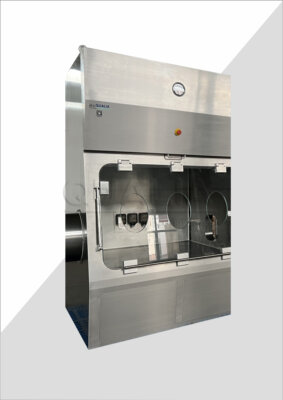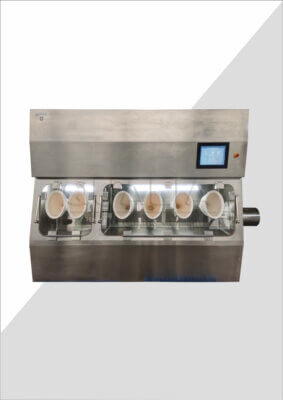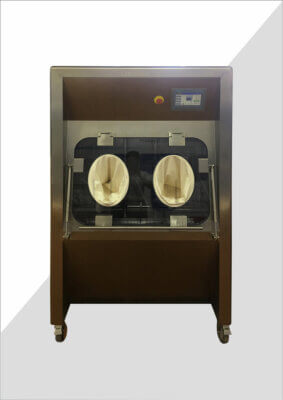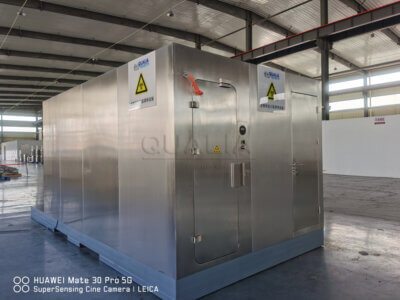

High-containment equipment projects fail at the interface, not at the equipment itself. When a BSL-3 module arrives on site and the exhaust plenum dimensions don’t match the EPC’s ductwork, or when an effluent decontamination system is installed but no party has documented who owns the drain line heat trace validation, the project doesn’t pause for an orderly discussion—it stalls while legal teams review contract language and project managers assign blame. That pattern is predictable, and it originates earlier than most organizations want to acknowledge: in the period before procurement approval, when scope boundaries feel premature to formalize. The judgment that resolves it is knowing exactly what a responsibility matrix must specify—and which assignments, if left vague, will convert a technical interface problem into a contractual dispute at the worst possible moment.
Responsibility matrix fields for high-containment projects
A responsibility matrix without column-level specificity is a list of intentions, not a project control document. The distinction matters because high-containment projects involve at least three parties with partially overlapping scope—buyer, EPC, and equipment supplier—and each party’s understanding of where its obligations end will diverge under pressure if the document allows it. The matrix must define, for every control or activity, not just who is responsible but what that responsibility concretely requires: timelines, acceptance criteria, and the names of the actions involved, not categories.
The four-column structure that makes this workable separates the control or activity from each party’s specific role and adds a column for shared details that resolves handoff mechanics. “Access control” as a matrix row is operationally useless. “Quarterly access reviews for containment-classified systems, conducted by supplier, reviewed and approved by buyer QA” is assignable and auditable. The difference is not administrative precision for its own sake—it is the difference between a deviation being closed in three days and a deviation sitting open for six weeks while each party waits for the other to initiate.
| Column | Опис | Specificity Requirement |
|---|---|---|
| Control/Activity | The specific task, check, or deliverable to be performed | Use exact, measurable descriptions (e.g., “Quarterly access reviews for systems in scope” instead of “Access control”) |
| MSP Responsibility | What the supplier/managed service provider must execute | Define actions, timelines, and acceptance criteria; avoid vague assignments |
| Client Responsibility | What the buyer/facility owner must provide or perform | Specify owner-side obligations without ambiguity |
| Shared Details | Joint tasks, handoffs, or communication flows | Detail who detects, investigates, notifies, and closes each shared item |
The mistake pattern worth flagging here is template copying. A matrix copied from a previous project without adjustment to the actual scope of the current engagement creates liability by listing activities that no party is contracted to perform. In containment projects, that typically surfaces as a row assigning decontamination cycle validation to the supplier when the current contract places that work with the EPC’s commissioning team—and then the row sits unsigned, unchallenged, and forgotten until the IQ execution phase.
Buyer-owned requirements and approval points
The buyer’s role is not passive approval. In a high-containment project, the buyer owns the user requirements specification as a living document, and the acceptance criteria embedded in that document are the threshold against which every delivered system is measured. If those criteria are underspecified at project initiation—if containment performance is described as “meets BSL-3 requirements” without reference to specific pressure differentials, airflow volumes, or alarm setpoints—then every FAT and SAT protocol written from that URS inherits the ambiguity.
What the buyer must own, and what must be named explicitly in the matrix, includes: final approval of all test protocols before execution, sign-off authority at each acceptance gate (FAT, SAT, IQ, OQ, PQ), and the right to reject any documentation package that does not meet the URS. ASTM E2500-25 positions URS development and verification planning as the foundational activities that define what “fit for purpose” means for a given system—which means the buyer cannot outsource that definition to the supplier and then expect the acceptance process to run cleanly.
The downstream consequence of incomplete buyer ownership at this stage appears at IQ. If the buyer has not documented which performance attributes require third-party witnessing versus internal sign-off, the IQ execution phase often involves renegotiating those decisions under time pressure, after the equipment is already installed and the project schedule is running.
EPC-owned utilities and installed interfaces
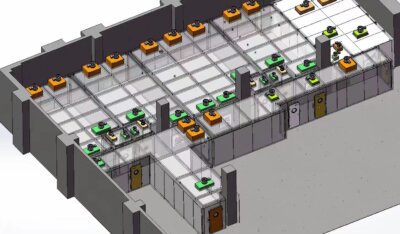
EPC responsibility in high-containment projects is often where the most consequential ambiguity lives, because the EPC connects the supplied equipment to the building systems that determine whether that equipment can function as designed. Power quality, HVAC supply and exhaust volumes, drain line sizing, structural load capacity, and interlock wiring between building management systems and contained equipment are all interfaces where the EPC’s scope and the supplier’s equipment design must be precisely aligned before installation begins.
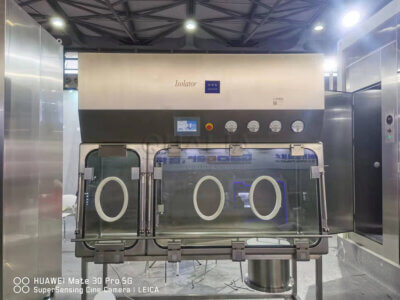
The risk is not that EPCs fail to understand their work—it is that “EPC-provided” and “EPC-validated” are not the same thing, and the matrix must distinguish between them. An EPC may be responsible for installing an exhaust connection to an OEB4/OEB5 isolator without being responsible for verifying that the delivered static pressure at that connection matches the isolator’s design requirement. If that verification is not assigned to a specific party, it is likely to surface as an unresolved discrepancy during commissioning.
The threshold that changes the recommendation here is containment dependency. For any utility connection where a failure mode directly affects containment integrity—negative pressure cascade, exhaust airflow to a BSL-3 module, effluent drain connectivity to an EDS—the matrix should assign active verification responsibility to a named party, not passive installation responsibility. The difference matters to the commissioning team and, later, to the inspecting authority reviewing the qualification package.
Supplier-owned equipment and documentation deliverables
The equipment supplier’s deliverable set extends well beyond the physical system. For high-containment and GMP-critical equipment, the documentation package is a qualification input, and gaps in that package delay IQ execution as reliably as hardware defects do. What the supplier must own—and what must be named explicitly in the matrix—includes the design qualification package, factory acceptance test protocols and executed reports, installation qualification support documentation, and operating and maintenance manuals in a format compatible with the buyer’s document management requirements.
The point where this typically breaks down is not omission but ambiguity about authorship versus approval. The matrix must specify not just that the IQ protocol exists but who drafts it, who reviews it, and who approves it before execution begins. EudraLex Volume 4 Annex 15 treats the qualification lifecycle as a structured sequence of documented activities—but it does not prescribe that the supplier writes the IQ protocol. That assignment is a project decision, and if it is not made explicitly, both the supplier and the buyer’s validation team may draft separate versions and then spend time reconciling them during a period when commissioning resources are already stretched.
For projects involving complex systems—BSL-3/BSL-4 modular laboratory systems or containment isolators with integrated control logic—the documentation scope is substantial enough that a documentation deliverables schedule, referenced within the matrix, is worth establishing as a contractual attachment. Without it, the matrix row for “supplier documentation” collapses into the same category of vague obligation it was designed to prevent.
Shared failure points during acceptance testing
Shared responsibilities are the highest-risk rows in any containment project matrix, and the failure pattern is consistent: when a responsibility is described as shared without specifying the mechanics, each party assumes the other is handling the active part. The consequence at acceptance testing is not an argument—it is a delay, because testing stalls when someone arrives to witness a protocol that hasn’t been finalized, or a deviation is logged with no assigned owner and sits open through the end of the FAT window.
The three shared activities where this pattern most reliably appears in high-containment projects are FAT and SAT attendance, protocol support, and deviation closure. For FAT attendance on contained equipment, the question of who travels to the supplier’s facility to witness testing, who provides the formal sign-off, and what constitutes a passing result must be resolved before the FAT date is set. For protocol support, the question of who drafts, reviews, and approves the test protocol—and who supplies test agents, reference standards, or witness samples—is not implied by the word “shared.”
| Shared Activity | Risk if Vague | Що потрібно уточнити |
|---|---|---|
| FAT/SAT Attendance | Both parties assume the other will attend; testing stalls or incomplete sign-off | Which party travels to site, who witnesses which tests, and who provides final sign-off |
| Protocol Support | Protocols are incomplete or un-reviewed; execution deviates from requirements | Who drafts, reviews, and approves test protocols; who supplies raw data and materials |
| Deviation Closure | Deviations go unaddressed, each party waiting for the other to act | Who logs, who investigates root cause, who approves closure, and who communicates resolution |
Deviation closure is where the downstream cost of vague sharing is most visible. A deviation logged during FAT that lacks an assigned investigator and a defined closure approval chain tends to follow one of two paths: it is closed without adequate root cause documentation and later challenged during regulatory inspection, or it remains open and blocks the SAT schedule while parties negotiate ownership. The matrix must assign a single party to log, a single party to investigate root cause, and a single party to approve closure—and must name the communication step that informs all parties when closure is achieved.
For additional context on how commissioning sequences interact with these handoff decisions, the BSL-3 commissioning step-by-step guide covers how acceptance testing phases connect to the broader qualification lifecycle.
Ownership rule for every critical requirement
The matrix becomes operationally meaningful when each critical requirement—containment integrity, pressure cascade performance, decontamination cycle validation, effluent treatment—has exactly one accountable owner and one named supporting owner before procurement approval is signed. This is not a structural preference for clean documentation. It is a practical threshold that forces a conversation about scope gaps and site readiness at a point in the project when they can still be resolved without rework.
The trade-off is real: more boundary detail in the matrix surfaces uncomfortable questions earlier. An EPC that hasn’t confirmed structural readiness for a heavy containment system, or a buyer whose QA team hasn’t resourced the protocol review phase, will find those gaps exposed when the matrix is being completed rather than when the system arrives on site. Organizations often defer that specificity because it feels premature—and the deferral is exactly what converts a manageable scope question into a commissioning delay.
A signed or acknowledged matrix is the instrument that converts those assignments from one party’s interpretation into a binding project commitment. An unsigned matrix—even a well-structured one—is unenforceable when a dispute arises. ICH Q9(R1) supports the principle that quality risk management requires clear ownership of risk controls, but a signed matrix is a project governance mechanism, not a regulatory requirement. Its value is practical: it closes the gap between what each party assumed it was responsible for and what it is actually committed to deliver.
| Ownership Rule | Чому це важливо | What to Confirm Before Sign-Off |
|---|---|---|
| One accountable owner and one supporting owner per critical requirement | Removes doubt about who takes action when issues arise | Every row in the matrix has a single accountable name and a named support role |
| Matrix must be signed or acknowledged by all parties | An unsigned matrix is one party’s opinion, not a binding agreement | Document is signed by buyer, EPC, and supplier; acknowledgment included in SOW |
| Matrix is fully customized to project scope | Copying a template creates liability for tasks no party is contracted to perform | All listed activities correspond to actual deliverables; no generic or irrelevant items remain |
The review check before procurement approval is straightforward: scan every row of the matrix for a single accountable name, confirm a supporting owner is named, and verify that no row reads as “shared” without a specifics column that resolves the mechanics. Any row that fails this check is a future dispute in draft form.
The responsibility matrix earns its place in a high-containment project not as a compliance artifact but as the document that converts project assumptions into commitments before those assumptions can generate rework. The questions it should answer before procurement approval are specific: which party drafts each qualification protocol, who approves it, who attends each acceptance event, who logs and closes deviations, and which utility interfaces require active verification versus passive installation. For projects involving systems where containment performance depends on both the supplied equipment and the installed building infrastructure—pressure cascade, exhaust continuity, effluent treatment connectivity—the boundary between supplier scope and EPC scope is the highest-risk line in the matrix and deserves the most explicit treatment.
Before a project moves from vendor selection to purchase order, the matrix should be reviewed against three checks: every critical requirement has a single accountable owner; every shared row has specifics that resolve who detects, investigates, and closes; and every party has signed or formally acknowledged the document. If those conditions aren’t met, the matrix is still a template—and the project is carrying the risk that comes with it.
Поширені запитання
Q: What if our project doesn’t involve an EPC? The article assumes a three-party structure, but we manage installation directly.
A: The responsibility matrix still works—but you collapse the EPC column into the buyer’s scope and make the handoff points between your internal installation team and the equipment supplier even more explicit. The same failure mode applies: undocumented assumptions about utility verification, protocol authorship, and acceptance-test attendance will surface later, only now the dispute is between your own group and the vendor rather than between EPC and supplier. The matrix’s four-column logic doesn’t require an EPC; it requires that no interface is left to guesswork, regardless of how many parties are involved.
Q: After the signed responsibility matrix is in place, what is the immediate next action before issuing the purchase order?
A: Reconciled the documentation deliverables schedule with the matrix and attach it to the contract. The matrix assigns who drafts, reviews, and approves qualification documents; without a date-anchored schedule that lists exactly which documents must be delivered by which milestone, the “supplier documentation” row remains a vague obligation. This is the step where the matrix transitions from a project-governance document to an actionable scope attachment that procurement can enforce.
Q: At what project scale or risk level does a detailed supplier responsibility matrix become overkill?
A: When the equipment operates outside GMP-critical or containment-critical boundaries—for example, a standard general-purpose utility skid that doesn’t affect product quality or biosafety. If a failure at the interface won’t trigger a regulatory observation, a product-impact investigation, or a containment breach, a simplified contract division of work is often sufficient. The threshold is containment dependency: once a utility connection directly affects negative pressure, effluent treatment, or aseptic boundary integrity, the matrix’s level of detail stops being overhead and starts being risk control.
Q: How does using a formal responsibility matrix compare to relying on well-written contract scope language alone?
A: A contract divides obligations; a signed responsibility matrix assigns not just what each party will do but who initiates, who closes, and what “done” means for every activity that crosses a boundary. Contract language typically tells the EPC to “provide exhaust connection to isolator,” but won’t name the party who verifies that the delivered static pressure meets the design spec. The matrix converts contract-level obligations into executable, single-owner actions—and that difference is what keeps a protocol approval from stalling while parties wait for someone else to move first.
Q: Is the time required to negotiate and populate a detailed matrix justified for a single piece of containment equipment, like one isolator, or is this only worthwhile for large integrated systems?
A: Even for a single piece of equipment like an Ізолятор OEB4/OEB5, the matrix adds value because the interface points—exhaust duct alignment, BMS interlock wiring, drain connectivity, qualification protocol ownership—don’t disappear when the system count drops. A single isolator still couples to building utilities, still requires FAT/SAT attendance decisions, and still generates documentation packages that someone must review and approve. The effort scales down with system count, but the risk of an unsigned “shared” row resulting in a commissioning delay doesn’t shrink just because the equipment list is short.
Пов'язаний вміст:
- Перелік документів для постачальника лабораторного модуля рівня біологічної безпеки 3 (BSL-3): документи про заводські приймально-випробувальні випробування (FAT), приймально-випробувальні випробування на об’єкті (SAT) та передачу об’єкта
- RFQ Scope for BSL-3/4 Module Laboratories: What Suppliers Should Include Before Proposal Review
- URS and RFQ Scope for High-Containment Equipment: Requirements, Supplier Evidence and Validation Boundaries
- BSL-3 постачальник модульних лабораторій, шлюзів, витяжних систем HEPA та систем знезараження для лабораторій
- URS for High-Containment Equipment: What QA, Engineering and Procurement Should Define Before RFQ
- Фактори, що впливають на вартість лабораторії рівня BSL-3: обсяг модулів, резервування систем опалення, вентиляції та кондиціонування повітря, комплекс заходів з деконтамінації та випробувань
- High-Containment Equipment RFQ Checklist: Documents, Tests, Utilities and Supplier Responsibilities
- Перелік документів для передачі об’єкта рівня BSL-3/4: комплексні докази приймання для фахівців з біобезпеки та інженерів об’єкта
- High-Containment Equipment RFQ Checklist: Documents, Utilities, Controls and Validation Support