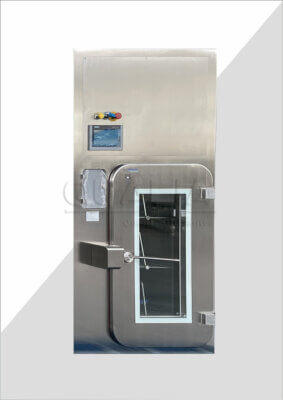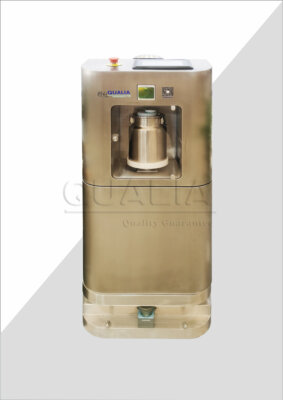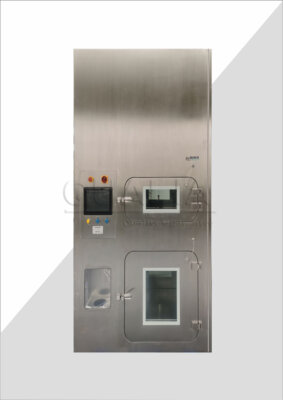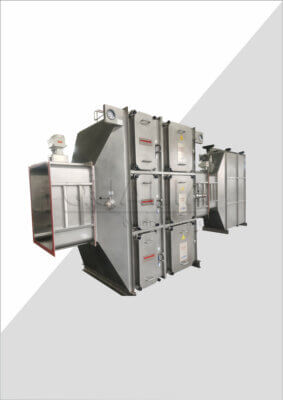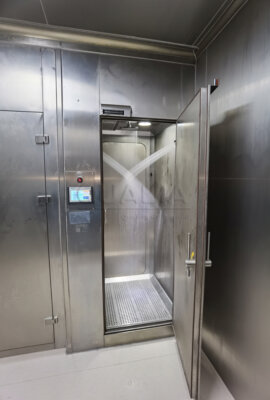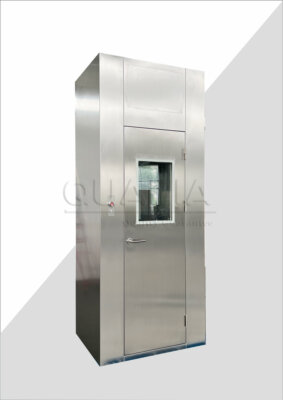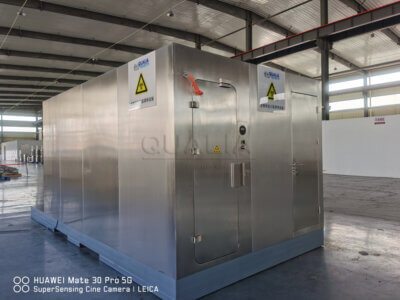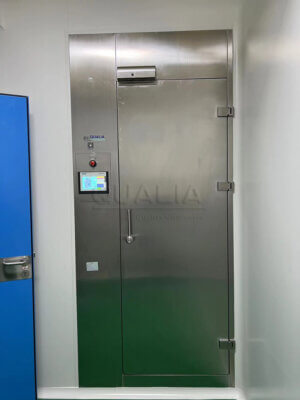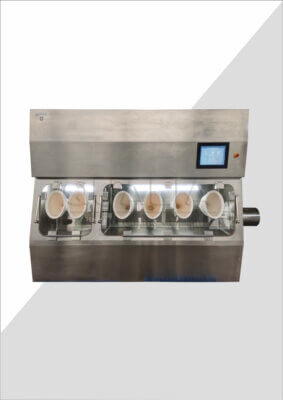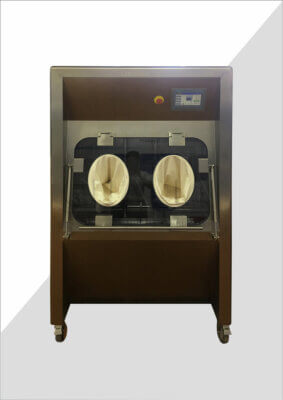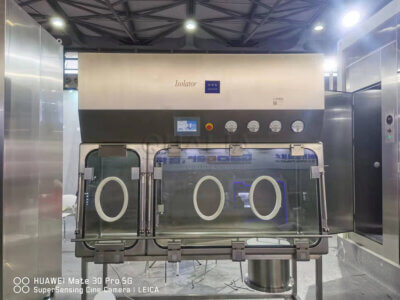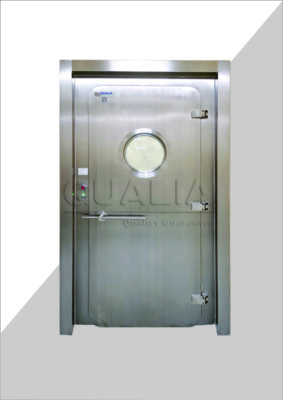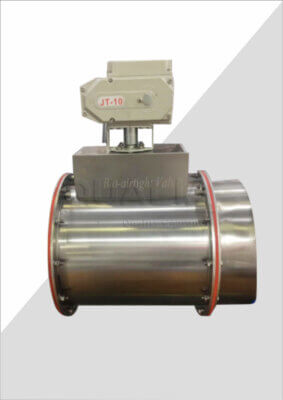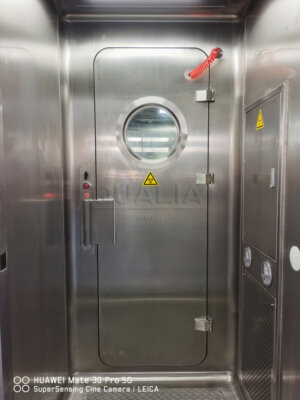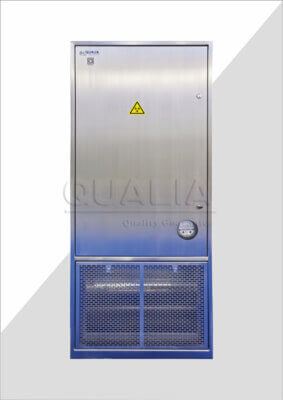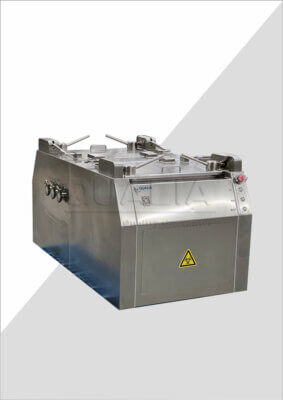

Specifying the wrong transfer equipment for a BSL boundary is rarely caught during procurement — it surfaces at commissioning, when the biosafety team realizes the interlock logic has no connection to a validated decontamination step, or at audit, when a static pass box is sitting between two containment zones without documented risk-assessment support for procedural cleaning. Retrofitting a VHP system into a wall opening sized and plumbed for a static unit is expensive, structurally disruptive, and almost always delays facility qualification by weeks. The decision that prevents this is made before the RFQ is released: defining which transfer risk category applies to each boundary, then selecting equipment whose chamber functions, interlock design, and decontamination method match that category consistently across the user requirement specification, the room pressure narrative, and the SOP set. What follows gives you the technical and procurement basis to make those judgments with the specificity they require.
Transfer risk categories that drive pass box selection
Pass box type selection should follow the output of a risk assessment, not a default preference or budget tier. The three standard configurations — static, dynamic, and air shower — are not interchangeable options that can be upgraded or downgraded freely; each represents a different assumption about what controls are sufficient at the transfer boundary, and each carries a different defensibility position if the assumption is challenged.
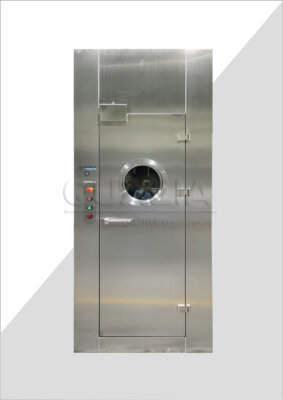
Static pass boxes offer no active air handling. Their containment relies entirely on interlock sequencing and surface finish, with decontamination performed procedurally by the user before or after transfer. That design is genuinely easier to qualify and maintain than VHP or immersion-based systems, but it is only defensible where a documented risk assessment has explicitly accepted procedural cleaning as the control at that specific boundary. Teams that default to static equipment without that written acceptance create a compliance exposure that is difficult to close retroactively — particularly in BSL-3 environments where the incoming risk assessment may not survive audit if it was never formally completed.
Dynamic pass boxes introduce a built-in prefilter, HEPA H14 filtration, and a powered blower to supply continuous ISO Class 5 (Grade A) clean air inside the chamber. Air shower pass boxes occupy a middle tier, using high-velocity jets in the 18–30 m/s range to scrub surface particulates during a short, bounded cycle — without continuous ventilation or HEPA filtration. The important distinction is that neither of these configurations provides bio-decontamination. ISO Class 5 air supply controls particulate; it does not constitute a validated decontamination step. Conflating the two is a specific misread that drives under-specified installations into BSL-3 and BSL-4 environments.
| Tip cutie de trecere | Air Handling & Cleanliness | Risk Category & Application |
|---|---|---|
| Cutie de transfer statică | No HEPA, no active air circulation. Procedural surface cleaning only. | Lowest-risk transfers where surface cleaning is an acceptable control. |
| Cutie de transfer dinamică | Built‑in prefilter, HEPA H14, blower. ISO Class 5 (Grade A) clean air supply. | Aseptic transfers requiring continuous clean air and validated particulate control. |
| Air shower pass box | High‑velocity air jets (18–30 m/s) for short durations; no HEPA or continuous ventilation. | Mid‑risk transfers that need particulate removal without biocontamination control. |
One practical discipline that prevents type-category drift: use the same transfer category designation in the URS, the room pressure narrative, and the SOP set before any equipment is sized or ordered. If the biosafety team is still working through what materials cross each boundary, the chamber cannot be correctly specified, and a pass box sized for sample containers will not accommodate the hood or equipment that ultimately needs to cross the boundary.
Chamber functions used in BSL material movement
Inside a dynamic pass box, the functional components that matter for BSL applications are the filter assembly, the airflow velocity, and the air change rate — and each of these should appear explicitly in the equipment datasheet and acceptance test plan, not just in a vendor’s marketing description.
HEPA H14 filtration at ≥99.995% efficiency at the most penetrating particle size is the filter standard a compliant dynamic configuration is built to achieve. Unidirectional vertical airflow at 0.45 m/s with approximately 250 air changes per hour provides the continuous particulate control inside the chamber. These are engineering thresholds and measurable performance targets — not regulatory minimums that apply universally across all BSL levels — and buyers should treat them as specification anchors to confirm are present in the acceptance test protocol rather than assumed from the equipment category name.
What these figures do not address is biocontamination control. A chamber achieving 250 ACH with H14 HEPA filtration will effectively manage particulates from the outgoing clean environment, but if the risk assessment identifies biological hazard at the transfer boundary, the air handling function alone does not satisfy the decontamination requirement. The distinction between particulate removal and bio-decon is where specifications most commonly become vague, particularly when procurement teams inherit an RFQ that lists ISO Class 5 as the performance target without addressing what happens to a contaminated incoming load.
For equipment moving into a containment zone — or out of one — the relevant functional question is what the chamber does between the two door-open events, not only what it does during steady-state occupancy. That gap between events is where interlock sequencing and decontamination integration either protect or expose the boundary.
Interlock gaps that create contamination exposure
The most consequential specification gap in pass box procurement is not an absent feature — it is a feature present in the wrong configuration. Mechanical or magnetic interlock prevents both doors from opening simultaneously, and that function is correctly treated as a fundamental requirement. The mistake is treating it as sufficient for biosafety, which it is not.
An interlock that prevents simultaneous door opening does not guarantee that a decontamination cycle has occurred before the clean-side door is released. Unless the interlock logic is explicitly tied to decontamination-cycle completion — confirmed by the controller, not just by door position — a contaminated load can move through the boundary while the interlock technically functions as designed. This is the gap that surfaces at commissioning or audit, not during procurement review, because the mechanical function passes every visual inspection.
Electronic interlocks allow more sophisticated sequencing logic: cycle-complete signals, fault detection, remote alarm outputs, and event logging. Mechanical-only interlocks provide none of those audit trails. The choice between them is a design trade-off with monitoring and auditability implications that go beyond door control, and it becomes particularly significant for BSL-3 and BSL-4 installations where event logs may be required for incident response or regulatory review.
Seal design is a related gap. Standard door gaskets rely on mechanical compression and latching; inflatable silicone seals remove the need for external latches and actively conform to the door frame under pressure, reducing leakage under the room pressure differentials that characterize containment zones. Where maximal airtight containment is required, this is not a feature upgrade — it is a specification decision with direct consequences for the leak-tightness validation outcome.
| Interlock Gap / Risk | De ce este important | Ce trebuie să confirmați |
|---|---|---|
| Interlock sequence not tied to biodecontamination completion | Contaminated load may be released before a decontamination step finishes. | Interlock logic must prevent clean‑side door opening until the validated biodecontamination cycle is complete. |
| Mechanical interlock only, without electronic control and monitoring | Limits sequence logging, fault detection, and remote alarm capability. | Confirm whether electronic interlocks with monitoring and alarm functions are specified for the BSL facility. |
| Standard door gaskets instead of inflatable silicone seals | Higher leakage risk under room pressure differentials; may rely on mechanical latches. | Verify that inflatable silicone seals are included where maximal airtight containment is required. |
| No formal test that both doors cannot open simultaneously | A single fault could allow direct contamination exposure across the barrier. | Ensure factory/site acceptance testing verifies simultaneous‑opening prevention. |
Factory and site acceptance testing should include a formal check that both doors cannot be opened simultaneously under any controller state. Treating this as a review check rather than an assumed design property prevents the single-fault scenario where a controller anomaly creates a direct contamination pathway across the barrier.
Decontamination methods matched to transfer direction
Not all material movements across a BSL boundary require the same decontamination response, and the method should match both the direction of transfer and the risk level of what is moving. The clearest framework is to assign decontamination requirements by transfer direction at each boundary during the risk assessment phase, then specify equipment accordingly.
For outgoing transfers from containment — waste, samples, or equipment leaving a BSL-3 or BSL-4 zone — integrated VHP or AHP biodecontamination provides the validated kill step. A properly validated cycle achieves a log 6 reduction using Geobacillus stearothermophilus biological indicators on stainless steel ribbons, which represents the efficacy benchmark for these systems. That benchmark is what a validated cycle must meet; it is not a floor that every pass box is required to demonstrate, but it is the performance reference that separates a validated decontamination claim from a procedural one.
VHP cycle parameters provide the planning inputs needed to match equipment selection to operational requirements. Injection time runs from 30 seconds to 20 minutes depending on chamber volume and concentration target; dwell phase runs 15–45 minutes; aeration runs 20–90 minutes, with total cycle times ranging from 30 minutes to approximately 2 hours. These ranges are planning inputs and order-of-magnitude guides — actual parameters are chamber- and cycle-specific and require validation data from the manufacturer’s tested configurations. For facilities evaluating Caseta de legitimații VHP options, confirming that the manufacturer’s validation package covers the specific chamber size and biological indicator data is a necessary step before treating published cycle times as operationally binding.
For incoming transfers — materials entering a containment zone from the outside — the decontamination requirement depends on what risk the incoming material introduces to the contained environment, which is a separate risk assessment question from what the outgoing direction requires. Some facilities address this asymmetry with separate pass boxes for each direction; others use a single unit with directional cycle programming. Either approach requires that the interlock logic and cycle sequence be documented to reflect which door is the containment side for each transfer direction.
For incoming transfers where surface contamination rather than biological hazard is the concern, an air shower pass box can serve a defined purpose — particulate removal without bio-decon. But its use on a containment boundary requires documented risk-assessment support for the conclusion that bio-decon is not required in that direction. The air shower tier is not a cost-saving substitute for a validated kill step; it is a different control addressing a different hazard category.
Integration points with room pressure and validation
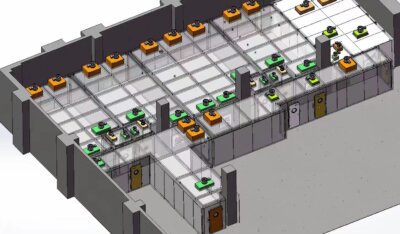
A pass box is not a standalone device at a BSL boundary — it is a pressure and containment interface between two zones with different pressure requirements, and the design choices made at the equipment level propagate directly into room pressure stability, HVAC engineering, and validation scope.
The first integration point is pressure monitoring. Direct-reading pressure gauges positioned on both sides of the pass box provide real-time visibility into the pressure relationship between the pass box chamber and the surrounding rooms. Where that monitoring is absent or gauges are improperly scaled, operators cannot confirm that the chamber is maintaining the correct pressure relationship during a transfer — and any pressure equalization event during door operation may go undetected.
Leak tightness is the validation measure that determines whether the pass box is performing as a containment boundary or as a pressure leak. The general containment standard references a leakage rate of ≤10⁻²/h per ISO 10648-2, Class 3 containment enclosure classification. For BSL-3 and BSL-4 installations, a stricter criterion applies: leakage under −500 Pa must be less than 0.5% vol/h. The difference between these two thresholds is significant, and the stricter criterion should be explicitly written into the site acceptance test plan rather than assumed to be automatically applied because the unit is installed in a high-containment room. Requesting a test report that references the specific standard, class, and measured value at the applicable pressure differential is a minimum documentation requirement before installation sign-off.
| Punctul de integrare | Specificație / Cerință | What to Confirm or Consider |
|---|---|---|
| Chamber pressure monitoring | Direct‑reading pressure gauges on both sides of the pass box. | Gauges must be positioned and scaled to show pressure relationship to surrounding rooms. |
| General leak tightness | Leakage rate ≤10⁻²/h per ISO 10648‑2, Class 3 containment enclosure. | Request a test report that references the exact standard and class. |
| Airtight pass box in BSL‑3/4 | Leakage under −500 Pa must be <0.5% vol/h. | Confirm this stricter criterion is written into the acceptance test plan for high‑containment installations. |
| Exhaust air return option | Catalytic converter allows exhaust air to return to the room instead of dedicated HVAC ducting. | Evaluate impact on room pressure balance, HVAC design, and installation cost; confirm compatibility with facility engineering. |
The exhaust air return option — a catalytic converter that allows aerated VHP exhaust to return to the room rather than route through dedicated HVAC ducting — is an engineering trade-off, not a recommended default. It reduces installation complexity and eliminates costly ductwork, but it introduces questions about room pressure balance, H₂O₂ concentration in the return air, and HVAC compatibility that must be resolved with the facility engineering team before specifying this option. In some facility configurations it is a practical solution; in others it creates more complexity than it eliminates. Confirming compatibility with the existing HVAC design should happen before the equipment order, not during installation.
Procurement data needed before RFQ release
Procurement stalls on pass box specifications almost always trace to the same root cause: a user requests biosafety performance without defining the parameters that allow a manufacturer to respond with a complete proposal. The missing items are not obscure technical details — they are the basic dimensions of what the equipment must do — and leaving them undefined forces manufacturers to either ask clarifying questions that delay the RFQ cycle or make sizing assumptions that may not survive biosafety team review.
Internal chamber dimensions are the first required input. Standard sizes span from 400×400×400 mm up to 1200×1200×1200 mm, and the correct size depends entirely on what will pass through — which is exactly what the biosafety team may still be defining when procurement initiates the RFQ. If the transfer category and material list are not finalized before the RFQ is released, chamber sizing may be driven by the largest item someone thinks might eventually cross the boundary, which can result in an oversized unit that creates a larger pressure interface than the room design anticipated.
Material and surface finish specifications must be named explicitly. Both 304 and 316 stainless steel are available; 316 with an interior surface finish of Ra 0.8 µm is the stronger specification for cleanroom-side surfaces and should be written into the RFQ when that condition applies to the installation. Leaving material grade unspecified does not result in the buyer receiving the better option by default.
| RFQ Data Item | De ce este important | Typical Values / What to Specify |
|---|---|---|
| Internal chamber dimensions | Chamber must accommodate the intended payload without compression or obstruction. | Standard sizes from 400×400×400 mm up to 1200×1200×1200 mm; specify exact required dimensions. |
| Material and surface finish | Corrosion resistance and cleanability are essential for cGMP and biosafety surfaces. | 304 or 316 stainless steel; 316 preferred for cGMP cleanroom side, interior finish Ra 0.8 µm. |
| Biodecontamination cycle time and payload | Unstated cycle‑time expectations cause specification gaps and delayed procurement. | State the acceptable total cycle time (30 min–2 hr) and the chamber payload capacity required. |
| Residue limits | H₂O₂ concentration limits affect safety and process compatibility if not named upfront. | Define the maximum allowable H₂O₂ residue concentration for post‑decontamination aeration. |
Biodecontamination cycle time and residue limits are the two items most likely to cause late-stage procurement friction. Acceptable total cycle time — whether the facility can tolerate a 30-minute cycle or requires it to complete within that window — directly affects whether a given chamber size and H₂O₂ concentration target can meet operational throughput requirements. H₂O₂ residue limits after aeration must be named if personnel will enter the transfer zone immediately post-cycle or if downstream materials are sensitive to residual oxidant. Neither of these values can be reasonably assumed by a manufacturer; both must come from the facility’s process and biosafety requirements before the RFQ is released.
Verified bio-decon demand as the equipment selection threshold
The threshold that separates a standard dynamic pass box from VHP-integrated or VHP-interfaced equipment is not cleanroom classification — it is verified bio-decon demand derived from the risk assessment. Facilities sometimes assume that an ISO Class 5 air supply inside the chamber is equivalent to a containment-grade decontamination capability; it is not, and treating it as such produces an installation that may satisfy cleanroom documentation while leaving the biosafety control gap unaddressed.
When the risk assessment concludes that a validated kill step is required at the transfer boundary — specifically, a documented log 6 reduction against a relevant biological indicator — that conclusion triggers a specific equipment category. A static or dynamic pass box without integrated or interfaced decontamination cannot satisfy that requirement procedurally without an extremely well-controlled and documented cleaning protocol, and even then, the absence of a built-in validated cycle is a vulnerability under inspection. The WHO Laboratory Biosafety Manual and CDC BMBL both establish the principle that transfer controls must be commensurate with assessed risk — which means the risk assessment output must drive the equipment selection, not the reverse.
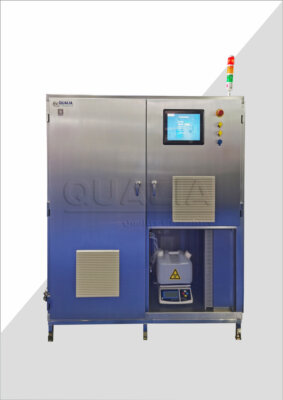
For facilities that need verified decontamination but are not yet ready or able to install a fully integrated VHP system, a pass box fitted with a VHP disinfection interface can connect to external bio-decon equipment. That option extends the validated decontamination capability to a simpler chamber design, but it carries an important caveat: the equivalence of this approach depends entirely on the external system’s own validation status and the interface design. An external VHP connection is not equivalent in assurance to an integrated validated cycle unless the complete connected system — chamber, interface, and external generator — has been validated as a unit. Procurement teams should request validation scope documentation that covers the full system, not just the pass box chamber in isolation.
The Cutia de securitate biologică product category addresses the interlock and containment-boundary requirements that apply across BSL applications; for facilities where the risk assessment confirms bio-decon demand at the transfer boundary, the selection moves specifically to equipment with integrated or validated-interface decontamination capability. The selection threshold is a risk assessment output — not a product tier decision made at procurement.
The decision that protects a BSL installation from late-stage qualification problems is made before the first equipment specification is written: confirmed transfer risk categories, explicit decontamination requirements by direction, and named performance thresholds for interlock sequencing, leak tightness, and cycle efficacy. Equipment selected without those inputs will be sized and configured around incomplete assumptions, and the gaps will not become visible until commissioning testing or audit review.
Before releasing an RFQ, the minimum confirmed inputs are chamber dimensions matched to actual payload, material grade specified for the cleanroom-side surface, an acceptable total decontamination cycle time, and a stated H₂O₂ residue limit. If the risk assessment has not yet concluded whether bio-decon is required at each boundary, that conclusion needs to come first — because the answer determines not just which pass box model is appropriate, but whether a standard dynamic unit is sufficient at all.
Întrebări frecvente
Q: What happens if the risk assessment is still incomplete when the facility needs to order a pass box?
A: Delay the RFQ until the risk assessment concludes which transfer categories apply at each boundary — ordering before that point forces chamber sizing and interlock configuration around unconfirmed assumptions. A chamber sized for sample containers will not accommodate equipment or biosafety hoods that the biosafety team may later determine must cross the same boundary, and retrofitting a VHP system into an opening sized for a static unit is structurally disruptive and delays facility qualification. The risk assessment output is not an input the procurement process can work around; it is the prerequisite that makes every downstream specification decision defensible.
Q: After the pass box is installed and passes factory acceptance, what validation steps still need to happen on site before the boundary is considered qualified?
A: Site acceptance testing must confirm leak tightness at the installation-specific pressure differential — for BSL-3/4, leakage under −500 Pa must measure below 0.5% vol/h, not just meet the general ISO 10648-2 Class 3 threshold — and the interlock sequencing must be tested under actual controller states to confirm both doors cannot open simultaneously under any fault condition. If a VHP cycle is integrated, the biological indicator challenge using Geobacillus stearothermophilus must be run in the as-installed configuration, because published cycle parameters from the manufacturer are developed for specific chamber sizes and cannot be treated as operationally binding without site-generated validation data.
Q: Is a pass box with a VHP disinfection interface for an external generator equivalent in assurance to a fully integrated VHP system?
A: Not automatically — equivalence depends on whether the complete connected system, including the chamber, the interface, and the external generator, has been validated as a unit. An external VHP connection extends decontamination capability to a simpler chamber design, but the validation documentation must cover the full system rather than the pass box chamber in isolation. Procurement teams should request validation scope documentation that explicitly names all three components before treating the interfaced configuration as equivalent to an integrated validated cycle.
Q: At what point does choosing a static or dynamic pass box over a VHP unit create an audit vulnerability rather than a justifiable cost decision?
A: The vulnerability appears the moment a static or dynamic unit is installed at a boundary where the risk assessment has not formally accepted procedural cleaning as the control — or where that acceptance was never documented. Cleanroom classification, including ISO Class 5 air supply inside a dynamic unit, does not substitute for a validated kill step. If the risk assessment identifies biological hazard at the transfer boundary and the unit provides no integrated or interfaced bio-decon, the absence of a validated cycle is an exposure under inspection regardless of how well the interlock functions or how clean the chamber surfaces are.
Q: If a facility’s HVAC layout makes dedicated VHP exhaust ducting impractical, does the catalytic converter return-air option reliably solve the problem?
A: It solves the ductwork problem in some facility configurations but introduces others that must be resolved before the equipment order. Returning aerated VHP exhaust to the room raises questions about H₂O₂ concentration in recirculated air, effects on room pressure balance, and compatibility with the existing HVAC design — none of which can be confirmed without input from the facility engineering team. In configurations where those conditions are compatible, the catalytic converter option is a practical solution; in others it creates more engineering complexity than the ductwork it eliminates. Confirming HVAC compatibility before specifying this option is required, not optional.