A rápida implementação de vacinas de mRNA criou um novo paradigma de fabricação. Para os profissionais que estão ampliando ou projetando novas instalações, o principal desafio não é apenas a aquisição de equipamentos, mas a arquitetura de um sistema integrado que equilibre a eficiência da plataforma com a agilidade terapêutica. Um equívoco comum é que a produção de mRNA é simplesmente uma versão em escala reduzida dos produtos biológicos tradicionais. Na realidade, ela exige uma filosofia de equipamento exclusiva, centrada na fragilidade molecular, na flexibilidade de uso único e na precisão analítica. Erros na filosofia de projeto ou na estratégia da cadeia de suprimentos podem criar gargalos operacionais e limitar a expansão futura do portfólio.
A atenção às especificações dos equipamentos é fundamental agora que o setor está indo além das campanhas de um único produto em escala pandêmica. A próxima fase exige instalações capazes de realizar mudanças rápidas nas campanhas para vacinas variantes e terapias de maior valor, como vacinas personalizadas contra o câncer ou terapias de substituição de proteínas. Suas decisões sobre equipamentos hoje determinarão sua posição competitiva e a resiliência operacional para a próxima década. Essa transição exige uma visão estratégica do custo total de propriedade, não apenas das despesas de capital.
Equipamento principal de produção de vacinas de mRNA: Uma visão geral da plataforma
Definição do fluxo de trabalho da plataforma de mRNA
A plataforma de produção de vacinas de mRNA é um processo padronizado de várias etapas que determina um conjunto específico de requisitos de equipamentos. Esse fluxo de trabalho, validado em escala para as vacinas contra a COVID-19, é segmentado em síntese upstream e purificação/formulação downstream, cada uma com um equipamento especializado. Diferentemente dos produtos biológicos tradicionais, o processo ocorre em uma escala física menor, mas exige extrema precisão para proteger a frágil molécula de RNA.
O imperativo do design de uso único
Toda a plataforma é fundamentalmente projetada em torno de biorreatores, fermentadores e montagens de uso único. Essa filosofia evita a contaminação cruzada e agiliza a troca de lotes, criando uma dependência crítica das cadeias de suprimentos descartáveis. Esse projeto permite mudanças rápidas na campanha, essenciais para a produção de múltiplas variantes de vacinas em uma única instalação. Em minha experiência, o planejamento logístico desses consumíveis geralmente requer mais tempo de espera e mitigação de riscos do que a própria instalação do equipamento.
Caminho da diversificação estratégica
A convergência das necessidades de equipamentos com outras terapias de ácido nucleico significa que as instalações projetadas para mRNA serão prontamente adaptáveis para a produção de terapias de maior valor. Isso oferece um caminho de diversificação estratégica. Investir em uma plataforma de mRNA flexível e modular não é apenas uma jogada de vacina; é um ponto de entrada para o campo mais amplo da medicina genética, incluindo edição de genes e vetores de terapia celular.
Principais equipamentos para síntese de mRNA upstream (pDNA e IVT)
O gargalo do DNA de plasmídeo
A produção upstream começa com a geração de DNA de plasmídeo (pDNA), o modelo fundamental para todo o mRNA. Isso envolve a fermentação bacteriana em fermentadores de uso único, normalmente em uma escala de 5 a 50 L, seguida de centrifugação, filtragem profunda e cromatografia em várias etapas. A produção de DNA de plasmídeo é o principal gargalo de capacidade. Sua fermentação de vários dias e sua purificação complexa definem a cadência do upstream. Investir em tecnologias de pDNA de alto rendimento oferece maior vantagem para aumentar a produção total do que otimizar apenas as etapas de downstream.
Precisão de transcrição in vitro
Em seguida, o modelo de pDNA linearizado alimenta a reação de transcrição in vitro (IVT), realizada em biorreatores ou recipientes de mistura de uso único. A escala da IVT é relativamente pequena, geralmente abaixo de 100 L, mas requer componentes certificados livres de nuclease e controle preciso da temperatura (37 °C) para evitar a degradação do RNA. O equipamento deve garantir a mistura homogênea sem a introdução de forças de cisalhamento que possam danificar a fita de mRNA nascente.
A tabela a seguir detalha os principais equipamentos e parâmetros para essas etapas críticas do upstream.
Principais equipamentos para síntese de mRNA upstream (pDNA e IVT)
| Etapa do processo | Escala típica / parâmetro | Principais equipamentos |
|---|---|---|
| Fermentação de DNA de plasmídeo (pDNA) | Escala de 5-50 L | Fermentadores de uso único |
| Purificação de pDNA | Fermentação de vários dias | Centrifugação, filtragem de profundidade |
| Purificação de pDNA (cont.) | Processo em várias etapas | Cromatografia, sistemas UF/DF |
| Transcrição in vitro (IVT) | < 100 L de escala | Biorreatores/vasos de mistura de uso único |
| Controle de reação IVT | Controle preciso de 37°C | Agitação com controle de temperatura |
Fonte: ASME BPE-2022. Esse padrão garante o design higiênico, os materiais e a fabricação de equipamentos críticos upstream, como fermentadores e biorreatores, evitando a contaminação e garantindo a integridade do processo para reações sensíveis de pDNA e IVT.
Purificação e formulação downstream: TFF, cromatografia, LNP
Purificação do produto frágil
A purificação da mistura de TIV bruta requer muitos equipamentos. A filtragem de fluxo tangencial (TFF) é essencial para a troca e a concentração inicial do buffer. Em seguida, é realizada a cromatografia - geralmente usando resinas multimodais ou de troca aniônica no modo de fluxo - para remover impurezas críticas, como o RNA de fita dupla (dsRNA). Uma etapa final de UF/DF formula o mRNA em seu tampão final. Cada etapa deve ser projetada para minimizar os tempos de retenção e a exposição a nucleases.
Encapsulamento de nanopartículas de lipídios
O mRNA purificado é então encapsulado por meio da formulação de nanopartículas de lipídios (LNP). Isso se baseia em dispositivos de mistura microfluídica de precisão para obter um tamanho de nanopartícula reproduzível e alta eficiência de encapsulamento. Após a formulação, as LNPs passam por outra etapa de TFF para troca de buffer e remoção de etanol antes da filtragem estéril. A fragilidade inerente dos complexos mRNA-LNP atualmente exige o armazenamento a ≤ -65°C, o que torna a estabilidade um dos principais fatores de P&D em liofilização.
A tabela abaixo descreve as operações críticas da unidade e suas especificações no processo downstream.
Purificação e formulação downstream: TFF, cromatografia, LNP
| Operação da unidade | Função principal | Especificação de saída crítica |
|---|---|---|
| Filtragem de fluxo tangencial (TFF) | Troca de tampão, concentração | Concentração de mRNA e formulação de tampão |
| Cromatografia | Remoção de impurezas (por exemplo, dsRNA) | Conteúdo de dsRNA <0,5% |
| Final UF/DF | Formulação final do buffer | mRNA no tampão de armazenamento final |
| Mistura microfluídica | Formulação de LNP | Tamanho reprodutível das nanopartículas |
| TFF pós-LNP | Remoção de etanol, troca de buffer | Troca de buffer LNP final |
Fonte: Documentação técnica e especificações do setor.
Uso único vs. aço inoxidável: Filosofia de design e flexibilidade
O caso da tecnologia de uso único
A confiança da plataforma de mRNA na tecnologia de uso único (SUT) é uma escolha definitiva de projeto. A SUT minimiza o risco de contaminação cruzada e reduz drasticamente o ônus da validação da limpeza. Ela acelera a configuração do processo, o que é vital para instalações de vários produtos. Embora o aço inoxidável ofereça durabilidade para campanhas de grande volume e de um único produto, sua natureza fixa entra em conflito com a necessidade de uma produção ágil e flexível. Assim, a escolha se inclina predominantemente para o SUT.
Gerenciamento da fragilidade da cadeia de suprimentos
Isso cria uma dependência crítica de uma cadeia de suprimentos confiável para componentes descartáveis. A qualificação do fornecedor e o fornecimento de backup tornam-se um risco operacional essencial. Os fabricantes precisam garantir acordos com vários fornecedores para montagens importantes, como bolsas de biorreator e membranas de filtro, para atenuar essa fragilidade. A despesa estratégica não está no skid do equipamento, mas em garantir um fluxo ininterrupto de consumíveis qualificados e estéreis.
Integração de instalações: Projeto modular, serviços públicos e cadeia de frio
A vantagem da arquitetura podular
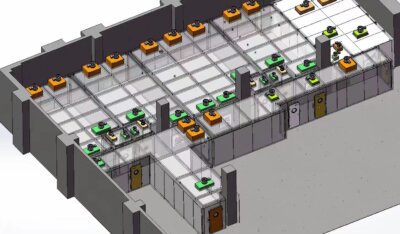
As instalações modernas de mRNA priorizam projetos modulares e podulares usando pods de sala limpa pré-fabricados instalados em um “espaço cinza” não classificado. Essa arquitetura modular de pods com várias suítes permite a rápida implantação, mudanças flexíveis de campanha e contenção de contaminantes específicos do processo. O planejamento de capital deve favorecer essas instalações flexíveis e de um único andar em vez das instalações tradicionais de vários andares para agilizar o tempo de colocação no mercado.
Serviços públicos essenciais e controle ambiental
Os requisitos de serviços públicos incluem painéis para gases de processo e resíduos de solventes, sendo que as áreas LNP precisam de equipamentos à prova de explosão para o manuseio de etanol. Além disso, todo o projeto da instalação deve integrar uma cadeia de frio robusta, incorporando freezers de temperatura ultrabaixa (≤ -65°C) para as matérias-primas e o medicamento final. A qualidade da água é fundamental, com sistemas projetados para atender a padrões rigorosos de pureza para evitar a contaminação por RNase.
A integração desses aspectos requer um planejamento cuidadoso, conforme mostrado nas considerações sobre o projeto da instalação abaixo.
Integração de instalações: Projeto modular, serviços públicos e cadeia de frio
| Aspecto das instalações | Principais recursos de design | Justificativa / Requisito |
|---|---|---|
| Projeto arquitetônico | Salas limpas modulares e podulares | Implementação rápida, campanhas flexíveis |
| Preferência de layout | Um andar sobre vários andares | Tempo de colocação no mercado mais rápido |
| Utilitários da área de LNP | Equipamento à prova de explosão | Segurança no manuseio do etanol |
| Armazenamento da cadeia de frio | Freezers de temperatura ultrabaixa (≤ -65°C) | Estabilidade da matéria-prima e do produto final |
| Sistemas de água | Padrões de água de alta pureza | Evita a contaminação nos processos |
Fonte: ISO 22519:2020. Esta norma especifica os requisitos para sistemas de água e vapor purificados, que são utilitários essenciais na produção de mRNA para limpeza, preparação de buffer e como matéria-prima do processo, afetando diretamente a qualidade do produto e o projeto da instalação.
Equipamento analítico e de controle de qualidade para liberação de produtos de mRNA
Um novo paradigma no controle de qualidade
O controle de qualidade das vacinas de mRNA representa uma mudança de paradigma. A potência não é medida por ensaios biológicos, mas por meio de uma caracterização físico-química rigorosa dos atributos críticos de qualidade (CQAs). Isso exige instrumentos analíticos avançados: Eletroforese em gel capilar (CGE) para integridade e comprimento da cauda poli-A; sistemas UPLC com espectrometria de massa para eficiência de tamponamento e análise de lipídios.
Quantificação de atributos críticos de qualidade
Os testes de liberação requerem a quantificação da eficiência de capping (>95%), o conteúdo de dsRNA (<0,5%) e a verificação da sequência. O Dynamic Light Scattering (DLS) mede a distribuição do tamanho das partículas e o qPCR quantifica o DNA residual. Consequentemente, o investimento em equipamentos deve priorizar essas ferramentas analíticas sofisticadas e o conhecimento especializado, mudando o paradigma do CQ dos testes biológicos para a análise molecular.
A tabela abaixo mapeia os CQAs para seus métodos analíticos primários.
Equipamento analítico e de controle de qualidade para liberação de produtos de mRNA
| Atributo crítico de qualidade (CQA) | Especificação de destino | Instrumento analítico primário |
|---|---|---|
| Integridade do mRNA / cauda Poly-A | Verificar o comprimento e a integridade | Eletroforese em gel capilar (CGE) |
| Eficiência da tampa | Eficiência >95% | UPLC com espectrometria de massa |
| Conteúdo de dsRNA | Nível de impureza <0,5% | Cromatografia / Ensaios específicos |
| Distribuição do tamanho das partículas | Tamanho consistente das nanopartículas | Espalhamento dinâmico de luz (DLS) |
| DNA residual | Quantificação e verificação | Sistemas qPCR |
Fonte: Documentação técnica e especificações do setor.
Observação: Enquanto a USP <797> regula os ambientes estéreis para o envase final, os métodos analíticos para CQAs de mRNA são definidos pela validação específica da plataforma e pelas diretrizes da ICH.
Custo total de propriedade (TCO) e considerações operacionais
Além das despesas de capital
O cálculo do TCO vai além do equipamento de capital e inclui consumíveis, serviços públicos e mão de obra. O alto consumo de conjuntos de uso único e matérias-primas especializadas de grau GMP - enzimas, nucleotídeos, lipídios - é um custo contínuo importante. Os custos operacionais também são impulsionados pela rigorosa cadeia de frio e pelos ambientes de sala limpa que consomem muita energia.
A sensibilidade da matéria-prima
O processo é altamente sensível às impurezas da matéria-prima, o que obriga a extensas auditorias de fornecedores, caros reagentes de grau GMP e rigorosos testes internos. O estabelecimento de parcerias de longo prazo com fornecedores é essencial para o controle de custos e a consistência dos lotes. Portanto, a análise de TCO deve levar em conta as despesas estratégicas de segurança da cadeia de suprimentos, análises avançadas e P&D que aumentam a estabilidade.
Um detalhamento dos principais fatores de TCO esclarece onde os orçamentos operacionais devem ser concentrados.
Custo total de propriedade (TCO) e considerações operacionais
| Gerador de custos | Categoria | Impacto / Consideração |
|---|---|---|
| Consumíveis | Conjuntos de uso único | Maior custo operacional contínuo |
| Matérias-primas | Enzimas de grau GMP, nucleotídeos | Alto custo, sensibilidade a impurezas |
| Cadeia de suprimentos | Auditorias de fornecedores, fornecimento de backups | Mitigação dos principais riscos operacionais |
| Utilitários | Cadeia de frio (≤ -65°C), salas limpas | Custo significativo de energia e capital |
| Investimento em P&D | Liofilização, processamento contínuo | Vantagem competitiva de longo prazo |
Fonte: Documentação técnica e especificações do setor.
Preparando suas instalações para o futuro: Processamento contínuo e liofilização
A mudança para a manufatura contínua
Para garantir a competitividade em longo prazo, as instalações devem prever a evolução tecnológica. A fabricação contínua substituirá o processamento em lote, impulsionada pelas necessidades de maior produtividade, melhor controle de qualidade em tempo real e redução do espaço ocupado. É fundamental o investimento antecipado em P&D de processamento contínuo para IVT conectada, cromatografia de perfusão e formulação microfluídica em linha. Essa abordagem pode ser explorada por meio de serviços de desenvolvimento e otimização de processos.
Mitigando a restrição da cadeia de frio
Ao mesmo tempo, o equipamento de liofilização (secagem por congelamento) é fundamental para atenuar as restrições da cadeia de frio. O desenvolvimento de um produto de mRNA-LNP liofilizado oferece uma possível vantagem competitiva decisiva no acesso ao mercado, especialmente em ambientes com poucos recursos. O envolvimento proativo dos órgãos reguladores para formalizar a análise da plataforma e os padrões de validação de processos acelerará drasticamente as aprovações de produtos futuros, tornando a estratégia regulatória um componente essencial da preparação para o futuro.
As decisões estratégicas de equipamentos para uma instalação de produção de mRNA se resumem a três prioridades: flexibilidade, controle e previsão. Priorize projetos modulares de uso único que permitam a agilidade de vários produtos. Investir em conjuntos analíticos avançados para dominar o paradigma exclusivo de controle de qualidade dos produtos de ácido nucleico. Alocar capital não apenas para o processo em lote de hoje, mas para o processamento contínuo em escala piloto e linhas de liofilização que definirão o padrão de amanhã.
Precisa de orientação profissional para projetar ou otimizar sua plataforma de produção terapêutica de mRNA? Os especialistas da QUALIA somos especializados em traduzir esses requisitos complexos de equipamentos e instalações em estratégias executáveis e preparadas para o futuro. Entre em contato conosco para discutir os desafios e as metas específicas do seu projeto. Você também pode entrar em contato com nossa equipe diretamente em Entre em contato conosco.
Perguntas frequentes
P: Como a escolha entre equipamentos de uso único e de aço inoxidável afeta o risco operacional em uma instalação de mRNA?
R: A plataforma de mRNA favorece fortemente a tecnologia de uso único para evitar a contaminação cruzada e permitir mudanças rápidas na campanha. Isso cria uma dependência crítica em cadeias de suprimentos descartáveis, tornando a qualificação do fornecedor e o fornecimento de backup um risco operacional primário. Para projetos que exigem agilidade em vários produtos, é necessário garantir contratos com vários fornecedores e tratar as parcerias da cadeia de suprimentos como um componente estratégico essencial, e não apenas como uma tarefa de aquisição.
P: Qual equipamento analítico é essencial para o teste de liberação da vacina de mRNA e por que ele é diferente?
R: Os testes de liberação mudam dos ensaios biológicos para a análise físico-química dos Atributos Críticos de Qualidade. Os instrumentos essenciais incluem a eletroforese em gel capilar para a integridade do RNA, UPLC-MS para a eficiência de nivelamento e qPCR para DNA residual. Você deve quantificar a eficiência de capping acima de 95% e o conteúdo de dsRNA abaixo de 0,5%. Isso significa que o investimento em seu laboratório de CQ deve priorizar a análise molecular avançada e o conhecimento especializado em relação aos bioensaios tradicionais.
P: Qual é a melhor abordagem de projeto de instalações para apoiar a implantação rápida e as campanhas de produção flexíveis?
R: Um projeto modular e podular usando pods de sala limpa pré-fabricados instalados dentro de um espaço não classificado é o ideal. Essa arquitetura permite a implantação rápida, isola os contaminantes específicos do processo e simplifica as mudanças de campanha entre os produtos. Para novos projetos de capital que visam à velocidade e à flexibilidade, você deve priorizar instalações modulares de um andar em vez de plantas tradicionais de vários andares para reduzir o tempo de colocação no mercado.
P: Como a produção de DNA de plasmídeo influencia a capacidade geral de fabricação de mRNA?
R: A geração de DNA de plasmídeo é o principal gargalo de capacidade devido às etapas de fermentação de vários dias e de purificação complexa. O dimensionamento da produção de pDNA oferece maior vantagem para aumentar a produção total da vacina do que a otimização dos estágios downstream isoladamente. Isso significa que o projeto do seu processo upstream e o investimento em tecnologias de pDNA de alto rendimento ditarão a cadência e a escala gerais de toda a sua operação de fabricação.
P: Quais normas regem os sistemas e componentes críticos do equipamento de produção de mRNA?
R: O projeto e a fabricação do equipamento devem aderir a padrões higiênicos como ASME BPE-2022 para componentes de bioprocessamento. Os sistemas de purificação de água essenciais para a limpeza e como matéria-prima devem estar em conformidade com ISO 22519:2020. Se estiver especificando biorreatores, skids de filtragem ou tubulações, é preciso assegurar a conformidade do fornecedor com esses padrões para garantir a integridade e a capacidade de limpeza do sistema.
P: Quais são os principais fatores de custo além do equipamento de capital para o custo total de propriedade da vacina de mRNA?
R: Os principais custos contínuos incluem consumíveis de uso único, matérias-primas de grau GMP (enzimas, nucleotídeos, lipídios) e a rigorosa cadeia de frio. O processo é altamente sensível a impurezas, o que obriga a extensas auditorias de fornecedores e testes internos. Para uma análise precisa do TCO, é preciso considerar as despesas estratégicas de segurança da cadeia de suprimentos, análises avançadas e P&D de estabilidade, como a liofilização.
P: Como podemos preparar uma instalação de produção de mRNA para o futuro em relação à evolução da tecnologia?
R: Investir em P&D para o processamento contínuo, que conecta as etapas de IVT, cromatografia e formulação para obter maior produtividade e melhor controle de qualidade. Simultaneamente, desenvolva recursos de liofilização para atenuar as restrições da cadeia de frio. O envolvimento proativo dos órgãos reguladores para formalizar a análise da plataforma também acelerará as aprovações futuras. Isso significa tratar a estratégia regulatória e a inovação de processos como prioridades de capital integradas e contínuas.
Conteúdo relacionado:
- Guia completo de equipamentos de produção de vacinas para instalações farmacêuticas e de biotecnologia: edição 2025 de conformidade com GMP
- Comparação de modelos cRABS: Encontre seu sistema ideal
- 5 Estratégias para aumentar a escala dos sistemas de filtragem in situ
- Isoladores de biossegurança: Fundamentos da produção de vacinas
- Dampers de isolamento de biossegurança de lâmina simples versus lâmina dupla
- O guia definitivo para a seleção de filtros in situ
- Otimização de processos biotecnológicos com filtragem in situ
- Medindo o desempenho do cRABS: Principais métricas para o sucesso
- Quando você deve fazer o upgrade para um cRABS? 5 indicadores-chave