
Most SMEPAC protocols that reach the field are written around steady-state operation. That design choice is rarely deliberate — it is the default that emerges when the protocol is assembled by people who are thinking about the equipment running, not about what happens when it stops, when a glove port is broken open, or when a waste bag is removed. The exposure events that result from those transitions are not incidental; they are often the highest-emission moments in the entire task cycle, and a protocol that never planned to challenge them will not detect them. The decision that resolves this is not more sampling — it is committing to a defined task sequence, a rationale-backed evidence package, and a locked containment performance target before the first test run begins, so that every result can be evaluated against a pre-defined criterion rather than reverse-engineered after the fact.
Task Sequence That the SMEPAC Protocol Must Challenge
The task sequence is the structural backbone of the protocol, and getting it wrong before sampling begins means the evidence package cannot be corrected after the fact. The core design problem is scope: a protocol written around a single component in isolation will miss emissions that only emerge when adjacent units interact. For integrated production lines — charging to blending, blending to containment discharge, containment to waste handling — the ISPE SMEPAC guide is explicit that the protocol must account for emissions from each component and for disturbances that arise from interaction between them. That requirement does not apply uniformly to all equipment configurations, and treating it as if it does wastes testing time without adding diagnostic value.
For simpler devices — a single isolator transfer port, a contained dispensing station — the guidance shifts toward targeting critical emission points rather than constructing a full system walkthrough. The operative question is whether the task flow being tested stresses the moments where containment is genuinely at risk: material charging, transfer, discharge, and the transitions between them. A task sequence that captures only mid-operation steady state and skips those boundary events will produce clean data that does not represent the containment system’s actual performance envelope.
Three variables cut across both integrated and simple configurations: material handling method, room environment and ventilation state, and operator technique. These are not background conditions to be noted and ignored — they are test variables that must be standardized and documented, with deliberate variation only when the protocol is specifically designed to probe robustness under different conditions.
| 계획 기준 | 중요한 이유 | Protocol Design Implication |
|---|---|---|
| Challenge emissions from each component and interference across integrated production lines | Failing to examine combined operations can miss emissions that only occur when units interact | Task sequence must include simultaneous multi-unit steps, not isolated single-component runs |
| For simple devices, target only the critical emission points | Improves test efficiency while preserving diagnostic value | Define the minimal task flow that still stresses high-risk transfers, charging, and discharge |
| Control material handling, room environment, air quality, ventilation, and operator technique as test variables | These factors directly affect containment performance | Standardise these controls and document them, planning deliberate variation only where robustness needs proving |
Surrogate, Air Sampling and Surface Wipe Evidence Package
Surrogate selection is the decision most frequently treated as administrative when it is in fact technical. The choice of surrogate material determines whether the test results are transferable to the actual API, and a mismatch in particle size, solubility, or dustiness quietly invalidates the evidence package before sampling begins. The ISPE SMEPAC guide recommends evaluating these properties explicitly — surrogates such as lactose, paracetamol, mannitol, and naproxen are referenced as options, with selection driven by which material best matches the API’s aerosol propagation behaviour in both solid and liquid states, and by the detection limit achievable at the expected exposure concentrations.
Sampler equipment identity is a separate specification decision that the protocol must lock. Different sampler models produce considerably different results under otherwise identical test conditions. If the protocol specifies only a general sampler type rather than the exact model and configuration, a substitution made for availability or cost reasons in the field can make results from different test runs incomparable — and if that substitution happens between the initial test and a follow-up or retest, the data cannot be used to demonstrate performance consistency.
Surrogate mass standardization carries the same logic. The SMEPAC guide provides a range of acceptable placebo weights, but using that range without fixing a single mass per test run introduces a variable that makes cross-run comparison unreliable. A protocol that allows the operator to use “approximately X grams” without specifying a tolerance will produce variance in airborne concentration that is indistinguishable from genuine containment performance differences.
| 사양 요소 | What to Lock Down | Risk if Not Specified |
|---|---|---|
| Surrogate material behaviour | Evaluate solubility, dustiness, and stability to confirm aerosol propagation matches the API in both solid and liquid states | Mismatched surrogate invalidates test results |
| Surrogate type | Select from lactose, paracetamol, mannitol, or naproxen based on particle size and detection limit | Particle size or detectability differences weaken transferability to the actual API |
| Sampler equipment identity | Name the exact sampler model and configuration | Different samplers produce significantly different results under identical conditions, obscuring true containment performance |
| Placebo relevance | Choose a test placebo most relevant to the real-life API used in production | If irrelevant, test outcomes may not represent actual containment |
| Surrogate mass standardization | Fix a single mass; avoid using a range without justification | Variation in volumes leads to inconsistent data and undermines comparability across runs |
Disconnect, Cleaning and Glove-Movement Events That Need Logging
The emissions gap in most completed SMEPAC datasets is not in the steady-state data — it is in the transitions. Disconnect events, glove port entry and exit, double-gloving procedures, rigorous wipe-down sequences, and waste bag removal are each moments where containment boundary integrity changes, operator proximity to the emission source is highest, and airborne concentration may spike briefly even in a well-designed system. If those events are not written into the task sequence and tied to a timestamped event log, the air sample data collected during those moments cannot be correlated with what was actually happening at the equipment.
The practical logging requirement is specific: the event log must capture the timing of double-gloving, the initiation and completion of each wiping procedure, the moment waste handling begins, the point of disconnect for transfer operations, and any deviation from the planned task sequence. This is not documentation for its own sake. When an air sample shows an elevated reading, the only way to determine whether it reflects a containment failure, an operator technique issue, or a procedural gap is to overlay the sample timestamp against the event log and identify what was happening at that moment. Without the log, the data supports only a general conclusion — not a localized one that could drive equipment modification or procedural correction.
The design principle that follows from this is coverage at every stage where operator exposure is plausible, not only during the phases where the equipment is in active production mode. Cleaning-in-place transitions, waste disposal at end of campaign, glove port break-open at shift change — these are exposure stages. If the protocol does not assign sample points and event-logging requirements to each of them, the resulting dataset will appear cleaner than the actual risk profile of the operation.
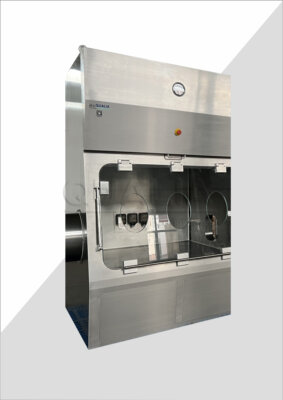
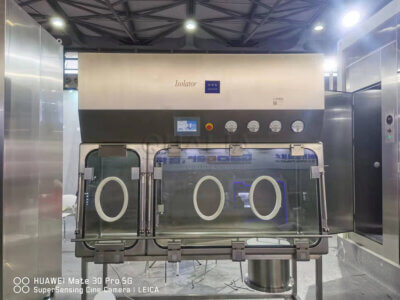
For containment systems operating at OEB4 or OEB5 levels — where the OEB4/OEB5 아이솔레이터 is the primary operator protection barrier — the consequence of logging gaps is compounded: a passing SMEPAC result that excluded disconnect and cleaning events may not represent the containment performance during the moments of highest exposure potential.
Sampling Depth Versus Field Execution Burden
Adding sampling points and event-logging requirements to a SMEPAC protocol improves diagnostic resolution. It also increases the probability of execution failure in the field — not because the personnel are inadequate, but because synchronizing sample IDs with operator posture and equipment state in real time is a coordination task that compounds with every additional data point. This is the trade-off that teams consistently underestimate when building protocols at a desk, and it is the one that most often produces a dataset that is technically dense but internally inconsistent.
The ISPE SMEPAC third edition provides methods for estimating data below the limit of quantification, which extends the analytical reach of a test without requiring higher-sensitivity instrumentation. It also includes structured procedures for evaluating surface sampling data and responding to non-compliant results. These tools support deeper root-cause analysis and more defensible regulatory responses — but they add protocol length and data management complexity that must be absorbed by the team executing the test.
The life-cycle framing matters here too. SMEPAC testing is not a one-time qualification activity; changes in personnel, operating procedures, and equipment wear all affect containment performance over time. The guide addresses reassessment frequency across the containment system life cycle, which means the depth versus burden decision is not only about the initial test — it is about whether the protocol can be executed consistently across periodic reassessments without degradation in data quality. A deep protocol that a team executes reliably once but cannot repeat consistently is less useful than a leaner protocol that generates comparable data across the system’s operational life.
| 요인 | Deep Sampling Approach | Lean Sampling Approach | 주요 고려 사항 |
|---|---|---|---|
| Trace detection | Includes statistical methods for below-LOQ data, improving sensitivity to low emissions | Limited to above-LOQ reading, may miss small but relevant releases | Deeper data supports root-cause investigations but adds data complexity |
| Surface result management | Structured evaluation and non-compliance procedures from SMEPAC guide | May rely on ad-hoc judgment for excursions | Formal response protects regulatory defensibility, but adds protocol length |
| Life-cycle monitoring | Defines reassessment frequency, accounts for personnel, activity, and equipment wear changes | Often one-off testing without scheduled resampling | Periodic reassessment catches performance drift; lean misses long-term validity |
| Field execution burden | Higher sample-point count, longer run time, heavier coordination load | Fewer sample points and simplified documentation reduce burden | Every added sample increases logistical demands and potential operator error |
For closed RABS configurations where sampling access is more constrained than in open systems, the field execution burden is particularly relevant — access to specific sample points may require planned interventions that add time and coordination complexity to an already demanding protocol.
Protocol Release Check Before the First Test Run
A containment performance target set after results are in hand is the single most common reason a completed SMEPAC dataset becomes difficult to defend at commissioning sign-off. The CPT must be defined before testing begins, with its derivation documented. The ISPE SMEPAC guide suggests that a CPT as low as one-tenth of the lowest applicable occupational exposure limit for the API is a reasonable design figure — framing this as a benchmark the protocol can adopt, not as a universally mandated threshold. Whatever value is selected, it must be locked with a documented rationale before any samples are collected, because revising it after data is in hand compromises the credibility of the entire evidence package.
Two material-form checks should gate protocol release. First, confirm that the test surrogate is a powder — SMEPAC methodology does not apply to liquids, vapors, or subliming solids, and using an inappropriate material form renders the results invalid for containment assessment purposes. Second, confirm that the API amount, equipment configuration, and activity duration used in testing match actual production conditions closely enough that the test results can be claimed to represent real-life operation. A protocol that tests a smaller batch in a clean room rather than the production amount in the operational environment generates data that is analytically clean but operationally irrelevant.
The multidisciplinary team requirement for protocol sign-off is not procedural formality. Site engineers, operators, technology suppliers, occupational hygienists, and process safety representatives each carry a category of knowledge that the others cannot fully substitute. An engineering-only review will tend to miss operator technique variables; an operator-only review will tend to miss the analytical implications of sampler selection. The third edition of the SMEPAC guide includes a systematic checklist for both simple and complex systems that is designed to surface gaps that single-discipline review typically misses.
Qualified execution is a separate requirement from team review. Testing should be performed by a Certified Industrial Hygienist or Occupational Hygienist with documented SMEPAC experience. Execution errors in field sampling — incorrect sample timing, improper filter handling, missed event logging — produce data artefacts that are often invisible in the final dataset and can lead to a passing result that does not reflect actual containment performance. Engaging a qualified tester is a data integrity decision, not a credentialing formality.
| 항목 확인 | 확인 대상 | 간과할 경우의 위험 |
|---|---|---|
| 차단 성능 목표 | Set CPT at ≤0.1× the lowest OEL of the API | Pass/fail lacks reference; outcomes may be unexpectedly non-compliant |
| Material form | Confirm the test surrogate is a powder, not a liquid, vapor, or subliming solid | SMEPAC validity lost; results unusable for containment assessment |
| Production alignment | Match API amount, equipment, and activity duration to real-life conditions | Test data becomes irrelevant to actual operations |
| System checklist | Use the third-edition verification checklist for simple or complex systems | Critical protocol gaps may be missed without structured review |
| Multidisciplinary team | Include engineers, operators, technology suppliers, occupational hygienists, process safety | Unbalanced review can leave technical, operational, or safety blind spots |
| Qualified tester | Engage a Certified Industrial Hygienist or Occupational Hygienist with SMEPAC experience | Execution errors or misreadings compromise data integrity |
The protocol decisions that determine whether a SMEPAC test produces defensible data are almost entirely upstream of the test itself: surrogate selection, sampler specification, surrogate mass, CPT level, event-log structure, and task sequence scope must all be locked before the first operator enters the test space. Any one of these left open — surrogate mass treated as a range, sampler model left unspecified, CPT deferred until results are reviewed — typically requires a full retest to correct, not a data amendment.
Before releasing a protocol for execution, the most useful check is to trace a hypothetical overexposure event backward through the dataset and ask whether the protocol, as written, would generate the sample timing, event-log correlation, and equipment-state documentation needed to locate the emission source and distinguish a containment failure from an operator technique issue. If that trace fails at any point, the gap is in the protocol, not in the containment system — and it is easier to close that gap now than to explain it under audit.
자주 묻는 질문
Q: Does SMEPAC methodology apply if the API sublimes or exists primarily as a vapor at processing temperatures?
A: No — SMEPAC does not apply to liquids, vapors, or subliming solids, and testing an API or surrogate in those states renders the results invalid for containment assessment. If the material transitions from powder to vapor during processing, the test conditions no longer represent the actual aerosol propagation behavior the methodology is designed to measure, and a different assessment framework must be selected before any sampling is planned.
Q: What should the team do immediately after a completed SMEPAC dataset shows a result that exceeds the containment performance target?
A: The first step is to overlay the elevated sample timestamp against the event log to localize when the exceedance occurred — during steady-state operation, a transition event, or a specific operator action. Without that correlation, the result supports only a general conclusion. The ISPE SMEPAC guide includes structured procedures for evaluating non-compliant results, but those procedures depend on having a timestamped event log that can place equipment state and operator activity at the exact moment of the elevated reading. If the log is incomplete, the root cause cannot be distinguished between a containment failure and a technique or procedural gap.
Q: At what point does adding more sampling locations stop improving the protocol and start degrading the quality of the data collected?
A: The threshold is reached when the coordination demand of synchronizing sample IDs with operator posture and equipment state in real time exceeds what the field team can execute consistently. A protocol that generates internally inconsistent data — because event logging fell behind, sample labeling was rushed, or timing drifted — produces a denser dataset that is less defensible than a leaner one executed cleanly. The practical check is whether the protocol can be repeated across periodic reassessments with comparable data quality, not only completed once under controlled conditions.
Q: How does SMEPAC testing compare to relying on the manufacturer’s published containment performance data for a purchased isolator or cRABS?
A: Manufacturer data typically reflects the equipment’s containment capability under the test conditions used during qualification — which may not match the specific task sequence, surrogate mass, operator technique, or room environment of the purchasing site’s operation. SMEPAC testing at the installation site challenges the containment system as it is actually used, including disconnect events, glove port handling, and cleaning transitions that manufacturer testing may not have replicated. Published performance figures are a useful design input, but they cannot substitute for site-specific evidence where the CPT must be defended against a documented operational task sequence.
Q: Is a single SMEPAC test sufficient for the life of the containment system, or does the protocol need to be re-executed after equipment modifications or personnel changes?
A: A single test is not sufficient. Changes in personnel, operating procedures, and equipment wear all affect containment performance over time, and the ISPE SMEPAC guide addresses reassessment frequency across the system life cycle specifically because initial qualification data loses validity as those variables shift. A protocol designed only for one-time execution — without considering whether it can be repeated consistently — may produce strong initial data that cannot be compared against later assessments, leaving the team unable to demonstrate sustained performance under audit.