When a BSL-3 laboratory procurement splits containment equipment across multiple suppliers without defining shared interfaces, individual systems can pass their own factory acceptance tests while the integrated facility fails commissioning. The failure mode is specific: a HEPA exhaust housing arrives without factory-installed DOP scan probe ports, the duct flange dimensions don’t match what the HVAC contractor fabricated on site, and the validation team discovers there is no factory leak-tightness baseline to distinguish a manufacturing defect from an installation problem. That ambiguity stalls occupancy, forces field welding inside a nearly commissioned containment zone, and opens the acceptance record to challenge during regulatory inspection. A well-structured User Requirements Specification resolves this before procurement begins—by assigning every containment-critical interface to either supplier scope or facility scope, with a testable acceptance path for each.
Pressure cascade requirements in the BSL URS
Directional airflow and exhaust air handling are not performance aspirations in BSL-3 design—they are fixed design thresholds. The CDC BMBL 6th Edition requires that BSL-3 laboratories maintain sustained directional airflow drawing air from clean areas toward potentially contaminated areas, and that exhaust air cannot be recirculated. These two requirements function as binary pass/fail conditions in the URS, not as optimization targets.
The practical implication for the URS is that pressure cascade must be expressed as measurable conditions, not as intent. The document should specify the differential pressure setpoints between the corridor, anteroom, and laboratory core, the direction of that cascade, the alarm thresholds that indicate loss of containment hierarchy, and the BMS monitoring points that provide continuous evidence. Stating that the facility “will maintain negative pressure” without specifying the magnitude and the monitoring architecture gives commissioning teams nothing to test against and gives inspectors nothing to verify.
The threshold that changes the recommendation is the relationship between the HVAC control strategy and the physical equipment in scope. If the module or prefabricated laboratory system includes integrated controls, the URS must define how the supplier’s pressure control logic interfaces with the facility BMS—who owns the pressure setpoint, who handles alarms, and what happens during a power interruption. Leaving that boundary undefined means the HVAC engineer and the module supplier may each assume the other handles failsafe response, and neither tests it during FAT.
Airlock and APR door interface evidence
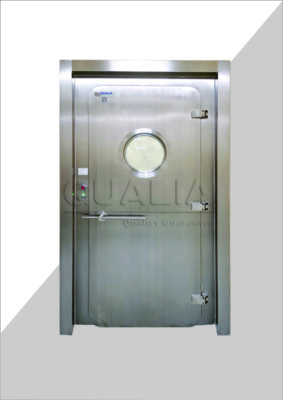
CDC BMBL 6th Edition states that BSL-3 laboratory entry must be through two self-closing, interlocked doors. This is a physical configuration requirement, not a design recommendation. The URS must treat it as a pass/fail provision: either the airlock geometry, door hardware, and interlock logic satisfy it or they do not.
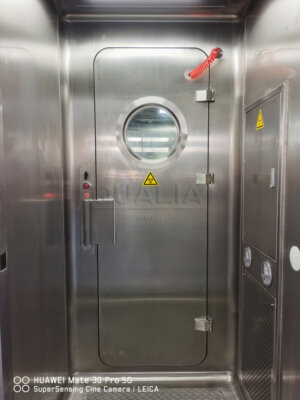
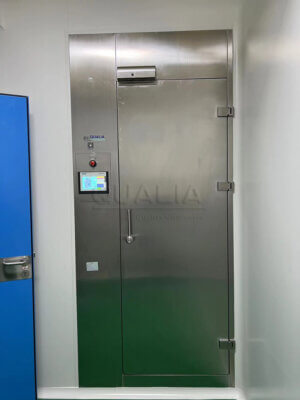
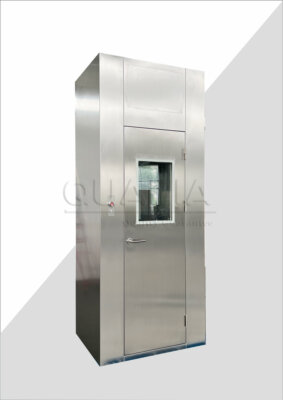
The interface evidence the URS should capture goes beyond door count. Pneumatically sealed doors with automatic pressure regulation introduce specific integration dependencies—the door’s sealing pressure, the compressed air supply specification, the interlock control logic, the emergency release mechanism, and the fail-safe state during loss of power or instrument air. If the URS specifies only that two interlocked doors are required without documenting these parameters, the FAT can verify the door hardware in isolation while leaving the facility interface entirely untested. A door that seals and interlocks correctly in the factory may not maintain its seal differential under the negative pressure conditions present in the installed facility if those conditions were never part of the acceptance criteria.
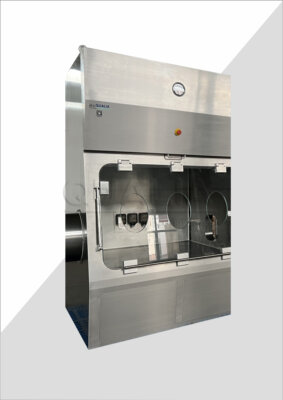
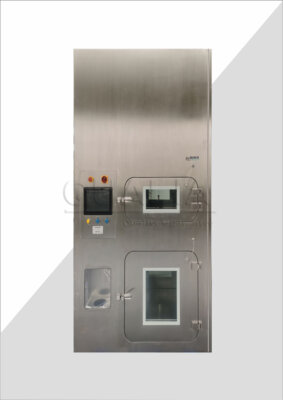
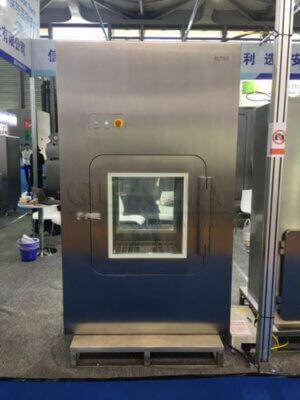
The downstream consequence surfaces during IQ/OQ. If the APR door specification was not cross-referenced to the pressure cascade requirements in the URS, the OQ test protocol for airlock performance has no defined acceptance criterion linking door seal integrity to the pressure differential it is expected to maintain. Approval is then a judgment call rather than a documented pass—a position that is difficult to defend during inspection. For teams specifying pneumatically sealed airlocks in BSL-3 and BSL-4 modules, the 공압 씰 APR 도어 product specification provides the interface parameters that need to appear in the URS.
HEPA exhaust and filter testing expectations
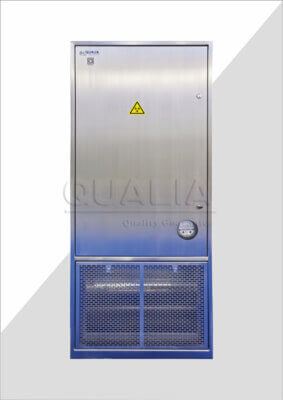
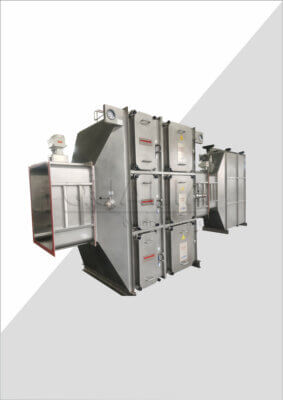
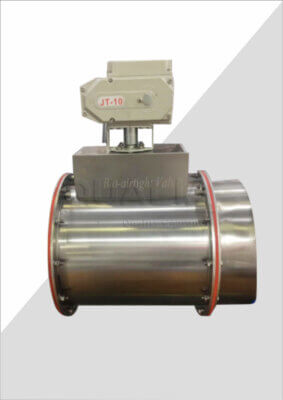
The most common procurement error for HEPA exhaust and BIBO housing is treating test access as optional scope rather than as a factory-installed design feature. Retrofitting static pressure taps, DOP/PAO scan probe access points, aerosol injection ports, and differential manometer connections after housing installation often requires removing the housing from the duct or performing site welding inside a contaminated exhaust path. The cost of that retrofit consistently exceeds what the same ports would have cost at the factory, and the disruption to the containment envelope creates its own risk during the remediation work.
Three specification decisions need to be locked in the URS and carried into the BIBO RFQ before quotes are issued. Filter grade and exact dimensions—whether H13, H14, or U16—must be stated explicitly; without this, suppliers quote different filter classes and commissioning faces a sourcing problem when the specified filter is unavailable or incompatible with the housing. Seal type between filter and housing must also be specified, because the applicable leak-test method and its acceptance criteria differ between a continuous knife-edge fluid seal and a gasket seal. A mismatch between the seal type delivered and the test method written into the OQ protocol leaves the validation team without a valid test.
ISO 14644-3:2019 provides the test method framework for in-situ HEPA filter installation testing; it does not determine what gets factory-installed or how scope is divided. Its role in the URS is to anchor the test procedure and acceptance criteria, not to drive procurement decisions.
| 사양 항목 | 명시되지 않은 경우의 위험 | What to Confirm in RFQ |
|---|---|---|
| Test & measurement ports (static pressure taps, DOP/PAO scan probe access, aerosol injection, differential manometer connections) | Retrofitting often requires housing removal or site welding, costing more than factory installation | Confirm all ports are factory-installed before delivery |
| Filter grade and exact dimensions (H13, H14, U16) | Suppliers quote different filters; comparability breaks and filter sourcing problems arise during commissioning | Explicitly state filter grade and dimensions |
| 필터-하우징 밀봉 방식 (continuous knife-edge fluid seal vs gasket seal) | Seal type determines applicable leak-test method and acceptance criteria; mismatch may compromise containment | Specify seal type and link to required test method |
Requesting factory leak-tightness test reports from the supplier is a risk-management step, not a regulatory requirement. Without a documented factory baseline, a failed in-situ DOP/PAO test during commissioning is unresolvable: the owner cannot determine whether the problem is a manufacturing defect in the housing or a site installation error. The practical protection is to require, as a contractual term in the RFQ, both the factory test report and a supplier commitment that the housing is designed to pass in-situ testing at the specified efficiency class.
VHP and EDS integration in module scope
CDC BMBL 6th Edition requires that BSL-3 laboratories be equipped to decontaminate laboratory waste—specifying incinerator, autoclave, or another decontamination method as acceptable engineering solutions. The URS must capture this as a system-level requirement, not as a preference. VHP surface decontamination and effluent decontamination systems are engineering solutions that satisfy the requirement; neither is itself mandated by the biosafety standard, but the requirement to address waste decontamination is mandatory.
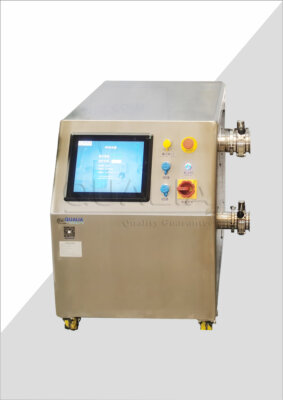
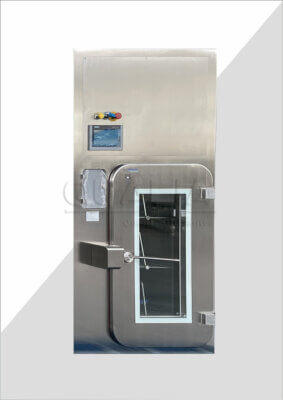
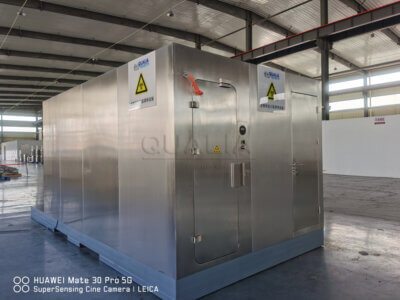
The integration complexity arises when VHP and EDS are procured separately from the module or laboratory envelope. A VHP generator introduced into a BSL-3 module for room decontamination or transfer pass-through decontamination creates specific HVAC interface demands: the HVAC system must be capable of being isolated during the VHP cycle, the module must be sufficiently leak-tight for the VHP concentration to reach and hold the validated sporicidal dose, and the exhaust path following aeration must account for catalyst breakdown or charcoal adsorption of residual hydrogen peroxide. None of these interface conditions belong solely to the VHP equipment supplier or solely to the HVAC engineer—they sit at the boundary, and the URS is the document that assigns them.
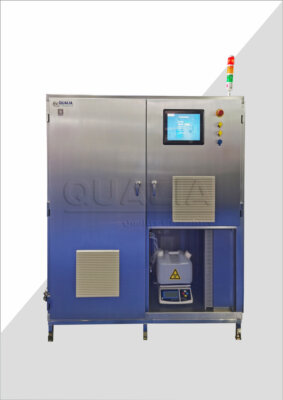
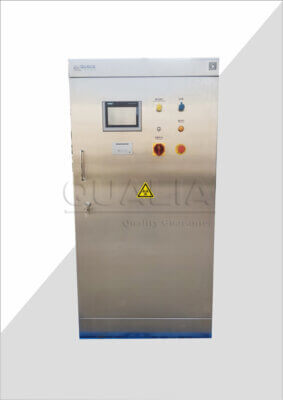
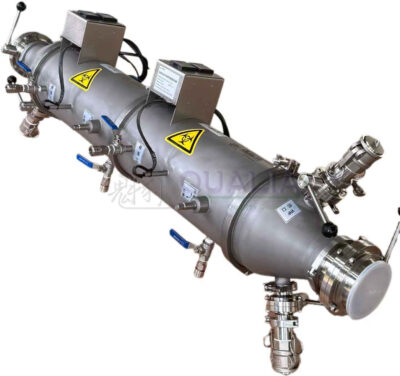
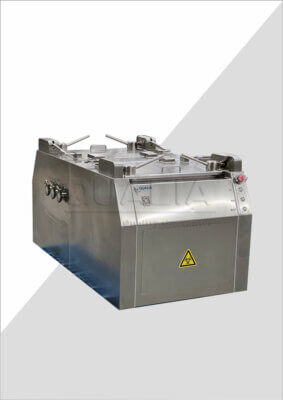
For liquid waste, the EDS must be specified with the same boundary clarity. The URS should define which drain lines feed the EDS, whether the system operates in batch or continuous mode, the validated decontamination cycle parameters, the alarm and interlock logic connecting the EDS to laboratory operations, and who holds the validation package. If the EDS is treated as a utility item rather than a containment-critical system, it may not receive IQ/OQ/PQ treatment proportionate to its risk—leaving a pathway for undecontaminated effluent to bypass the system without a documented response protocol. The 폐수 오염 제거 시스템 product scope illustrates the control and monitoring parameters that need to be represented in the URS before the system can be meaningfully validated.
Facility versus supplier boundary decisions
The procurement friction in BSL equipment is not primarily technical—it is structural. When the URS describes what a system must do without specifying who supplies each component, competitive quotes appear comparable while describing fundamentally different scopes. The hidden cost surfaces after award, as field purchases and change orders fill the gaps between what the supplier delivered and what the facility engineer assumed was included.
For BIBO housings, the component-level split is the most common source of this ambiguity. BIBO bags, UV sterilization lamps, magnehelic gauges, volume control dampers, transition pieces, test sections, and DOP scan probes are each routinely described by some suppliers as included and by others as site-provided. Requiring suppliers to list these items as discrete line items in the RFQ—clearly marked as factory-supplied or site-provided—eliminates the scope difference that is hiding inside price differences. A quote that is lower because it excludes the test section and scan probe is not a better price; it is a different product.
Duct interface details carry a different failure pattern. The BIBO housing inlet collar, outlet collar shape, flange type, and pipe size must be finalized before the RFQ is issued. Issuing the RFQ without these details produces quotes that cannot be accepted without change orders, because the housing manufacturer must resolve the interface before fabrication begins, and that resolution after award typically changes both cost and schedule.
| Scope Item | Ambiguity Risk | 견적 요청서(RFQ)에서 명확히 해야 할 사항 |
|---|---|---|
| BIBO housing components (bags, UV light, magnehelic gauge, dampers, transition pieces, test sections, DOP scan probe) | Hidden cost differences and unexpected field purchases when scope is bundled | Require supplier to list each component as a discrete line item, clarifying factory-supplied versus site-provided |
| Duct interface details (flange type, inlet/outlet collar shape, pipe size) | Quotes cannot be compared or accepted without change orders | Finalize all duct interface details before issuing RFQ |
The cross-discipline review that prevents these problems—biosafety, HVAC, controls, and validation teams aligned before RFQ—takes time that procurement timelines rarely budget explicitly. The trade-off is real: early cross-review delays procurement by weeks, but a boundary ambiguity discovered during installation delays commissioning by months and introduces containment risk during remediation.
URS approval rule for integrated BSL acceptance
A URS that documents each containment system individually without capturing the interfaces between them can produce a situation where every equipment supplier passes FAT, every field installation passes visual inspection, and the integrated facility still fails commissioning qualification. The mechanism is straightforward: there are no testable acceptance criteria for the interfaces themselves, so failure at those interfaces has no established owner and no predetermined acceptance path.
The practical approval rule is that no containment-critical interface in the URS should reach the approval signature without a testable acceptance criterion attached to it. This means each interface—pressure cascade monitoring, airlock interlock logic, HEPA housing test access, VHP isolation capability, EDS alarm connectivity—must have a named test, a defined acceptance value, and a documented responsibility assignment. Where that assignment crosses the supplier-facility boundary, both parties must be named.
For HEPA and BIBO housing specifically, the factory leak-tightness test report and the supplier’s documented commitment to pass in-situ DOP/PAO testing at the specified efficiency class serve as the baseline that makes field qualification defensible. Without a factory baseline, a field test failure becomes an unresolvable dispute—the owner cannot separate a manufacturing defect from an installation error, and the validation record is incomplete regardless of the outcome. Requesting these documents in the RFQ, before supplier selection, ensures that they are available when commissioning begins rather than being chased after a failure. Teams preparing for commissioning qualification can find practical sequencing guidance in the BSL-3 실험실 시운전하기: 단계별 가이드.
The URS approval signature should be withheld until every critical interface has a testable acceptance path. That standard is not a documentation formality—it is the condition that makes integrated BSL acceptance possible rather than aspirational.
The most consequential decision in BSL equipment procurement is not which system to select—it is whether the URS defines every containment-critical interface before selection begins. Pressure cascade setpoints, airlock interlock parameters, HEPA seal type, VHP isolation logic, and EDS alarm boundaries are each resolvable at the URS stage with limited cost. Discovered during commissioning, each one is a schedule event, a potential containment breach, and a qualification gap. The factory test baseline and the supplier’s in-situ commitment are the tools that keep field test failures from becoming unresolvable disputes.
Before approving the URS, confirm that every interface listed in the document has a named acceptance criterion, a test method, and a clear assignment to either supplier or facility scope. Interfaces that cannot be assigned—because the HVAC design is incomplete, the EDS drain layout is unresolved, or the BMS specification has not been issued—should be treated as open risks, not as items to be addressed during installation. The URS is the point at which those risks are cheapest to close.
자주 묻는 질문
Q: What if our BSL-3 lab uses an autoclave and incinerator for waste decontamination instead of VHP and EDS — do we still need to address these interfaces in the URS?
A: Yes, the URS still must define the interface requirements for whichever decontamination method is chosen. The principle of assigning every containment-critical interface with a testable acceptance path applies equally to autoclave or incinerator systems — document the utility connections, cycle validation evidence, alarm logic, and the scope boundary for the validation package. The VHP and EDS sections can be omitted, but the rigor behind the remaining decontamination interfaces should match the same standard.
Q: After the URS is approved with all interface criteria, what is the immediate next step to ensure suppliers are contractually bound to those requirements?
A: Translate the URS criteria directly into the procurement documents. For BIBO housings and other critical equipment, issue the RFQ with the interface requirements carried as mandatory contractual terms — list component scope as discrete line items, embed the demand for factory test reports and in-situ performance commitments, and finalize duct interface details before soliciting bids. This step prevents the scope ambiguity that otherwise emerges after supplier selection.
Q: Does the requirement for factory-installed DOP/PAO test ports on HEPA housings apply to all BSL-3 exhaust systems, or only large BIBO installations?
A: It applies to all HEPA-filtered exhaust paths in BSL-3 containment, regardless of size. In-situ filter integrity testing per ISO 14644-3 cannot be performed without dedicated test access points; retrofitting those ports after installation breaches the containment envelope and introduces a biosafety risk. The standard does not exempt smaller housings, making factory installation the only defensible approach.
Q: How do I decide between specifying a knife-edge fluid seal and a gasket seal for BIBO HEPA housings in the URS?
A: Choose a knife-edge fluid seal when the application demands the highest containment reliability — it maintains a continuous barrier even under thermal cycling and requires less frequent seal replacement. Gasket seals cost less initially but degrade over time, lead to more frequent re-testing, and introduce a higher leak risk. The URS must lock this choice because the seal type dictates the applicable in-situ leak test method and its acceptance criteria.
Q: For a small BSL-3 laboratory project, is the rigorous interface URS approach really worth the extra engineering effort?
A: Yes. The cost of resolving even one interface failure during commissioning — such as a missing scan probe port or a duct mismatch — routinely exceeds the entire URS development effort. A single change order involving field welding inside a commissioned containment zone can delay occupancy by weeks and create regulatory exposure. The URS is the cheapest and lowest-risk point to lock in interface clarity, regardless of project size.