Most high-containment equipment projects reach the RFQ stage with a document that describes what the equipment looks like rather than what it must do under failure conditions. When acceptance criteria are absent or ambiguous, suppliers respond with different evidence scopes — and those differences do not surface during negotiation; they surface as change orders during FAT or SAT, when schedule pressure is highest and contract leverage is lowest. The gap is rarely about intent: QA, engineering, and procurement each contribute valid assumptions that are never formally reconciled into a single verified document. What resolves the problem is treating the URS as a cross-functional commitment that closes before supplier comparison begins, not as a procurement input that gets refined through supplier dialogue. After reading this, you will be better positioned to identify which requirements your current draft still leaves open to interpretation, and which of those will generate the most expensive disputes downstream.
Containment functions that belong in the URS
The URS for high-containment equipment earns its value by specifying intended functions under realistic operating and failure conditions — not by listing catalog features or referencing a supplier’s standard configuration. The difference matters because a function specification generates a verification requirement; a catalog reference does not.
Glove port specifications illustrate this clearly. Stating that glove ports must be present is not a URS requirement. Stating that glove ports must resist the specific select agent or hazardous drug handled, allow rapid change or replacement under containment conditions, and include a documented glove reach test to confirm that sleeve length does not create uncontrolled strain points — that is a requirement with a testable acceptance criterion. The distinction applies equally to work deck surfaces: smooth, non-porous, decontamination-resistant materials with minimal seams are a design input that reduces contamination accumulation and directly supports cleaning validation. Specifying surface material and finish in the URS is what makes a later cleaning validation defensible; leaving it to supplier discretion means the validation protocol must work around whatever surface arrived on the factory floor.
Decontamination agent resistance deserves its own line in the URS because VHP compatibility failures are not always visible at commissioning — surface degradation under repeated cycles becomes a containment integrity issue only after months of operation. If the URS does not specify that surfaces must withstand repeated VHP exposure, the supplier is under no contractual obligation to demonstrate compatibility, and material compatibility testing becomes a post-installation negotiation.
Alarm coverage and waste disposal are two functions most teams underspecify at the URS stage and then struggle to validate later. Alarms for containment breach, airflow fault, and pressure deviation need defined response parameters — not just a statement that alarms shall be present. Waste disposal systems, particularly vacuum-based collection for hazardous materials, must define containment boundaries so the commissioning team knows where supplier responsibility ends and site infrastructure begins.
Each of these containment functions, once written into the URS with specificity, becomes a validation checkpoint that QA can trace through IQ, OQ, and PQ. Left underspecified, each one is a scope dispute waiting to emerge at acceptance testing.
| Containment Function | What the URS Should Specify | 중요한 이유 |
|---|---|---|
| 글러브 포트 | Must resist the select agent or hazardous drug, allow easy change or replacement, and include a glove reach test to prevent dangerous leaks in case of breakage | Prevents leaks and ensures operator safety during glove failures |
| Work deck surfaces | Smooth, non-porous, decontamination-resistant material like stainless steel with minimal seams, corners, and accumulation-prone areas | Reduces contamination accumulation and facilitates cleaning |
| Decontamination agent resistance | Surfaces must resist damage from decontamination agents such as vaporized hydrogen peroxide (VHP) | Ensures long-term integrity of containment surfaces under repeated decontamination |
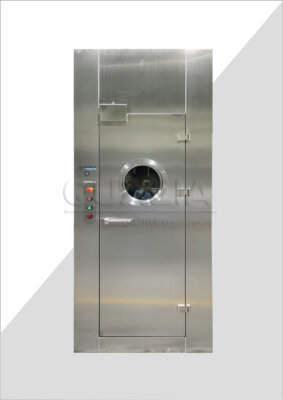
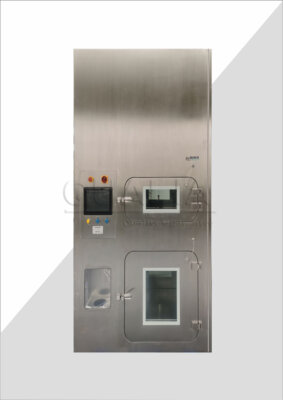
| Passthrough systems | Interlocking doors that prevent simultaneous opening, decontamination procedures before transfer, and sealed leak-proof design | Prevents cross-contamination during material transfer |
| Ergonomic requirements | Comfortable working height, adequate space, adjustable glove ports, proper lighting, noise level limits, footrests | Improves operator comfort and reduces errors that could compromise containment |
| 경보 시스템 | Alarms for containment breaches, airflow faults, and pressure level deviations | Enables immediate response to containment failures |
| Waste disposal system | Vacuum system to collect and contain hazardous waste, with safe handling and containment measures | Ensures safe handling and containment of hazardous waste |
Passthrough interlock logic and ergonomic requirements often get deferred to detailed design, which means they are negotiated against a signed contract rather than defined before one exists. Interlocking doors that prevent simultaneous opening are a containment function, not an ergonomic preference — they belong in the URS with a defined verification method. Ergonomic criteria including working height, adjustable glove port positioning, and noise limits matter not because of comfort but because operator fatigue and discomfort in high-hazard environments increase the likelihood of procedural errors that compromise containment. Specifying them in the URS is how they survive value-engineering conversations during procurement.
Utility and interface assumptions procurement must freeze
The friction point that surfaces latest and costs the most in high-containment projects is utility and interface ownership. A supplier can qualify equipment logic, demonstrate negative pressure maintenance under factory test conditions, and deliver a complete set of FAT records — but they cannot qualify missing site pressure, drainage, or BMS integration. If those assumptions were never frozen in the URS, the gap appears at SAT when the commissioning schedule has no room left.
Cleanroom classification and air change rate are foundational. Widely used design references suggest ACH ranges of 240–500 for ISO Class 5, 30–60 for ISO Class 7, and 20–40 for ISO Class 8 — but these are planning thresholds, not universal regulatory mandates, and the specific value for any given application depends on process risk, room volume, and contamination control strategy. The point is not that one ACH figure is correct; it is that whatever figure the project adopts must appear in the URS before the RFQ goes out, because mismatched ACH expectations between facility design and equipment specification lead to performance qualification failures that require infrastructure modifications, not equipment adjustments.
Decontamination method selection is where procurement teams most consistently underestimate the downstream consequences. The choice between VHP and UV-C, and between automated and manual cycles, drives utility connection requirements, affects fumigation downtime planning, and determines the scope of sealability validation. A typical VHP cycle — including preconditioning, fumigation, soak phase, degassing, and purging — is commonly referenced at a minimum of twelve hours. That figure has direct implications for facility layout, room scheduling, and operational throughput planning. Reversing the decontamination method after the RFQ means renegotiating both the equipment design and the cleaning validation approach simultaneously. The URS is the last point at which that decision is cheap to make.
| Utility/Interface Parameter | What Must Be Defined | Impact if Left Unfixed |
|---|---|---|
| Cleanroom classification & air change rate (ACH) | Specify ISO class (5, 7, or 8) and required ACH range (ISO 5: 240–500, ISO 7: 30–60, ISO 8: 20–40) | Mismatched ACH leads to equipment failing cleanroom performance validation |
| Differential pressure | Minimum 10 Pa between cleanroom and adjacent areas | Contamination ingress risk if pressure cascade not maintained |
| 오염 제거 방법 | Define whether UV-C or HPV, and whether cycles are manual or automatic | Different methods require different utility connections and facility integration |
| Temperature & relative humidity | Specify environmental ranges (e.g., 18–24°C, 30–60% RH) suppliers must design to | Equipment designed outside these ranges may malfunction or require costly HVAC modifications |
| Ventilation/filtration | HEPA filtration specification (e.g., single HEPA supply, double HEPA exhaust) | Critical containment ventilation design; late changes cause redesign |
| Fumigation cycle duration | Account for full fumigation cycle (preconditioning, fumigation, soak, degassing, purging), typically ≥12 hours | Impacts facility layout and operational downtime planning |
HEPA filtration tier is a related interface decision that teams often treat as a supplier default. Whether single HEPA supply and double HEPA exhaust is appropriate for a given application is a project decision that must be stated in the URS, because it affects exhaust duct sizing, building HVAC loading, and HEPA housing installation scope — all of which cross the supplier-site interface. The differential pressure requirement — commonly referenced at a minimum of 10 Pa between the isolator or cleanroom and adjacent areas — must similarly be frozen before RFQ, because the supplier designs to a stated differential; they cannot compensate for a site HVAC system that was specified independently and cannot hold the required cascade.
Verification methods for each critical requirement
A requirement without a verification method is not a requirement — it is a preference that a supplier can acknowledge and then interpret freely. The URS must pair every critical requirement with a defined verification approach, an acceptance criterion, and a named acceptance owner before the RFQ is released. If those three elements are not present, suppliers will quote different evidence scopes, and QA will spend the qualification phase establishing acceptance criteria that should have existed before procurement began.
Containment performance quantification is the area where this gap is most costly. The Containment Performance Target (CPT), expressed in µg/m³, is the acceptance criterion against which SMEPAC testing is evaluated — the Containment Performance Limit (CPL) must remain below the CPT throughout the test to confirm that the equipment performs at the required exposure band. For OEB 5 applications, naproxen sodium is the accepted surrogate material; for lower OEB levels, lactose, mannitol, or paracetamol are commonly used. These are testing-framework references that have developed within the containment testing community — they are not imposed by a single regulatory authority — but they represent accepted practice, and the URS must reference the applicable standard (such as SMEPAC methodology per EN 689) so that suppliers quote against the same safety level and results are comparable across proposals.
The occupational hygienist responsible for defining the SMEPAC measurement strategy must be identified in the URS, not left as an open question during execution. Responsibility for who provides surrogate material and who designs the test protocol affects both cost allocation and the credibility of the result. If the URS is silent on this, the responsibility gap will not be resolved by goodwill; it will be resolved by whoever has the most leverage at the point the test needs to be scheduled.
Failure mode testing must be required explicitly. The specific scenarios are generated through risk assessment by the project team — they are not prescribed by a universal protocol — but the URS must state that failure mode testing is required, that scenarios will be identified through formal risk assessment, and that those scenarios will be built into execution protocols before FAT. Without that requirement in the URS, suppliers have no contractual basis for including failure scenario testing in their qualification scope, and QA has no documented basis for requiring it during review.
| 인증 방법 | What It Assesses | Key Acceptance Criteria or Standard |
|---|---|---|
| Negative pressure maintenance test | Containment integrity under normal operation | Equipment must demonstrate negative pressure and no hazardous leakage |
| 장애 모드 테스트 | Response to potential failure scenarios | Failure scenarios identified through risk assessment and built into protocols; equipment must withstand and respond appropriately |
| SMEPAC containment performance test | Quantified containment leakage | Containment Performance Target (CPT) in µg/m³; results must remain below Containment Performance Limit (CPL) as per EN 689 |
| Surrogate material testing | Relevance of challenge agent to potency level | OEB 5 uses naproxen sodium; lower OEB uses lactose/mannitol or paracetamol |
| Commissioning plan with witnessing and independent verification | Regulatory compliance of high-containment facility (HBF) | Plan must include witnessing, testing, and independent verification |
ASTM E2500-25 provides a relevant framework for the science- and risk-based approach to verification — the principle that verification activities should be designed around process risk rather than around procedural defaults is directly applicable here. The practical implication is that the URS should specify not just what tests are required but what risk level each test is designed to address, so that the commissioning plan can be independently reviewed against the original containment intent rather than against a generic checklist.
Supplier responsibilities for protocols and records
Supplier documentation responsibilities that are not written explicitly into the URS become negotiating points after contract signature. The pattern is consistent: a project team assumes that a supplier of high-containment equipment will naturally provide a commissioning plan, a design risk register, and material compatibility records, discovers at FAT preparation that those documents were never formally scoped, and absorbs the delay while the supplier prepares documents they were not contracted to produce. EudraLex Volume 4 Annex 15 is clear that commissioning and qualification activities must be documented with traceable evidence — the principle applies regardless of which party executes the work, and that is exactly why the URS must assign each deliverable explicitly rather than relying on supplier convention.
Four deliverable categories warrant explicit assignment. The commissioning plan — covering witnessing, testing, and independent verification of containment performance — must be a named supplier deliverable with a defined format and review stage, not an expectation. The design risk register, documenting physical barrier materials, filter specifications, decontamination system validation, and alarm system test records, must exist as a traceable document that regulatory reviewers can interrogate. Without it, QA faces the task of reconstructing design intent from email threads and meeting notes at the worst possible moment — during inspection preparation. Failure mode testing protocols and material compatibility documentation follow the same logic: if the URS does not name them as contractual deliverables, they are not deliverables.
| Supplier Responsibility | What the URS Should Require | Why Supplier Ownership Matters |
|---|---|---|
| Commissioning plan | Provide a plan covering witnessing, testing, and independent verification of containment performance | Avoids delays and scope gaps at commissioning stage |
| Design risk register | Document critical design elements: physical barrier materials, filter specifications, decontamination system validation, alarm system testing | Provides traceable documentation for regulatory review |
| Failure mode testing protocols | Deliver protocols with failure scenarios identified through risk assessment and built into execution protocols | Ensures risk-based testing that supports validation |
| Material compatibility documentation | Demonstrate equipment compatibility with process materials, cleaning agents, and fumigants; provide test documentation | Verifies long-term suitability and prevents degradation disputes |
Material compatibility documentation deserves specific attention for VHP-decontaminated systems. Suppliers should be required to demonstrate that all internal surfaces, seals, gaskets, and electronic components are compatible with the specified decontamination agent and cycle parameters. This is not a one-time check — it supports the argument that repeated VHP cycles do not degrade containment integrity over the equipment’s service life. If compatibility data is not provided at handover, the maintenance team will eventually encounter seal failures or surface degradation with no baseline to compare against and no clear owner to hold accountable.
RFQ language that avoids validation scope disputes
The most common early project error is releasing the RFQ before acceptance criteria are locked. When suppliers receive a URS that describes containment functions without defined acceptance criteria, verification methods, or standard references, they make their own assumptions about evidence depth — and those assumptions diverge. The project team does not discover the divergence during proposal evaluation; it discovers it when one supplier’s FAT protocol includes SMEPAC testing to a defined CPT and another supplier’s protocol includes a visual inspection and a pressure hold. Reconciling those approaches after contract award is a change order, not a clarification.
Containment performance language is the most important element to get right. The RFQ must state the CPT in µg/m³, reference the applicable testing standard (SMEPAC methodology per EN 689 is the accepted framework for pharmaceutical containment testing), and specify the OEB band so that surrogate material selection is unambiguous. Stating that “containment performance shall be demonstrated” without a quantified target means suppliers quote a demonstration — the standard, method, and depth of that demonstration will vary, and the project absorbs those differences as contract disputes.
Cleaning and decontamination validation scope is the second most common source of disputes. The RFQ must specify whether the supplier is required to demonstrate sealability for fumigation, provide ongoing sealability testing procedures, and define the boundary between equipment decontamination and room decontamination. If that boundary is left implicit, both parties will assume it falls on the other side of the supplier-site interface, and the gap will appear during SAT or during the first regulatory inspection. Specifying HEPA filter classification — H14 per BSEN1822 is the commonly referenced standard — and confirming whether double HEPA exhaust is required gives reviewers a clear performance standard to test against rather than a general requirement to interpret.
| Ambiguity or Risk | What the RFQ/URS Must Specify | How It Prevents Disputes |
|---|---|---|
| Acceptance criteria missing | Include acceptance criteria, CPT, and required testing standard (e.g., SMEPAC per EN 689) upfront | Suppliers quote the same evidence scope; avoids change orders during FAT/SAT |
| Containment performance undefined | Define CPT in µg/m³ and reference SMEPAC or equivalent standard | Makes proposals comparable across suppliers and ensures consistent safety level |
| Cleaning/decontamination validation scope vague | Specify cleaning/decontamination validation approach; require supplier to demonstrate sealability for fumigation and provide ongoing testing procedures | Prevents disagreements on validation depth for cleaning and decontamination |
| HEPA filter class not specified | Require evidence that HEPA filters meet class H14 per BSEN1822, and confirm double HEPA exhaust if needed | Verifies critical filtration with clear standard, eliminating ambiguity |
| Surrogate material and measurement strategy ownership unclear | State which party provides surrogate material and who defines the measurement strategy | Prevents cost and responsibility disputes during acceptance testing |
The surrogate material ownership question is a procurement trade-off with direct cost and schedule consequences. The URS must state which party provides the surrogate material and who defines the measurement strategy. If the buyer’s occupational hygienist defines the strategy, that must be reflected in the project schedule and in the supplier’s contractual obligations around test preparation and witnessing. If the supplier is expected to lead, the URS must specify the qualifications and independence requirements for the person doing so. Leaving this undefined invites a situation where both parties arrive at the test date having made incompatible assumptions about who is responsible for what.
다음과 관련된 프로젝트의 경우 OEB4/OEB5 아이솔레이터, defining CPT values and surrogate material selection before RFQ release is particularly important because the potency levels involved make post-hoc test design difficult to defend to regulators. Getting this language into the RFQ document rather than into a post-award protocol is the practical mechanism for avoiding that problem.
Approval point before supplier comparison begins
The URS is not a procurement input that gets refined through supplier dialogue — it is a cross-functional commitment between QA, engineering, and procurement that must be closed before supplier comparison begins. Every open item after that point is not a planning opportunity; it is a scope dispute with a price tag attached, and the tag gets larger the further into the project the item surfaces.
The approval gate before RFQ release is a defensibility checkpoint, not a formal regulatory hold point. Its function is to confirm that no supplier will be evaluated against requirements that are still open to interpretation. ICH Q9(R1) supports the underlying rationale — risk management is more effective when risks are identified and assessed before commitments are made — but the gate itself is a project control mechanism, and passing it requires five specific confirmations. First, every critical requirement must have a matching verification method, a named acceptance owner, and a required document type. Second, all critical design elements — barriers, glove ports, airflow, decontamination, waste disposal, alarms — must have defined acceptance criteria. Third, all utility and interface assumptions must be frozen: electrical, plumbing, ventilation, pressure differentials, and BMS integration. Fourth, containment level (CL1 through CL4) and ISO cleanroom classification must be fixed as project requirements, because these drive equipment complexity, cost, and lead time, and changing them after RFQ release forces supplier redesign. Fifth, the new build versus retrofit decision must be stated explicitly, because retrofit projects introduce space constraints and cost compromises that affect which equipment configurations are viable.
| Pre-Approval Checkpoint | 확인해야 할 사항 | Risk of Skipping |
|---|---|---|
| Verification method alignment | Every critical requirement has a matching verification method, acceptance owner, and required document type | Ambiguous supplier proposals and change orders due to missing acceptance plans |
| Acceptance criteria coverage | All critical design elements (barriers, glove ports, airflow, decontamination, waste disposal, alarms) have defined acceptance criteria | Containment functions left without verification, causing validation gaps |
| Utility/interface freeze | Electrical, plumbing, ventilation, pressure differentials, and BMS integration defined and frozen | Supplier can test equipment logic but cannot qualify missing site utilities, leading to costly post-installation rework |
| Containment level and cleanroom classification | Containment level (CL1–CL4) and ISO cleanroom class (5, 7, or 8) fixed as project requirements | Drives equipment complexity and cost; changing later forces redesign and budget overrun |
| New build vs retrofit decision | State whether facility is new build or retrofit; retrofit may impose space/cost compromises | Design options incompatible with site constraints, necessitating late redesign |
The retrofit versus new build distinction is the requirement that teams most frequently leave implicit, assuming it is obvious from context. It is not obvious to a supplier preparing a proposal, and the design options available in a 3.2 m ceiling height with existing ventilation penetrations are materially different from those available in a purpose-built shell. Discovering this mismatch after proposals are submitted either forces a second round of proposals or requires accepting a design that reflects the supplier’s assumptions rather than the site’s constraints.
For BSL-3 and BSL-4 laboratory modules, the containment level lock and utility interface freeze are interdependent — the pressure cascade, exhaust redundancy, and decontamination system design cannot be quoted reliably until both are confirmed. Teams working on modular BSL-3/BSL-4 laboratory systems should treat the approval checkpoint as the moment at which module-to-building interface drawings are version-controlled alongside the URS, not as separate document streams that will be reconciled later.
A URS for high-containment equipment does more than describe what to buy — it sets the boundary conditions under which qualification evidence will be judged and within which suppliers will be held accountable. The document earns that function only if every containment requirement is paired with a verification method before procurement moves, utility interfaces are frozen before proposals are invited, and supplier documentation responsibilities are named explicitly rather than assumed.
Before releasing any RFQ, the most productive review question is not whether the URS is complete in length but whether every critical requirement in it could survive a regulatory inspection as a traceable design commitment with a defined acceptance criterion and a named owner. Any requirement that cannot meet that standard is still an assumption — and assumptions resolved during procurement are inexpensive; the same assumptions resolved during SAT or inspection preparation are not.
자주 묻는 질문
Q: What happens if the URS is written before the new build versus retrofit decision is confirmed?
A: The URS will contain requirements that may be physically undeliverable on site, forcing either a redesign after proposals are submitted or acceptance of a supplier configuration that reflects their assumptions rather than your constraints. Ceiling height, existing ventilation penetrations, and drainage routing all affect which isolator or module configurations are viable — a supplier quoting for a purpose-built shell cannot produce a comparable proposal to one quoting for a constrained retrofit space, and the difference will not be reconcilable during evaluation. Confirm the site condition before the URS is approved for RFQ release.
Q: If the occupational hygienist who will define the SMEPAC measurement strategy is not yet contracted at URS stage, can that assignment be left open until closer to FAT?
A: No — deferring it creates a cost and schedule gap that is difficult to close under FAT preparation pressure. The URS does not need to name an individual, but it must state which party — buyer or supplier — is responsible for defining the measurement strategy, providing the surrogate material, and meeting the qualification requirements for the person leading the test. Once those responsibilities are contractually assigned at RFQ stage, the buyer can contract the occupational hygienist on a known scope; leaving the assignment open means both parties may arrive at the test date having made incompatible assumptions about who owns the work.
Q: Is a more detailed URS always the right approach, or are there project types where a lighter specification reduces friction rather than adding it?
A: A lighter URS reduces early effort but transfers that effort — with interest — into qualification, change order management, and inspection preparation. For commodity equipment in low-hazard environments, that trade-off may be acceptable. For high-containment equipment where containment integrity must be demonstrable to regulators, the cost of resolving ambiguity during FAT or SAT consistently exceeds the cost of resolving it at URS stage. The friction a detailed URS creates is front-loaded and bounded; the friction created by an underspecified URS is back-loaded and open-ended, arriving when schedule pressure is highest and contract leverage is lowest.
Q: How should the project team handle a situation where site utilities — pressure differentials, BMS integration, exhaust capacity — cannot be fully confirmed before the RFQ deadline?
A: The RFQ should not be released until those assumptions are frozen, because a supplier cannot quote equipment logic against a utility interface that has not been defined. If the deadline cannot move, the practical alternative is to document the unresolved utility assumptions explicitly in the URS as project risks with a named resolution owner and a date by which they must be confirmed — and to hold the supplier’s design freeze to that date rather than to RFQ issue. What the project cannot afford is to treat unconfirmed utility assumptions as supplier defaults; the supplier can test equipment logic but cannot qualify a missing or mismatched site interface, and that boundary must be explicit before proposals are evaluated.
Q: At what point does the CPT value need to be defined — can it be refined based on supplier proposals before being locked?
A: The CPT must be defined before the RFQ is released, not refined through supplier dialogue. If the CPT is absent or provisional at RFQ stage, suppliers will quote against different containment performance assumptions — one may scope SMEPAC testing to a rigorous µg/m³ threshold while another quotes a general pressure hold, and those proposals cannot be compared on a like-for-like basis. The CPT is derived from the Design Exposure Limit established for the facility and the specific OEB band of the compound being handled; both inputs should be available to QA and occupational health before procurement moves. Treating the CPT as something to be negotiated with suppliers transfers a safety design decision to a commercial conversation where it does not belong.