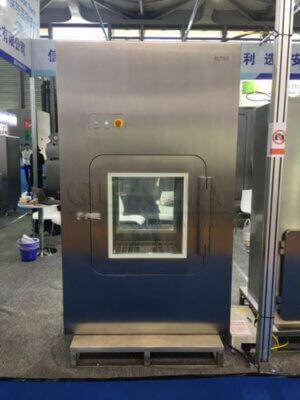

Decontamination cycles that pass on paper but fail under audit pressure usually share a common cause: the validation work was shaped by what was convenient to test rather than what was structurally hardest to reach. In a VHP pass box, that distinction matters because chamber geometry, load configuration, and aeration path interact in ways that a single well-placed biological indicator will never expose. Teams that discover this gap during requalification—or worse, during a regulatory inspection—face not just a repeat test cycle but a forced rethink of BI placement rationale, load control procedures, and cycle evidence traceability. What follows is a technical framework for building validation work that holds: grounded in worst-case surface identification, load pattern control, and cycle evidence that connects door release to confirmed residue clearance.
Worst-Case Surfaces and Shadowed Load Areas
The first planning error in VHP pass box qualification is treating the chamber as a uniform exposure environment. Chamber volume sets the operating parameter envelope, but it says nothing about whether vapor reaches the base of a stacked tray, the inner fold of a bag, or the contact point between two adjacent packages. These locations are geometrically disadvantaged — vapor access is reduced by physical obstruction, not by a regulatory category — and they define where the decontamination cycle is most likely to fall short.
Shadowed areas are not a guaranteed failure, but they are a planning criterion that should drive both BI placement decisions and load configuration controls. The distinction matters for how risk is framed: a shadow zone does not mean decontamination will fail there, but it does mean that if decontamination fails anywhere in the chamber, it will most likely fail there first. Treating that as a known geometry problem — one that must be deliberately challenged rather than assumed benign — is the difference between validation evidence that is defensible and evidence that looks complete until a reviewer asks why the indicators were all positioned in the upper central shelf.
The downstream consequence of misidentifying worst-case surfaces appears at change control, not at initial qualification. Once a pass box is released on a validation package that did not challenge true shadow zones, any subsequent load configuration change — a different package format, a taller carton, a tray added to the bottom shelf — potentially creates a new shadow geometry that the original study never tested. Without a documented rationale linking surface identification to load pattern controls, those changes are difficult to evaluate, and the envelope of the original validation is effectively undefined.
BI and CI Locations That Challenge Vapor Access
Bacillus stearothermophilus remains the standard biological challenge organism for VHP decontamination studies because of its established resistance profile to vaporized hydrogen peroxide. Its selection is not arbitrary, and neither should be its placement. The biological indicator’s function is to represent the hardest-to-kill organism at the hardest-to-reach location — both conditions must be satisfied simultaneously for the challenge to be meaningful.
The common placement failure is positioning indicators in geometrically accessible central locations because they are easy to retrieve and handle during the study. Central placement produces a passing result that does not represent worst-case exposure. Distribution studies exist specifically to identify where vapor circulation is weakest before indicators are placed, and the sequence matters: the distribution study informs placement, placement does not follow assumption. For a VHP pass box, that means BIs should be directed toward corners, packaging folds, surfaces in contact with adjacent items, and any location where geometric obstruction reduces vapor access. Chemical indicators (CIs) serve a complementary role — they provide spatial coverage across a broader number of positions where BIs cannot realistically be placed, extending the distribution map without replacing the biological challenge.
The risk in treating BI and CI placement as a procedural formality rather than a deliberate geometric challenge is that it generates data that appears complete but does not represent what the cycle will face in routine use. That gap rarely surfaces immediately; it tends to appear during reinspection or audit review when a reviewer asks for the placement rationale and the study documentation cannot answer why those specific locations were selected. Rebuilding that rationale after the fact, without a new distribution study, is not straightforward. For further detail on indicator selection and type distinctions, What Biological and Chemical Indicators to Use for VHP Cycle Validation addresses the practical decision criteria.
Load Pattern Control Before Routine Transfer
A validated load pattern and a routinely used load pattern diverge most often not through deliberate change but through operational convenience. An extra tray added to accommodate a larger transfer, a carton stack repositioned to fit a different packaging format, materials placed without reference to a documented arrangement — each of these individually may seem inconsequential, but any one of them can shadow a surface that was previously challenged, creating an unvalidated configuration without triggering any alarm or change control flag.
The control mechanism is a fixed, documented arrangement procedure established before routine transfer begins. That procedure is not a post-validation administrative step; it is a qualification output. The load pattern tested during validation defines the boundaries of what the cycle can be expected to achieve, and deviations from that pattern after release create an exposure and aeration profile that the validation data no longer covers.
| Persyaratan | Deskripsi |
|---|---|
| Defined Arrangement Procedure | Materials are arranged according to a documented procedure, preventing ad-hoc loading. |
| Excessive Stacking Avoidance | No excessive stacking that could obstruct vapor penetration or aeration. |
| Surface Blocking Prevention | Surfaces required for exposure are kept unblocked. |
| Fixed Routine Load Pattern | Load patterns are standardized for routine transfers to ensure consistent decontamination. |
Operationally, the most defensible approach is to make the arrangement procedure specific enough that a technician following it would produce the same load geometry across transfers, and specific enough that a QA reviewer comparing a routine transfer record to the validation protocol could confirm correspondence. Vague descriptions such as “items arranged to allow airflow” do not meet that standard. The procedure should capture shelf assignment, orientation, spacing constraints, and maximum item counts — parameters directly tied to the surface exposure geometry that was tested.
Aeration Endpoint and Residue Release Basis
Elapsed time is an operationally convenient aeration endpoint, but it does not create a defensible link between door unlock and actual residue clearance. The problem is not that timed aeration is always insufficient — under fixed, reproducible cycle conditions, an established time parameter may correlate reliably with residue clearance. The problem is that a time-only release criterion provides no basis for demonstrating what actually drove the decision to unlock the door, and under change control or regulatory review, that absence of linkage is difficult to resolve.
Tying door release to a demonstrated residual H₂O₂ concentration threshold — with ≤1 PPM used as a design-level reference criterion for operator safety and material release — creates a different evidentiary basis. The door interlock does not release because a timer expired; it releases because the chamber has been confirmed to have cleared to a level that supports safe material handling on the clean side. That distinction matters for how the cycle record reads and how material release decisions can be justified. It also means the aeration endpoint survives changes in ambient temperature or humidity that might affect the time required to reach clearance, conditions that a fixed elapsed-time criterion would not automatically account for.
The material-safety basis of the residue threshold also connects aeration to downstream release decisions, particularly for pharmaceutical materials or packaging components that have defined H₂O₂ compatibility limits. Where a validation package needs to establish that transferred materials are safe for downstream use, a concentration-based release criterion provides a documented, measurable link. Time alone cannot carry that argument. VHP Pass Box for Biosafety: When Hydrogen Peroxide Is Required covers the broader application context where this distinction in release basis becomes operationally significant.
Door Interlock Alarm and Cycle Data Evidence
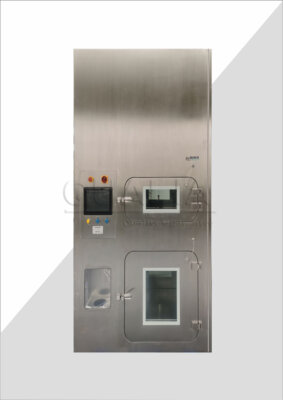
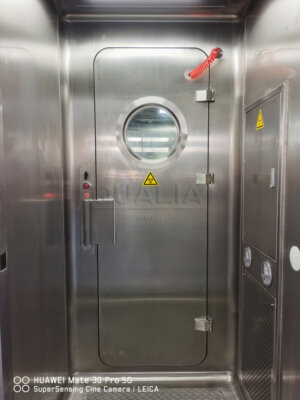
The door interlock on a VHP pass box is not only a contamination barrier — it is a validation evidence anchor. The requirement that both doors cannot open simultaneously and that the clean-side door unlocks only after safe residue concentration is confirmed creates a physical and logical connection between cycle completion and transfer authorization. When that logic is correctly implemented and recorded, the cycle record can reconstruct exactly when the chamber was accessible and under what conditions.
The validation challenge is not the interlock itself but what is captured around it. A cycle record that shows only final parameter values — peak concentration, total cycle time, final temperature — does not demonstrate how the cycle progressed or when the interlock conditions were met. A complete evidence trail links injection onset, dwell duration, aeration phase progression, residue concentration at door release, and any alarms or deviations in sequence, tied to timestamps that allow a reviewer to follow the cycle from initiation to transfer authorization as a connected record.
| Evidence Element | Persyaratan | Tujuan Dokumentasi |
|---|---|---|
| Sistem Interlock Pintu | Prevents both doors from opening simultaneously; clean-side door unlocks only after safe residue concentration is reached. | Links door release to aeration completion, preventing premature cross-contamination. |
| Recordable Cycle Parameters | Must capture temperature, humidity, sterilization time, VHP concentration, and time curve. | Provides a complete profile linking injection, dwell, and aeration stages for review. |
| Audit Trail & Electronic Signatures | Equipment includes audit trail and e-signature functions for compliance with computerized validation software. | Ensures data integrity and regulatory acceptance of cycle records. |
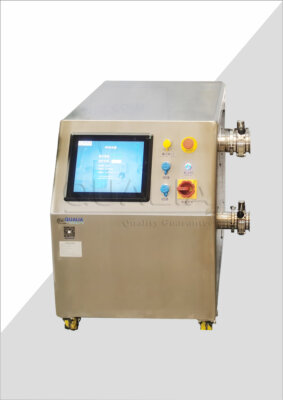
Audit trail integrity and electronic signature functions are planning criteria for regulatory defensibility, not optional enhancements. Without them, a cycle record that was correctly generated and physically accurate is still difficult to defend during change control or inspection because data integrity cannot be demonstrated through the record itself. This is a gap that appears not at the time of execution but at the point of review, which is why equipment specification — not just cycle development — should include confirmed audit trail capability before qualification begins. Equipment such as the Kotak Pass VHP should be evaluated at procurement stage for whether its control system produces a record format that satisfies data integrity review, not retrofitted after the fact.
Validation Package for VHP Pass Box Release
A validation package is only as strong as its weakest component, and the weakest component is rarely the biological challenge test — it is usually the absence of documented rationale connecting individual study results to each other. Distribution studies, chamber integrity data, biological challenge outcomes, and airflow qualification each address a distinct dimension of cycle assurance. Presented in isolation, each can appear satisfactory. The question a reviewer will ask is whether they collectively demonstrate that the cycle is reproducible, the chamber is contained, and the load configuration used in the study is the one that will be used in operation.
Chamber leakage integrity — with a design-level reference figure of ≤0.5% VOL/h under 100 Pa — establishes that the chamber retains vapor under cycle conditions, which is a prerequisite for both distribution uniformity and biological kill data to be meaningful. If the chamber leaks during the dwell phase, cycle parameters measured inside the chamber do not represent what actually occurred, and biological indicator results cannot be reliably attributed to the intended cycle. Leak verification should be treated as a precondition to distribution and challenge testing, not as a parallel or post-hoc check.
HEPA integrity, air velocity, and recovery testing per ISO 14644-3 address the aeration side of the package — confirming that the airflow system supporting residue clearance performs as specified. These are testing-framework references: ISO 14644-3 governs the test methods, not VHP pass box validation as a discipline. Their inclusion in the package matters because aeration performance is directly tied to the residue clearance basis discussed earlier; an aeration system that underperforms will affect the time-to-clearance relationship established during cycle development.
| Komponen Validasi | Key Requirement / Acceptance | Standard / Reference |
|---|---|---|
| Parameter Development | Establish cycle parameters (injection, dwell, aeration) through development runs. | Internal protocol basis. |
| VHP Distribution Studies | Verify VHP distribution across chamber, especially in weak-circulation zones. | Validation package requirement. |
| Biological Challenge Tests | Demonstrate 6-log and 12-log reduction using B. stearothermophilus indicators in worst-case positions. | BIs per standard. |
| Chamber Leakage Integrity | Leakage rate ≤0.5% VOL/h under 100 Pa, verified by automatic leak detection. | Chamber tightness test. |
| Airflow and Filter Performance | HEPA integrity tests, air velocity tests, and recovery tests per ISO 14644-3. | ISO 14644-3. |
The gap that most often delays package acceptance is not missing data but missing linkage. Parameter development runs that informed cycle selection should be traceable to the distribution study design. Distribution study results should be traceable to BI and CI placement rationale. Biological challenge outcomes should be traceable to the specific load pattern that was tested. If any of those connections cannot be reconstructed from the package documentation, the package is incomplete regardless of whether each individual study achieved its acceptance criterion.
VHP pass box qualification becomes difficult to defend when the validation work was designed around what the chamber can do under ideal conditions rather than what the worst-case geometry and load configuration demand. The most concrete judgment a team can make before committing to a validation protocol is whether the BI placement rationale, load pattern specification, and aeration endpoint basis can each survive a line-by-line review — not because the studies passed, but because the documentation demonstrates why those conditions were the hardest to achieve. If any of those three cannot be explained from the records alone, the gap will surface at audit even when the underlying cycle performed correctly.
Before releasing a validation package, confirm that the cycle record format supports full sequential reconstruction — injection, dwell, aeration, door status, alarms, and residue at release — as a linked, timestamped data trail with verifiable integrity. Confirm that the load pattern tested in validation is the pattern locked in the operating procedure, with no latitude for configuration drift. And confirm that the aeration endpoint criterion is tied to a measurable outcome, not elapsed time alone. Those three checkpoints identify where most requalification cycles originate before they become necessary.
Pertanyaan yang Sering Diajukan
Q: Does this validation framework apply if the VHP pass box shares a generator with other equipment rather than having a dedicated integrated unit?
A: The framework still applies, but shared generator configurations introduce a variable the article’s guidance does not cover: cycle reproducibility depends on whether the generator delivers consistent VHP concentration to the pass box independent of demand elsewhere in the system. Before applying the BI placement rationale and load pattern controls described here, confirm that the generator can be isolated and characterized specifically for the pass box chamber. Distribution studies run under shared-generator conditions without that confirmation will not reliably represent routine operation, and biological challenge results tied to those studies will carry an unresolved source of variability.
Q: At what point should load pattern controls be revisited after initial release — and what change would trigger a formal requalification rather than just a procedure update?
A: Any change that alters the surface exposure geometry tested during validation should trigger requalification, not only a procedure revision. That threshold includes changes in package dimensions, tray count, stack height, or item orientation that could create or enlarge a shadow zone not present in the original load configuration. A procedure update is appropriate only when the change is demonstrably within the already-tested geometric envelope — for example, substituting an item of identical dimensions and surface material. If that correspondence cannot be established by comparing the change to the validated load pattern documentation, the safer position is to treat it as a requalification trigger.
Q: How should a team handle the aeration endpoint criterion if the control system only supports elapsed-time release and cannot output a residue concentration reading?
A: The immediate consequence is that door release cannot be tied to a confirmed residue concentration, which weakens the evidentiary basis the article identifies as the defensible standard. In this situation, the team must establish through separate residue measurement studies — conducted across a defined range of ambient temperature and humidity conditions — that the fixed time parameter reliably corresponds to clearance below the ≤1 PPM threshold before the material release decision is made. Those correlation studies become part of the validation package and must be repeated if cycle conditions change. This is an equipment specification gap best resolved at procurement rather than worked around during validation.
Q: Is a 6-log biological challenge sufficient for all VHP pass box applications, or does the required log-reduction depend on the downstream use of transferred materials?
A: The appropriate log-reduction program depends on the decontamination claim being made and the regulatory context of the application, not on chamber size or cycle duration alone. A 6-log reduction is a standard reference program, but applications where transferred materials contact sterile drug product, or where the pass box serves a higher-classification environment, may require a 12-log program or a different biological kill claim entirely. The article identifies both programs as components of a validation package without specifying which applies to a given context. That determination should be made against the facility’s contamination control strategy and any applicable product-specific or regulatory requirements before the validation protocol is written.
Q: If the validation package is complete and each study meets its acceptance criterion, what is the most common reason it still fails regulatory review?
A: The most common failure point is missing traceability linkage between studies, not deficient individual results. A reviewer will ask whether the load pattern used in the biological challenge study is the same one locked into the operating procedure, whether the BI placement rationale is traceable to the distribution study output, and whether the cycle parameter development runs are connected to the distribution study design. If those connections cannot be reconstructed from the package documentation in sequence — without relying on verbal explanation or supplementary emails — the package is treated as incomplete regardless of passing outcomes. The documentation structure, not the test results, is what audit pressure most frequently exposes.
Konten Terkait:
- VHP Decontamination for BSL-3 Laboratories: Cycle Development, BI/CI Evidence and Material Compatibility
- VHP Pass Box for Biosafety: When Hydrogen Peroxide Is Required
- Kotak Lulus Keamanan Hayati: Panduan Jenis dan Pemilihan untuk Aplikasi BSL
- BSL-3 Pass Box and Dunk Tank Selection for High-Risk Material Transfer
- Biosafety Pass Through Box: Design and Containment Requirements
- Pass Box di Farmasi: Persyaratan GMP dan Panduan Konfigurasi
- VHP Decontamination Acceptance Criteria for BSL-3/4 Transfer and Room Decontamination Systems
- Jenis Kotak Masuk di Farmasi: UV Dinamis Statis atau VHP?
- VHP Sterilization of Isolators: Cycle Validation for GMP Compliance