Quotes that arrive back without a containment performance number, without a clear passthrough interlock specification, or without any reference to your facility’s ventilation cascade are not bids — they are catalog printouts with a project header. The gap between what procurement asks for and what validation eventually needs to prove tends to surface first at FAT or IQ, by which time fabrication is complete and the cost of realignment is measured in schedule weeks and change orders rather than revision hours. The document that controls that gap is the URS, and the most consequential decisions it contains are made before the RFQ is sent, not after. What follows will help you judge whether your URS is actually ready to generate comparable, verifiable supplier responses — or whether it will produce exactly the bids that are hardest to qualify.
Containment functions to define before quotation
The first failure pattern in high-containment URS development is writing requirements that address either cGMP air quality أو BSL-class biosafety containment, but not both at the same time. The two frameworks impose overlapping but distinct demands — pressure cascade direction, HEPA filtration redundancy, decontamination agent compatibility, waste stream handling — and a supplier scoping only one of them will produce a design that requires structural remediation to satisfy the other. The URS must make both frameworks explicit as a joint specification intent, not as separate annexes that nobody reconciles.
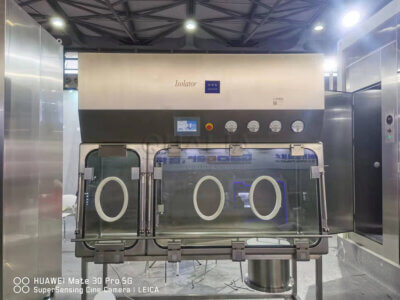
Physical barrier design is the second area where scope gaps are most expensive to correct post-fabrication. Glove port configuration — number, diameter, and reach distance — determines ergonomic access to the full work envelope; a glove port layout that clears the URS but fails reach testing during IQ means either rework or operator deviation in routine use. HEPA supply and double HEPA exhaust, decontamination system type (VHP being the most common for isolators), waste disposal connection geometry, and alarm logic for containment breach conditions all need to be explicit requirements, not assumed inclusions. If a requirement is not in the URS, it is not in the scope, regardless of what a supplier’s standard product includes.
Work deck surface requirements deserve their own requirement block. Smooth, non-porous construction with minimal seams affects both cleaning validation and long-term decontamination efficacy; specifying surface geometry, material class, and compatibility with the intended decontamination agent — VHP, liquid sporicide, or other — gives suppliers a material selection constraint they can quote against. Without it, you may receive a fabrication in a material that is technically cleanable but fails cycle efficacy testing under your validated VHP protocol.
Utilities and room interfaces that shape supplier scope
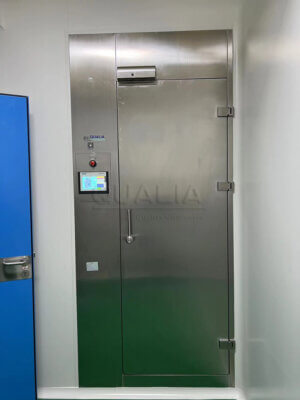
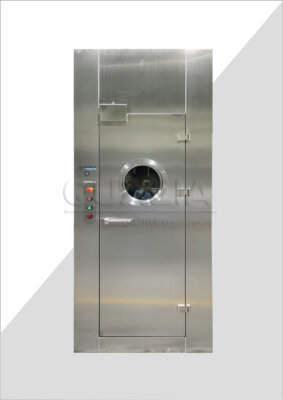
Passthrough configuration is one of the most underspecified areas in early-stage URS documents, and it is one of the most expensive to change once construction has begun. The number, size, and type of passthroughs — including whether interlocking doors are single or double — directly determines containment integrity at the transfer boundary. The URS should specify sealed leak-proof construction, interlock logic, and the decontamination procedure that applies at each passthrough interface. Omitting these details produces quotes that assume a standard passthrough configuration that may be incompatible with your airlock layout or transfer SOP.
Facility layout constraints need to be stated as actual dimensions and service connection requirements, not as general instructions to “coordinate with the building.” Equipment placement relative to the room’s pressure cascade, service penetration locations for electrical, plumbing, and ventilation, and workflow routing that aligns with the intended SOP sequence are all inputs that affect whether the installed system can be commissioned without structural modification. A supplier who does not know that a ventilation connection must maintain a specific negative pressure differential relative to the adjacent corridor cannot quote for a system that will reliably hold that cascade.
The fumigation operability requirement illustrates a utility interface that procurement frequently omits. Specifying the decontamination agent is not sufficient; the URS should also state how the isolator seals for a fumigation cycle, what total downtime per cycle is operationally acceptable, and what the scheduling consequence is for connected systems. A fumigation cycle that requires twelve or more hours of downtime affects facility throughput planning — that constraint belongs in the URS as a defined acceptance limit, not as an operational discovery during commissioning.
For projects involving BSL-3/4 module laboratories, the interface between the module’s built-in containment systems and any separately procured equipment needs a defined scope boundary in the URS. Where the module’s ventilation system ends and the equipment’s local exhaust begins, and how those two systems maintain the pressure cascade together, cannot be left for the integration phase to determine.
Acceptance evidence linked to each requirement
A URS requirement that cannot be assigned a verification method is not ready for quotation — it is a gap that will either block qualification or produce a rationale document that is difficult to defend under inspection. The discipline of classifying each requirement by how it will be verified — document, inspection, test, or approved rationale — is drawn from the logic that runs through مجلد EudraLex المجلد 4 الملحق 15 and is formalized in ASTM E2500-25. It is not the only acceptable framework, but the underlying principle is consistent: acceptance criteria must be verifiable, and the method must be defined before the equipment is built, not after it arrives.
For containment performance specifically, the requirement chain matters. The URS should state the Occupational Exposure Limit (OEL) for the material of concern, define a Containment Performance Target (CPT) in µg/m³ derived from that OEL with appropriate dilution factors, and require the supplier to propose a Containment Performance Limit (CPL) that demonstrably falls below the CPT. That CPL then becomes the acceptance criterion for SMEPAC or APCPPE testing. Without this chain, the requirement becomes “shall contain potent compounds,” which no test protocol can anchor to a pass/fail decision.
Failure mode coverage is the part of acceptance evidence that is most commonly left to the qualification phase. Requiring the supplier to identify failure modes using a recognized method — FMEA, FMECA, HAZOP, or HACCP — and to integrate failure mode testing into the overall verification protocol shifts that work appropriately upstream. The method is less important than the coverage: normal performance testing and failure scenario testing must both be addressed before the first qualification protocol is drafted.
Each evidence class carries a different burden and a different inspection profile.
| Evidence Class | What It Means | High‑Containment Example |
|---|---|---|
| المستند | Supplier‑provided records that confirm a specification without physical testing (certificates, data sheets, material declarations). | Material compatibility certificates showing resistance to VHP and decontamination agents. |
| الفحص | Visual or dimensional check that the installed equipment matches the design and layout requirements. | Verify glove‑port reach distances and passthrough interlock operation against URS drawings. |
| الاختبار | A controlled procedure that generates measurable data to confirm a performance target is met. | SMEPAC/APCPPE testing to demonstrate the Containment Performance Limit (CPL) stays below the defined CPT. |
| Approved Rationale | A documented justification accepted by stakeholders when direct evidence cannot be generated (e.g., based on engineering analysis or risk assessment). | Rationale for why a specific failure mode is considered sufficiently mitigated without a dedicated physical test. |
The approved rationale category is frequently misused. It should apply where direct test evidence genuinely cannot be generated and where the engineering or risk-based justification is documented, reviewed, and accepted by all relevant stakeholders before qualification begins — not as a post-hoc explanation for a test that was not planned.
Procurement wording that avoids catalog-only responses
The structural problem with catalog-based URS language is not that it produces technically false requirements — it is that it produces requirements that are true of the supplier’s standard product but not necessarily true of the installed, site-integrated, validated system. When a buyer takes performance statements from a supplier’s datasheet and restates them as URS requirements, the RFQ has been written to confirm a product already exists, not to define what the site needs. The result is non-comparable bids, because any supplier with a different standard configuration will either not respond or will caveat extensively, and the buyer cannot evaluate those differences against a site-specific acceptance baseline.
The OEL-to-CPT-to-CPL chain is the most reliable mechanism for replacing vague language with enforceable, comparable requirements. It forces suppliers to respond with a specific, measurable claim about their equipment’s performance relative to a number the buyer has defined — and it establishes the test basis for verifying that claim. An occupational hygienist should be involved in defining the measurement strategy, particularly where the CPT sits near the lower end of the OEB band, where small differences in how a test is conducted can change the result enough to affect supplier selection.
| If the URS uses … | المخاطر | What the URS should specify instead |
|---|---|---|
| Generic containment claims (“suitable for potent compounds”) | Suppliers interpret “potent” differently; no measurable acceptance criterion. | State the OEL, define a CPT in µg/m³, and require the supplier to propose a CPL below the CPT with a measurement strategy (e.g., SMEPAC/APCPPE). |
| Feature lists taken from supplier catalogues | Quotes repeat standard equipment specifications that may not match the facility layout, cleaning boundaries, or validation needs. | Write requirements around intended containment functions, room interfaces, utilities, controls, alarms, cleaning boundaries and maintenance access—tied directly to site SOPs and layout constraints. |
Maintenance access language is a specific area where catalog-based URS documents consistently underperform. Suppliers will quote for a system that can be maintained — but unless the URS specifies maintenance access requirements within the containment boundary, including how maintenance personnel are protected during access and how the system is decontaminated before maintenance begins, the operational consequence of that gap falls on the biosafety and engineering teams who inherit the installed equipment. For عازل OEB4/OEB5 procurement in particular, maintenance access through containment barriers is a design constraint that must be resolved in the URS, not during commissioning.
Cross-review by QA, biosafety and engineering
The bottleneck between a URS and a usable RFQ is not usually a documentation problem — it is an alignment problem. Procurement timelines often compress or skip the cross-review step, and the consequence is an RFQ that prices requirements QA cannot later verify, omits controls biosafety needs to sign off on, and creates integration conflicts that engineering discovers during installation. Catching those misalignments before the RFQ is sent costs hours; catching them during FAT or IQ costs weeks, and occasionally requires fabrication changes that affect the entire qualification basis.
The cross-review should move across nine areas of the URS: planning, facility design, process design, commissioning, disinfection, waste, pipework, human factors, and electrical safety. HSE’s 94-question set covering these areas provides a concrete review instrument rather than a general checklist — using it during cross-review surfaces specific gaps in how the URS addresses, for example, seal integrity for fumigation, pipework penetrations through containment barriers, and fail-safe behavior of alarm and interlock systems.
| Review Topic | What to Check in the URS |
|---|---|
| التخطيط | Biosafety level classification, project scope alignment, and containment strategy are clearly stated. |
| تصميم المنشأة | Room interfaces, equipment placement, ventilation, and containment barriers are defined. |
| Process design | Workflow, material transfer, and passthrough configurations align with SOPs. |
| التكليف | Acceptance criteria and verification methods are linked to each requirement. |
| التطهير | Fumigation cycle requirements, seal‑ability of the isolator, and downtime per cycle are specified. |
| النفايات | Waste disposal connections, leak‑proof design, and decontamination‑of‑waste provisions are addressed. |
| Pipework | Service penetrations and utility connections are detailed to maintain containment integrity. |
| Human factors | Operator access, glove‑port reach, and maintenance ergonomics are considered. |
| السلامة الكهربائية | Alarm systems, interlocks, and fail‑safe conditions for containment breaches are defined. |
Early regulator engagement is a practical risk reduction measure, not a universal legal requirement — but where the project involves BSL-3 or BSL-4 classification, reviewing the URS against guidance such as BMBL, ACDP, and HSE SPC before construction begins is significantly less costly than responding to a regulatory observation after the system is installed. The cross-review stage is the appropriate point to identify whether any containment strategy or design choice in the URS is likely to require regulatory justification, and to document that justification while the design can still be modified. See also the related treatment of BIBO vendor evaluation for EPC projects for how documentation requirements translate into supplier selection criteria at a different interface.
URS readiness threshold before sending the RFQ
Sending an RFQ before the URS meets a defined readiness threshold does not accelerate procurement — it defers the cost to qualification. Suppliers quote to what is written. If what is written is incomplete, ambiguous, or unverifiable, the bids will reflect that ambiguity: some suppliers will fill gaps with assumptions, others will exclude anything not explicitly specified, and none of the responses will be directly comparable on the items that matter most for validation.
The OEL-to-CPT alignment is the requirement that most frequently fails this threshold. Toxicologists applying different assessment frameworks to the same compound can produce OEL estimates that differ by a factor of three. If the design target is set at the wrong point within an OEB band — or at the wrong band entirely — the supplier will fabricate to the wrong containment level. Correcting that after fabrication is expensive; correcting it after qualification has started may require the qualification to be restarted. Setting the CPT at the OEL or at the lower boundary of the applicable OEB band, with that decision documented and reviewed before the RFQ is issued, eliminates a category of risk that cannot be recovered from cheaply.
| Readiness Criterion | ما أهمية ذلك |
|---|---|
| Each URS requirement is classified with a verification method (document, inspection, test, or approved rationale). | Avoids sending an RFQ where acceptance cannot later be proven, which blocks validation. |
| Containment design target is set at the OEL or bottom of the OEB band, and a CPT is defined. | Eliminates ambiguity in supplier quotes and prevents cost overruns from over‑specification or safety gaps from under‑specification. |
| A risk assessment identifies safety‑critical components, their specifications, and arrangements for monitoring and maintenance. | Ensures that safety‑critical elements are designed to be qualifiable and are not overlooked during procurement. |
The third readiness criterion — a risk assessment identifying safety-critical components, their specifications, and monitoring and maintenance arrangements — is also the mechanism by which the URS connects to downstream qualification. Safety-critical components that are not identified in the URS do not have acceptance criteria in the qualification protocols. That is not a paperwork gap; it means the qualification cannot demonstrate that those components perform as required, which creates an audit exposure that compounds across every inspection cycle after installation.
A URS that is genuinely ready to support high-containment equipment procurement will have three properties: every containment function is stated as a site-specific requirement with a defined verification method; the CPT is derived from the actual OEL for the materials and operations involved; and the document has been reviewed across QA, biosafety, engineering, and operations before it leaves the building. These are not procedural steps — they are the decisions that determine whether the bids you receive can be evaluated on merit and whether the qualification you run after installation can be completed without scope renegotiation.
What to confirm before issuing the RFQ: can every requirement in the URS be satisfied by a document, inspection, test, or approved rationale that you have already defined? If any requirement cannot be answered that way, the URS is not complete — and the project cost of completing it increases at every stage that follows.
الأسئلة المتداولة
Q: What should we do if our QA, biosafety, and engineering teams cannot align on requirements before the procurement deadline?
A: Delay the RFQ rather than issue it with unresolved gaps. Cross-functional misalignment at the URS stage produces bids that cannot be compared on scope, and any ambiguity procurement decides to “resolve later” will reappear as a qualification dispute after fabrication is complete — at significantly higher cost. If time pressure is the driver, the faster path is a structured cross-review session focused on the nine areas most likely to produce RFQ gaps (planning, facility design, process design, commissioning, disinfection, waste, pipework, human factors, electrical safety) rather than circulating a draft and waiting for asynchronous comment.
Q: Does this approach still apply if the equipment is a standard catalog product rather than a custom build?
A: Yes, and the risk is higher with catalog products. A supplier responding to an underdeveloped URS with a standard product will scope to their default configuration — which may satisfy the URS as written while missing site-specific acceptance needs such as your facility’s pressure cascade interface, your validated VHP cycle parameters, or your maintenance access requirements within the containment boundary. The URS defines what the installed, integrated, validated system must do at your site; catalog performance claims are supplier-side data, not buyer-side acceptance criteria.
Q: At what point does adding more buyer-defined requirements start creating problems rather than reducing ambiguity?
A: The practical limit is reached when requirements are defined at a level of detail that forecloses engineering solutions the supplier is better positioned to determine — for example, specifying a proprietary seal geometry rather than a leak-rate performance target and test method. The discipline that keeps requirements on the right side of that line is tracing each one back to a containment function, room interface, or acceptance outcome: if a requirement describes what the system must achieve and how achievement will be verified, it belongs in the URS. If it describes how the supplier must build the system, it is a design constraint that should only appear if there is a site-specific reason the supplier’s judgment cannot be trusted on that point.
Q: How should the OEB band be selected when toxicologists on the project team disagree on the OEL estimate?
A: Set the Containment Performance Target at the lower of the contested OEL values and document the basis for that decision before issuing the RFQ. Because toxicologists applying different frameworks to the same compound can produce estimates that differ by a factor of three, designing to the more protective figure eliminates the risk of fabricating to the wrong containment level. Correcting a containment performance shortfall after fabrication is expensive; correcting it after qualification has started may require the entire qualification to be restarted. The documented rationale for the conservative selection also provides an audit trail that defends the design target under regulatory review.
Q: After the RFQ is issued and bids are received, how should responses be evaluated when suppliers have proposed different CPL values?
A: Compare each proposed CPL against your defined CPT as the primary filter — any CPL at or above the CPT is a disqualifying gap, not a negotiating point. For bids where the CPL clears the CPT, evaluate the proposed test methodology (SMEPAC or APCPPE), the measurement strategy, and whether the supplier has involved an occupational hygienist in defining it. A CPL that is numerically low but supported only by internal testing without a defined measurement strategy offers weaker assurance than a more conservative CPL with a fully specified, independently validated protocol. The bid comparison should be structured around verifiability of the containment claim, not the CPL number alone.
المحتويات ذات الصلة:
- URS and RFQ Scope for High-Containment Equipment: Requirements, Supplier Evidence and Validation Boundaries
- OEB4/OEB5 Containment Performance and SMEPAC Testing Guide for HPAPI Isolator Projects
- كيفية كتابة URS لنظام BIBO في مشاريع ممارسات التصنيع الجيدة والسلامة البيولوجية
- OEB4 vs OEB5 Containment: OEL, OEB Banding and Containment Performance Target Logic
- أفضل موردي مانع التسرب الهوائي للأبواب الهوائية | دليل اختيار البائعين
- مورد معدات EDS | معايير التقييم | دليل الاختيار | دليل الاختيار
- اختيار الموردين لمولدات الطاقة الشمسية عالية الحرارة | معايير تقييم الموردين وأفضل الممارسات
- اطلب عرض أسعار لمعدات مختبرات BSL-3 ومختبرات معيارية من شركة QUALIA
- كيفية التحقق من مواصفات معدات التعقيم بالحرارة العالية جداً قبل الشراء