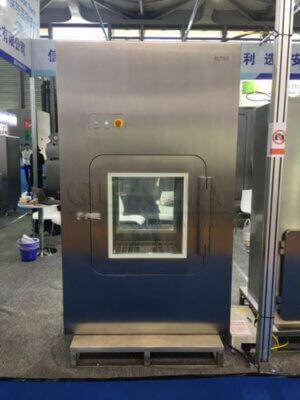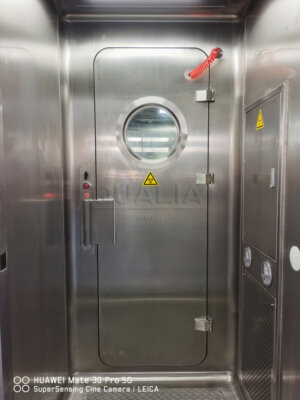

Facility teams that defer mist shower infrastructure decisions until equipment delivery regularly encounter the same set of compounding problems: a drain that cannot achieve passive gravity flow to the effluent decontamination system, an exhaust connection routed into the building return air by default, and an interlock wiring approach chosen without understanding its implications for biosafety inspections. Any one of these gaps can delay commissioning by weeks or trigger a change order that restructures mechanical and electrical work already completed. The decisions that determine whether installation proceeds cleanly are not made during installation — they are made during design coordination, and the consequences of deferring them arrive later as rework. What follows gives facility engineers, project managers, and biosafety officers the judgment framework to evaluate each critical decision before equipment is on site.
Pre-installation design coordination: the infrastructure decisions that must be resolved before equipment arrives on site
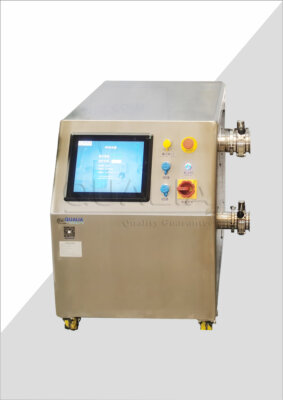
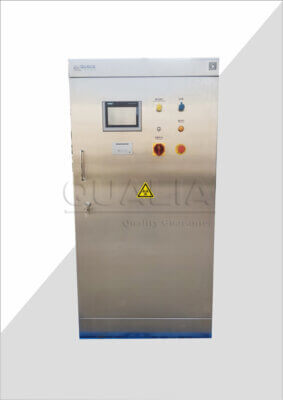
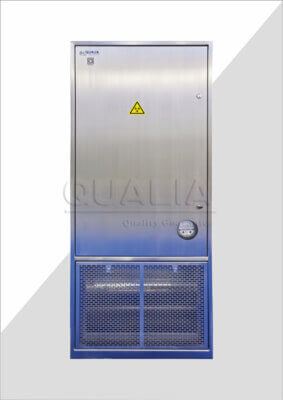
A mist shower installation does not begin when the unit arrives — it begins when the mechanical, electrical, and process engineering teams agree on how the unit connects to the building. The decisions that seem administrative at the design phase are the ones most likely to produce field conflicts: Where does the control cabinet mount? Is it above the unit or adjacent to it? What pre-wired cable configurations are specified, and have those specifications been communicated to the electrical subcontractor before rough-in begins?
Cabinet location determines conduit routing, which in turn determines whether the electrical rough-in — often completed weeks before equipment delivery — places junction boxes and conduit stubs in positions that actually align with the unit’s connection points. When pre-wired cable lengths are not specified before fabrication, installers frequently discover that factory cable runs are too short for the as-built cabinet position, or too long to be managed cleanly in the available space. Neither problem is insurmountable, but both consume commissioning schedule that is rarely built into the project timeline.
The four decisions that must be locked before the equipment arrives are: drain routing and EDS inlet elevation, exhaust connection point and filtration specification, interlock type and wiring method, and chemical supply reservoir location relative to the unit. Resolving these in parallel with equipment procurement — not sequentially after it — is the difference between a two-week installation and one that extends into the next quarter.
Drain and effluent routing: floor drain sizing, gradient requirements, and connection to effluent decontamination systems
The drain system in a mist shower installation is not a passive convenience — it is an active containment control. If effluent does not clear the shower floor completely before the second door is released, personnel can exit before the decontamination cycle finishes. The design target that addresses this risk is complete drainage within approximately 90 seconds of cycle completion, which requires both adequate drain diameter and sufficient floor gradient to move fluid without pooling.
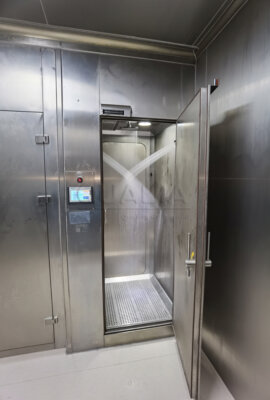
A minimum 50 mm diameter floor drain is the practical baseline for achieving that drainage rate. The mist shower unit itself includes an integrated drain pan with a removable stainless steel grid, which provides cleaning access and prevents debris from obstructing the drain connection — a maintenance detail worth confirming is accessible after the unit is fully positioned and secured. The drain pan design assumes the field connection to the building drain system is sized to match or exceed the pan outlet; undersizing the field connection introduces a restriction that defeats the drainage timing regardless of what is designed above it.
The elevation relationship between the shower floor drain and the Effluent Decontamination System — EDS inlet is the most consistently missed coordination point on these projects. When the EDS is installed on a lower floor with its inlet below the shower drain elevation, passive gravity drainage is straightforward. When the EDS inlet sits at or above the drain elevation — a scenario that occurs when the EDS is located on the same floor or when building constraints place it higher than initially assumed — gravity drainage becomes unreliable or impossible. A transfer pump must then be added to the system, which introduces a new point of failure, a power dependency, and often a change order that affects both the mechanical and electrical scopes. This is a detail that can be confirmed from architectural drawings before design is finalized, and it almost never is.
Exhaust air handling: why mist shower chambers require dedicated containment exhaust rather than building return air
The interior of a mist shower chamber during an active decontamination cycle contains aerosolized chemical agent suspended in a fine water mist. That aerosol must go somewhere when the cycle runs, and where it goes is determined entirely by how the exhaust connection is made during installation. If the exhaust port is connected — even temporarily or by default — to the building’s return air system, aerosolized decontaminant enters shared ductwork and distributes into adjacent spaces. This is not a theoretical risk; it is the documented consequence of inadequate HVAC coordination on containment projects, and it typically becomes apparent during the first operational test when personnel in adjacent corridors report chemical odor.
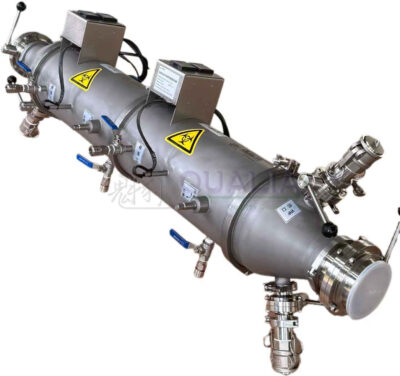
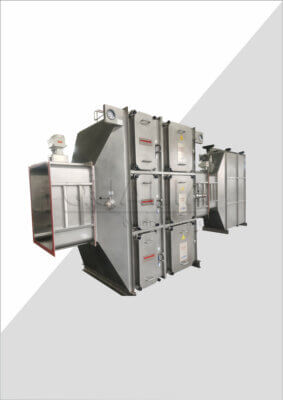
The correct routing connects the mist shower chamber exhaust to a dedicated containment exhaust stack that does not share pathways with general building air. Before that connection is made, a HEPA filter with a coalescent pre-filter should be specified in the exhaust stream. The coalescent pre-filter captures liquid aerosol droplets before they can saturate and compromise the HEPA media — omitting it shortens HEPA service life significantly and may allow breakthrough during high-volume spray cycles. ANSI/ASHRAE/ASHE Standard 170 provides the ventilation framework for health care facilities that establishes the principle of separating containment exhaust from recirculated air, and that principle applies with equal force to high-containment laboratory and pharmaceutical environments where aerosolized biocides are in use.
The coordination failure pattern is consistent: the HVAC design team specifies the containment exhaust stack for the biological safety cabinet network and the autoclave room, but the mist shower — added late in the design or treated as mechanical equipment rather than containment infrastructure — gets connected to whatever exhaust is available near the installation point. Catching this requires explicitly identifying the mist shower exhaust on the HVAC routing drawings and confirming the connection point with the mechanical engineer before rough-in.
APR door interlock wiring: hard-wired versus BMS-integrated options and the security implications of each
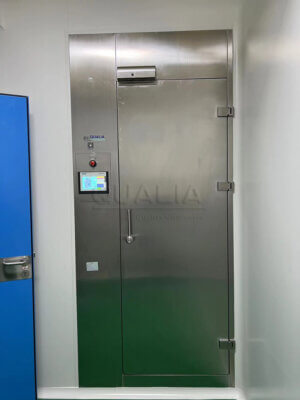
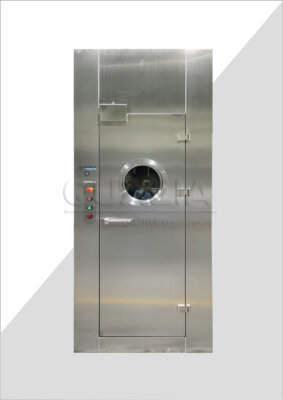
The door interlock on a mist shower enforces the exit sequence: the outer door cannot open until the shower cycle completes and the inner door is secured. This is the functional core of the system’s containment assurance, and the method used to implement the interlock determines how reliably that assurance holds under real operating conditions, including maintenance windows and system outages.
Hard-wired electromagnetic interlocking operates independent of software state. The physical circuit controlling the outer door release cannot be satisfied until the cycle completion signal closes the relay — there is no configuration change, maintenance mode, or software patch that creates a pathway around it. BMS-integrated interlocks use software logic to enforce the same sequence, which means the interlock condition is only as reliable as the BMS process running it. During BMS maintenance windows, software updates, or system restarts, the interlock logic may be in an indeterminate state. Biosafety inspectors at facilities handling Select Agents or operating under formal regulatory oversight routinely identify this as a documented security gap — not because BMS integration is inherently unsafe, but because the bypass pathway exists and must be accounted for in the facility’s biosafety plan.
| Interlock Type | الخصائص الرئيسية | Primary Regulatory/Operational Context |
|---|---|---|
| Hard-wired | Elector magnetic interlocking system; guarantees exit sequence enforcement | Facilities handling Select Agents or under strict biosafety inspection |
| BMS-integrated | Software-controlled; less expensive to modify, but can be bypassed during BMS maintenance | Programs prioritizing operational flexibility and remote monitoring, not subject to Select Agent regulations |
The selection rule that follows from this is practical rather than absolute: specify hard-wired electromagnetic interlock when the facility handles Select Agents, operates under CDC/USDA Select Agent Program oversight, or faces biosafety inspections where interlock bypass pathways will be scrutinized. Specify BMS-integrated interlock when the operational priority is remote monitoring, flexible cycle parameter adjustment, and audit logging through the building automation system, and when the program is not subject to Select Agent regulations. Trying to satisfy both requirements with a single implementation often produces a hybrid configuration that is difficult to validate and harder to explain to an inspector.
Chemical supply and dosing system installation: reservoir positioning, feed line routing, and concentration verification points
The chemical supply system for a mist shower determines whether the decontamination cycle delivers consistent biocide concentration across every run. Inconsistent concentration — caused by dosing pump miscalibration, reservoir positioning that allows air ingestion, or feed lines that are not purged before the cycle completes — undermines the entire purpose of the system while leaving no visible evidence that anything is wrong.
Reservoir positioning should place the chemical supply above the dosing pump inlet to ensure consistent head pressure and prevent air entrainment at low fill levels. When an optional dosing pump with adjustable proportional rate is included in the configuration, the reservoir-to-pump elevation relationship becomes a specification detail that affects both feed line routing and the calibration procedure. Feed lines should be routed to minimize horizontal runs that can trap air pockets, and any high points in the line routing require attention during purge procedures before commissioning.
Concentration verification points — sample taps or inline sensor provisions — should be located downstream of the mixing point and upstream of the spray nozzles. This placement allows confirmation that the delivered concentration matches the intended cycle specification before the fluid reaches the chamber. For mist shower systems used in high-containment exit protocols, post-installation concentration verification is not optional; it is the evidence base that supports the facility’s decontamination efficacy claims during biosafety reviews. Specifying sample tap provisions in the installation drawings — rather than adding them after commissioning raises questions — avoids a field modification that is disproportionately disruptive once the system is enclosed and piping is finished.
Electrical and control system integration: power supply, interlock signal wiring, and BMS data points
Control system compatibility is where mist shower integration most often produces last-minute scope changes. The mist shower control architecture using a Rockwell/Allen Bradley PLC with a PanelView 800 HMI has specific implications for how interlock signals are wired and what data points are available for BMS communication. Facilities with existing Rockwell infrastructure have a straightforward integration path; facilities standardized on a different PLC platform need to resolve protocol compatibility — whether through gateway devices, hardwired discrete signals, or accepting that the mist shower operates as a standalone controller with manual data handoff — before the electrical design is finalized.
The PLC monitors air and water pressures to the fogging nozzles as part of cycle verification. These pressure readings are process-critical data points: if nozzle pressure falls outside the specified range during a cycle, the decontamination coverage may be incomplete. BMS integration that captures these values in real time gives operators documented evidence of cycle integrity for each run — a record that supports both internal quality systems and external biosafety audits. BMS integration that does not capture these points leaves a gap in the evidence chain that is difficult to fill retroactively.
The interlock signal wiring between the door control circuit and the PLC must be treated as safety-critical wiring and segregated from general facility low-voltage circuits. Ground loops, induced interference, or shared conduit with power circuits can produce intermittent interlock behavior that is extremely difficult to diagnose after installation is complete.
| Integration Area | Specific Component/Data Point | Purpose for BMS Integration |
|---|---|---|
| Control System Hardware | Rockwell/Allen Bradley PLC with PanelView 800 HMI | Ensures compatibility for interlock signal wiring and BMS data point communication |
| مراقبة العمليات | Air and water pressures to the fogging nozzles | Provides operational verification data for the mist shower cycle |
Power supply requirements — voltage, phase, amperage, and UPS provisions if the facility requires interlock continuity during power events — should be confirmed from the equipment submittal drawings, not estimated from catalog specifications. Confirm these with the equipment supplier during design, not during the electrical rough-in.
Pre-commissioning inspection checklist: the items to verify before the first operational test
Attempting the first operational test before completing a systematic pre-commissioning inspection tends to produce failures that obscure each other. A dosing pump that is not yet calibrated, a drain that has not been flow-tested, and an interlock that has not been signal-traced will all produce observable problems during the first run — but diagnosing them in combination takes far longer than catching each one individually before the test begins.
The pre-commissioning sequence should confirm the following before any cycle is initiated:
Drain and effluent routing: Verify drain gradient by flowing clean water through the chamber and timing complete clearance. Confirm the EDS connection is open, vented, and ready to receive effluent. If a transfer pump was added to address elevation mismatch, confirm pump operation and alarm condition independently.
Exhaust system: Verify the exhaust connection routes to the dedicated containment stack, not building return air. Confirm HEPA and coalescent pre-filter are installed and the housing seals properly. Check that exhaust flow is established before the first spray cycle.
Interlock verification: For hard-wired interlocks, signal-trace the door release circuit from cycle completion relay to door hardware without energizing the full system. For BMS-integrated interlocks, confirm the interlock logic is active and not in a maintenance bypass state. Document the as-verified interlock configuration.
Chemical supply: Verify reservoir fill level, confirm feed line purge, and take a concentration sample from the verification point downstream of mixing. Confirm dosing pump proportional rate matches the protocol specification.
Control system: Confirm PLC program version matches the commissioning specification. Verify nozzle air and water pressure readings appear on the HMI under a static pre-cycle check. Confirm BMS data points are live and logging.
Scheduling a Factory Acceptance Test with the supplier before shipment and a Site Acceptance Test after installation is complete ensures that each verification stage is formally documented — and that the supplier shares accountability for system performance before the facility takes operational ownership. The SAT is the appropriate moment to run the first full cycle, not a discovery exercise for infrastructure problems that pre-commissioning should have surfaced.
The practical judgment that this installation domain requires is knowing which gaps close themselves during commissioning and which ones require a change order, a structural modification, or a regulatory conversation. EDS inlet elevation, exhaust routing, and interlock type do not self-correct — they determine the cost and schedule of every subsequent step. Locking those three decisions during design, with the mechanical engineer, electrical engineer, and biosafety officer aligned, is what separates a clean installation from one that produces findings during the first inspection.
Before procurement is finalized, confirm the EDS inlet elevation against the shower floor drain, confirm the exhaust connection point on the HVAC routing drawings, and confirm the interlock type against the facility’s regulatory context. These are the three questions most likely to produce a different answer than the one currently assumed — and finding out during design costs far less than finding out after rough-in is complete.
الأسئلة المتداولة
Q: What happens if the EDS has already been installed at an elevation that makes passive gravity drainage impossible?
A: A transfer pump must be added between the shower floor drain and the EDS inlet — there is no workaround that restores passive gravity flow once the elevation relationship is fixed. This change introduces a new point of failure, a power dependency, and typically a change order that affects both mechanical and electrical scopes. If the EDS position is still adjustable, resolving the elevation conflict at that stage is significantly less expensive than retrofitting a pump after rough-in is complete.
Q: Can a facility switch from BMS-integrated interlock to hard-wired interlock after the system is already commissioned?
A: Yes, but it requires rewiring the door release circuit back to a dedicated hardwired relay rather than a software-controlled output — work that involves both the electrical contractor and the control system integrator. The more relevant consideration is timing: converting after commissioning means the facility has already operated with a documented bypass pathway, which may need to be disclosed and explained to a biosafety inspector reviewing the facility’s security plan history. Making the interlock type decision before installation avoids that conversation entirely.
Q: Is a mist shower installation subject to the ANSI/ASHRAE/ASHE Standard 170 exhaust requirements even though it is a laboratory setting rather than a health care facility?
A: Standard 170 does not directly govern laboratory facilities, but its principle of separating containment exhaust from recirculated building air is the applicable design standard that mechanical engineers use as a reference framework in high-containment laboratory and pharmaceutical environments. The practical obligation comes from the facility’s biosafety plan and regulatory oversight context — not from Standard 170 itself — but the exhaust separation requirement holds regardless of which standard is cited as the basis.
Q: How should a project team handle mist shower integration when the facility’s existing BMS or PLC platform differs from the Rockwell/Allen Bradley architecture used in the control system?
A: The options are gateway devices that translate between protocols, hardwired discrete signals that bypass the protocol question entirely, or accepting standalone operation with manual data handoff to the BMS. The right choice depends on which BMS data points are operationally required — if cycle pressure readings and interlock status need to appear in real-time facility monitoring, a gateway is typically the most reliable path. This decision must be made during electrical design, not discovered during control system integration on site, because it affects conduit routing, panel space allocation, and potentially the BMS software configuration on the facility side.
Q: At what project phase does it become too late to change the chemical dosing configuration without triggering significant rework?
A: Once the feed line routing is enclosed and the piping is finished, adding or relocating concentration verification points or changing the reservoir-to-pump elevation relationship requires reopening finished work. The practical deadline is before the mechanical rough-in for the chemical supply lines is completed — at that point, sample tap provisions, line routing adjustments, and reservoir positioning changes can still be incorporated without structural modification. Specifying these details in the installation drawings rather than treating them as field decisions is what keeps the option open.
المحتويات ذات الصلة:
- أنظمة الاستحمام بالضباب: مرجع تقني لإزالة التلوث من الأفراد BSL-3 و BSL-4
- أجهزة تعشيق الدش الهوائي: منع التلوث
- الاستحمام بالضباب مقابل الاستحمام بالهواء لإزالة التلوث من الأفراد BSL-3: أي بروتوكول خروج مناسب
- المواصفات الفنية للدش الضبابي: أبعاد الحجرة أبعاد الفوهة مخرجات الفوهة ومعايير المواد لمرافق GMP
- تكامل نظام إدارة المباني (BMS) لمختبرات السلامة الحيوية المعيارية: عناصر التحكم والإنذارات والأجهزة المتداخلة
- لوحات التحكم في الدش الهوائي: الإدارة الدقيقة
- تركيب الدش الهوائي: دليل الخبراء
- اختبار دش الهواء: التحقق من الأداء
- صيانة الدش الهوائي: نصائح للعناية الوقائية