
Procuring door hardware before the pressure scheme is resolved is one of the most expensive sequencing errors in BSL-3 facility design. Teams that treat the airlock as a simple transition corridor — rather than a defined pressure zone with a specific operational logic — often discover late in construction that the interlock controls, HVAC sizing, and door specifications were all configured around an assumption that contradicts containment requirements. Correcting that misalignment after procurement typically means simultaneous rework across mechanical, controls, and layout. The judgment that prevents this is straightforward but easily deferred: the pressure scheme, personnel flow sequence, and emergency state behavior must all be resolved before any hardware selection begins. What follows will help you evaluate those decisions in the order they actually affect project outcomes.
Entry and Exit Sequence Before Airlock Hardware Selection
The airlock’s physical configuration is downstream of the operational sequence, not the other way around. Before specifying door hardware, interlock logic, or HVAC supply and exhaust volumes, the entry and exit workflow must be fully described — because that workflow defines the spatial, mechanical, and control constraints that hardware must accommodate.
For BSL-3 personnel flow, the fundamental constraint is unidirectional airflow into the suite. Staff don protective clothing before entering the containment zone and remove it upon exit. That sequence is not incidental; it determines where gowning space must be provided, how long the airlock will be occupied during each transition, and whether the pressure differential will hold long enough across a complete donning or doffing cycle. If the airlock is sized or timed without accounting for PPE workflow, personnel may be pressured to rush transitions in ways that defeat the purpose of the interlock entirely.
The interlock requirement — preventing simultaneous opening of both airlock doors — follows directly from this sequence. It is a minimum configuration logic derived from the need to prevent a direct airflow path between the containment zone and the corridor. Treat it as a planning criterion that sets the floor for your control architecture, not as a universally codified specification that resolves all interlock questions on its own. The specific logic for door release sequencing, timing delays, and alarm conditions still requires deliberate design.
The practical implication is that any hardware selection meeting held before the workflow sequence is documented is premature. The workflow establishes dwell time, spatial requirements, and the behavioral envelope the interlock must enforce. Door hardware selected before those inputs are resolved will almost certainly require revision once the controls engineer attempts to write a sequence that does not yet have a complete process description to match.
Door Interlocks, Pressure Steps, PPE, and Emergency Override
The most consequential pressure scheme decision in a BSL-3 airlock is whether the space is designed as an air sink or an air bubble. A positive pressure air bubble — where the airlock is maintained at higher pressure than adjacent spaces — is standard in conventional pharmaceutical cleanrooms to prevent contamination from entering a controlled zone. In containment applications, it is the wrong scheme. The airlock must function as an air sink: maintained at negative pressure relative to both the corridor and the containment laboratory, so that any door manipulation or seal degradation draws air inward rather than pushing it outward.
This is not a nuisance distinction. If the airlock is designed as a bubble and a door gasket fails, or a door is held open longer than expected, the pressure differential actively pushes contaminated air toward the corridor. The air sink configuration inverts that risk: any breach draws air toward the contamination source rather than away from it.
WHO Laboratory Biosafety Manual guidance frames −12.5 Pa (−0.05 in. w.g.) as a design threshold for the pressure difference across each barrier door and at the laboratory boundary. That figure is useful as a verifiable commissioning target, but it should be understood as a planning reference drawn from WHO guidance, not a universal regulatory floor that automatically satisfies every national authority’s requirement for a given facility. Its value is in giving the HVAC and controls design team a specific number to engineer and verify against, rather than leaving differential pressure as a qualitative objective.
Personnel must also be able to verify inward airflow direction at the area entrance before each entry cycle. This is not procedural formality — it is a real-time confirmation that the pressure cascade is functioning before the first door is opened. A visual airflow indicator or a mounted differential pressure gauge at the entry point satisfies this requirement and gives operators a daily verification step that does not depend on reading a BMS screen.
Emergency override behavior requires explicit design. If the override releases both doors simultaneously for emergency egress, the containment logic is suspended at the moment it may be most needed. The alternative — allowing single-door release while maintaining the interlock on the second door — requires careful analysis of egress codes and emergency scenarios. Neither approach is automatically correct; the point is that the override state must be specified and validated, not left as an assumption in the control narrative.
| Design Requirement | المواصفات | طريقة التحقق |
|---|---|---|
| Airlock pressure scheme | Negative pressure relative to both adjacent spaces (air sink) | Design review; pressure mapping during commissioning |
| Minimum pressure differential at barrier doors | -12.5 Pa (-0.05″ w.g.) across each barrier | Differential pressure monitoring with alarm |
| Airflow direction at entrance | Personnel must verify inward airflow before entry | Visual indicator or airflow test at entry point |
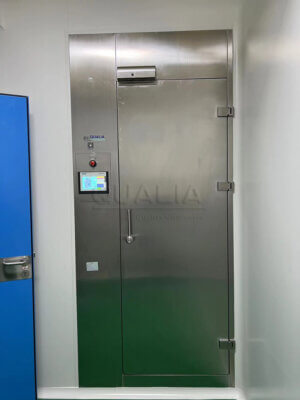
For facilities where door hardware must meet both containment sealing performance and interlock integration, ختم هوائي APR الأبواب are one hardware category designed around that combined requirement — though hardware selection should follow, not drive, the pressure scheme and interlock logic decisions described here.
Pressure Reversal and Nuisance Alarm Failure Modes
Pressure reversal in a BSL-3 airlock is not a random event — it is typically traceable to one of two root causes: the wrong pressure scheme was specified, or the HVAC system has a single point of failure. Both are preventable. Both are expensive to address after the system is installed.
The air bubble error is the more fundamental of the two. A team that defaults to positive-pressure airlock logic — drawing from GMP institutional knowledge rather than containment-specific design — may not realize the scheme is incompatible with BSL requirements until commissioning, when pressure mapping reveals that door manipulation produces outward airflow rather than inward. At that stage, correcting the pressure scheme requires revisiting HVAC supply and exhaust balance, possibly rerouting ductwork, and rewriting interlock logic that was written around the wrong pressure state. The mitigation is architectural: design the airlock as an air sink from the first layout sketch.
Single-unit HVAC failure is the operational vulnerability. A facility where a single air handling unit or exhaust fan serves the airlock and containment zone without redundancy will experience pressure reversal any time that unit trips offline — whether for a fault, a filter change, or a motor failure. Redundant backup AHUs or independent exhaust fans are the mitigation planning criterion here, though whether this configuration is a mandatory requirement or a strongly recommended practice depends on the governing authority and the specific facility’s risk classification. What is not ambiguous is the consequence of its absence: any unplanned HVAC outage without redundancy produces a loss of differential pressure that is, at minimum, a containment deviation and, depending on the activity in progress, a personnel safety event.
| مخاطر الفشل | العواقب | Mitigation Requirement |
|---|---|---|
| Positive pressure airlock (air bubble) used in BSL containment | Contamination may leak outward during door manipulation | Design airlocks as air sinks (negative to both adjacent spaces) |
| Single HVAC unit or exhaust fan failure | Pressure reversal and loss of containment envelope | Provide redundant backup AHUs or independent exhaust fans to maintain differential |
Nuisance alarms are a separate but related failure mode that tends to emerge from interlock logic that was never validated against abnormal sequences. An alarm that fires every time a door is opened slowly, or every time the HVAC transitions during startup, teaches operators to dismiss alarms habitually. That behavioral adaptation is a direct liability: when a real pressure deviation occurs, the response time is degraded because the alarm has been conditioned out of the operator’s attention. Preventing this requires testing the interlock logic against realistic door sequencing, HVAC fault scenarios, and maintenance bypass states during commissioning — not just during normal operation verification.
Two-Door Airlock Simplicity Versus Multi-Stage Control
A two-door airlock with a single interlocked pair of doors is the baseline configuration for BSL-3 personnel separation. It satisfies the core requirement — preventing a direct air path between the containment zone and the adjacent corridor — and it does so with a relatively compact footprint and straightforward operator workflow. For a facility where the primary regulatory obligation is CDC/NIH containment and GMP pharmaceutical classification is not in scope, the two-door design may be sufficient.
The complexity enters when FDA or EU GMP classification applies simultaneously. GMP cleanroom classification uses a positive pressure cascade — the cleanest zone is at the highest pressure, with adjacent zones stepping down. BSL containment uses the opposite logic: the containment zone is at the lowest pressure, with the airlock functioning as an air sink below both adjacent spaces. A single airlock designed to satisfy both simultaneously occupies a pressure state that is ambiguous with respect to GMP grade assignment. Inspectors reviewing the facility for GMP compliance will ask what grade the airlock room is classified as, and if the air sink creates a pressure inversion that is inconsistent with the cascade logic of the adjacent processing room, the classification argument becomes difficult to sustain.
The design path that resolves this conflict is an additional airlock stage between the air sink and the processing room. The extra airlock defines the regulatory boundary explicitly: the air sink handles containment, and the additional stage handles GMP classification transition. That solution works, but it carries real costs — additional square footage, more complex operator sequencing, longer gowning and degowning cycles, and a commissioning scope that now includes qualification of two sequential interlock systems rather than one.
| النهج | التطبيق النموذجي | Pressure Scheme | GMP/Containment Compliance | Space & Training Impact |
|---|---|---|---|---|
| Two-door simple airlock | Basic BSL-3 segregation | Negative air sink relative to both sides | May conflict with GMP classification; single airlock may not satisfy FDA/EU grade requirements | Smaller footprint; simpler operator workflow |
| Multi-stage with extra airlock | Facilities requiring both GMP classification and BSL containment | Air sink plus additional airlock (positive bubble or cascading) to define zones | Defines regulatory boundary; meets both FDA/EU GMP and CDC/NIH containment | Larger footprint; increased operator training for sequencing |
The selection logic, then, is not which approach is generically better. It is whether the facility’s regulatory obligations require both GMP classification and BSL containment simultaneously. If they do, the two-door approach is likely to produce a classification ambiguity that surfaces during regulatory review. If only containment applies, the two-door air sink design keeps the footprint, training, and commissioning scope manageable. That question — what are all the regulatory frameworks that apply to this space — must be answered before the airlock stage count is decided.
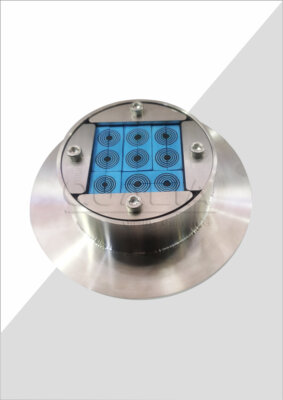
For applications where cable and utility penetrations must be managed within a sealed airlock boundary, Vacu-Pass cord and cable ports are one hardware category that addresses pressure-rated penetration control without compromising envelope integrity.
Daily Usability Under Normal, Maintenance, and Emergency States
An airlock that performs correctly during commissioning but creates daily friction will accumulate procedural workarounds over time. Those workarounds are not just operational inconveniences — they are the behavioral substrate of future audit findings. The design must be workable under three distinct states: normal operation, planned maintenance, and emergency response.
Under normal operation, the primary usability tension in a BSL-3 airlock is the conflict between maintaining a negative inward cascade and meeting cleanroom particle classification limits. Negative pressure cascades, by definition, pull air from cleaner adjacent spaces rather than from a filtered supply. Achieving cleanroom classification in a space that is designed to draw in air from a corridor requires extensive envelope sealing — wall penetrations, door frames, conduit entries, and ceiling transitions must all be managed as potential air infiltration points. That sealing work is not a one-time installation task; it is a maintenance burden that requires periodic inspection, resealing after any penetration work, and verification during annual recertification. Teams that do not budget for that maintenance burden at the design stage will find themselves managing a steady accumulation of classification excursions.
| Operational State | المتطلبات الحرجة | Usability Impact |
|---|---|---|
| Normal operation | Maintain negative inward airflow cascade; meet cleanroom classification limits | Achieving cleanroom classification can be difficult, requiring extensive sealing and increasing maintenance work |
| Emergency state | Uninterruptable backup power for HVAC, process controls, safety systems, and BSCs | Backup system must be properly sized and tested; power loss risks containment failure |
Maintenance state behavior requires its own documented procedure. When an HVAC unit must be taken offline for filter replacement or servicing, the interlock and pressure management logic must have a defined response — either a controlled transition to a redundant unit, a scheduled downtime window with documented containment precautions, or a temporary bypass state with compensating controls. If the maintenance bypass state is not described in the control narrative, operators will improvise it, and that improvised behavior will be the first thing an inspector asks about during recertification.
Emergency state coverage depends on uninterruptible backup power that explicitly includes HVAC systems, process controls, personnel safety systems, and biological safety cabinets. Backup power for lighting and egress alone does not maintain containment. Whether backup power coverage for HVAC and controls is a mandatory code requirement or a planning criterion derived from WHO LBM design guidance depends on the applicable jurisdictional standard and the facility’s specific risk profile. What is consistent across guidance is the principle: if pressure differentials and interlock functions cannot be maintained during a power disruption, the emergency state creates the exact conditions — door manipulation under loss of differential pressure — that the airlock is designed to prevent.
Airlock Approval Boundary for BSL-3 Personnel Flow
Approval of a BSL-3 airlock design is not a single sign-off at the end of construction. It is the cumulative result of resolving a specific set of design questions at defined project stages — and the most common approval delay is not a technical failure but a documentation gap: the installed system works, but the documented design does not describe all the states the system must support.
The GMP-containment boundary question, if unresolved at design review, will resurface during facility qualification. Adding an extra airlock to define the zone classification boundary is the design clarification that resolves this ambiguity, as discussed in the previous section. The approval implication is that the boundary decision must be made during design review, not during qualification. A facility that enters the qualification phase with an unresolved grade assignment for the air sink airlock will face either a qualification hold while the design is revised or a variance request that documents why the existing configuration satisfies the relevant requirements — neither outcome is efficient, and neither was necessary if the question was answered upstream.
| Approval Element | Design/Operational Requirement | نقطة تفتيش |
|---|---|---|
| GMP/Containment boundary definition | Extra airlock between air sink and processing room to clarify zone classification and satisfy both FDA/EU GMP and CDC/NIH containment | Design review and facility qualification |
| إعادة الاعتماد السنوي | BSL-3 laboratory recertification must verify airlock and HVAC system performance | Scheduled annual testing; documentation for regulatory compliance |
Annual recertification is the ongoing approval checkpoint. BSL-3 laboratories generally require annual recertification that includes verification of airlock and HVAC system performance. That annual cycle is not merely a regulatory obligation — it is the mechanism by which the cumulative effect of maintenance activity, procedural drift, and minor modifications is evaluated against the original design basis. An airlock whose interlock logic was never fully validated against abnormal states, or whose sealing has degraded since initial qualification, will produce findings during recertification that are more expensive to resolve than they would have been if caught during commissioning.
The practical review check before finalizing any BSL-3 airlock design is to confirm that the design documentation explicitly describes normal operation, maintenance bypass, and emergency state behavior for both the interlock and the pressure management system. If any of those states is absent from the control narrative, the approval package is incomplete — regardless of how well the hardware performs during initial testing. For additional context on door specifications in the BSL-3 airlock context, the article on BSL-3 airlocks and door specifications addresses the hardware-side criteria in more detail.
The most durable judgment this article supports is that BSL-3 airlock design is a sequencing problem as much as a technical one. Hardware selection, interlock logic, and HVAC sizing will all produce rework if the pressure scheme, personnel flow sequence, and regulatory scope are not resolved first. The air sink versus air bubble distinction is not a detail — it is the load-bearing decision that everything else is built on, and changing it late in the project means simultaneous revision across mechanical, controls, and layout.
Before approving an airlock design for construction, confirm that the control narrative describes all three operational states — normal, maintenance, and emergency — with specific pressure targets, interlock behavior, and backup system coverage documented for each. If the facility must satisfy both GMP classification and CDC/NIH containment, confirm whether the airlock stage count and zone boundary definition are explicitly resolved. Those two confirmations, made at design review rather than during qualification, are what distinguish a straightforward commissioning process from a compressed and expensive one.
الأسئلة المتداولة
Q: What happens if our facility must meet both GMP cleanroom classification and BSL-3 containment requirements simultaneously — can a single airlock satisfy both?
A: A single airlock cannot cleanly satisfy both without creating a classification ambiguity that will surface during regulatory review. GMP classification requires a positive pressure cascade toward the cleanest zone, while BSL-3 containment requires a negative air sink. A single airlock occupying both roles sits in a pressure state that inspectors reviewing GMP grade assignments will challenge directly. The design path that resolves this is an additional airlock stage between the air sink and the processing room, establishing an explicit boundary between the containment zone and the GMP-classified space. That solution adds square footage, extends operator sequencing, and expands commissioning scope — but it eliminates the classification ambiguity before qualification, which is far less costly than resolving it during a qualification hold.
Q: Once the airlock design is approved and construction is complete, what is the first operational checkpoint that confirms the system is actually performing as designed?
A: Annual recertification is the structured checkpoint, but the more immediate confirmation is commissioning-stage validation of the interlock logic against abnormal sequences — not just normal operation. If interlock testing during commissioning only verifies correct behavior under ideal door sequencing and stable HVAC, nuisance alarms and operator habituation will degrade response reliability before the first annual recertification cycle. The practical first step after construction is a commissioning test protocol that explicitly includes HVAC fault scenarios, maintenance bypass states, and realistic door sequencing edge cases, so that any logic gaps are identified and corrected before the facility enters routine operation.
Q: At what point does adding more airlock stages stop improving containment and start creating more risk than it prevents?
A: Multi-stage airlock sequences improve regulatory boundary definition and pressure cascade control, but each additional stage increases operator transition time, gowning and degowning complexity, and the number of interlock systems that must be maintained and recertified. The inflection point is facility-specific, but the governing question is whether each additional stage is resolving a documented regulatory or containment requirement or simply adding control depth beyond what the risk profile justifies. Stages added without a corresponding requirement tend to accumulate procedural workarounds as operators absorb the daily friction — and those workarounds are what produce audit findings. More stages are warranted when regulatory obligations require them; they are a liability when added as a general precaution without a specific design rationale.
Q: Is the −12.5 Pa pressure threshold a regulatory requirement we must meet, or is it a design reference we can adjust based on our authority having jurisdiction?
A: It is a planning reference drawn from WHO Laboratory Biosafety Manual guidance, not a universally mandated regulatory floor. Its value is in giving HVAC and controls engineers a specific, verifiable commissioning target rather than leaving differential pressure as a qualitative objective. Whether your authority having jurisdiction — CDC, national health ministry, or a site-specific biosafety committee — accepts that figure as sufficient, requires a higher threshold, or specifies a different standard entirely depends on the regulatory framework governing your facility. The −12.5 Pa figure should be treated as the starting point for design verification discussions with your AHJ, not as a value that automatically satisfies every applicable authority’s requirement.
Q: If our project budget is constrained, is it worth investing in redundant HVAC units for the airlock, or can that be deferred to a later phase?
A: Deferring HVAC redundancy is a high-risk sequencing decision because the consequence of a single-unit failure is not a performance degradation — it is a loss of differential pressure that constitutes a containment deviation at the moment of failure. Retrofitting redundant air handling or independent exhaust capacity after construction requires ductwork rerouting, ceiling access, and controls integration work that is disproportionately expensive compared to including it in the original mechanical scope. Whether redundancy is a mandatory code requirement or a strongly recommended practice depends on your jurisdictional standard and risk classification, but the cost-benefit calculation should account for the full expense of a containment deviation event — including personnel safety response, regulatory notification, and facility downtime — not just the hardware cost of the redundant unit itself.