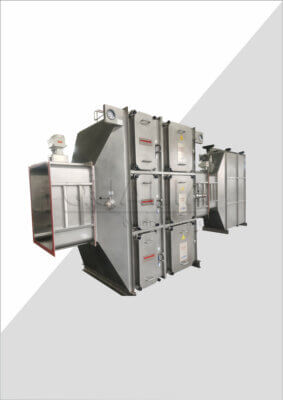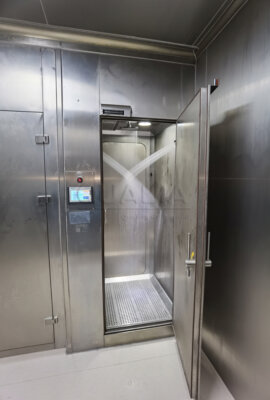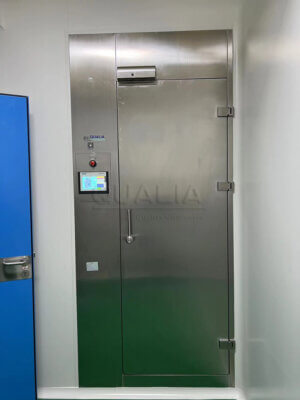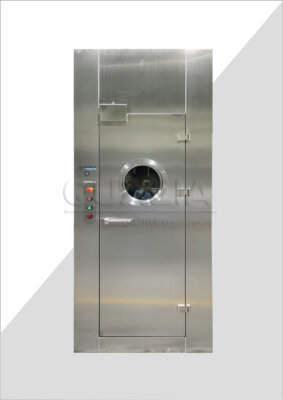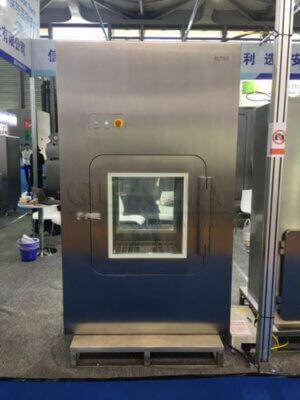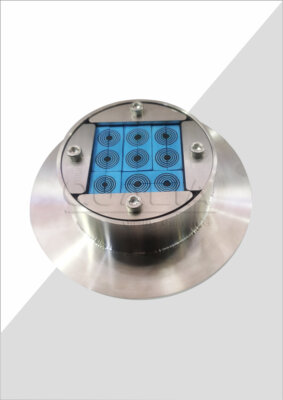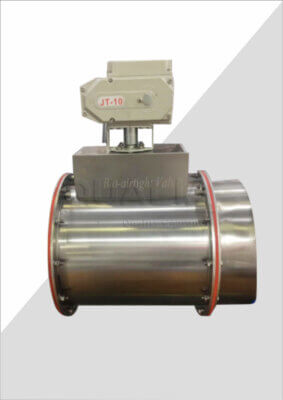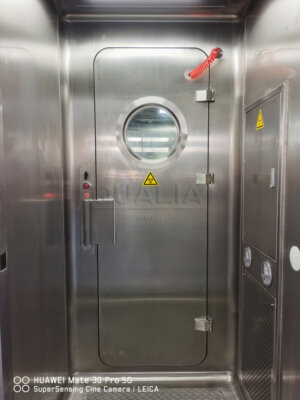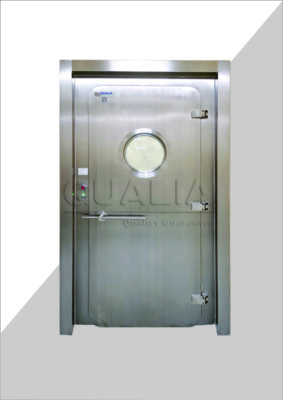

Specifying a pass box for a biosafety laboratory almost always looks like a procurement decision, but the real risk shows up later — during commissioning, when an auditor asks how a contaminated load is rendered safe before it leaves the suite and the answer turns out to be “the SOP covers that.” That gap between assumed procedural control and required engineering control is where qualification delays and costly redesigns originate. The choice of pass box class, sealing method, and decontamination integration has to be resolved against the actual transfer consequence at each biosafety level, not against a general checklist of stainless steel and interlocked doors. What follows helps you identify where BSL-level requirements diverge, which design features carry weight at higher containment, and where the threshold between a manageable procedural risk and a validation-mandatory engineering problem actually sits.
BSL transfer scenarios that reshape pass box requirements
The containment burden of a material transfer is not determined by the BSL number alone — it comes from the consequence if that transfer goes wrong. At BSL-1 and BSL-2, where agents present lower individual and community risk, the failure mode of a pass box is primarily a cleanliness problem, addressable through surface decontamination and good practice. At BSL-3 and BSL-4, the same failure mode becomes a potential exposure event with significantly higher consequences, which is why the physical design of the pass box has to carry a share of the safety burden that procedural controls cannot reliably hold on their own.
This distinction drives the most consequential split in pass box design: whether the unit must maintain an airtight barrier during transfer or whether a clean surface and interlocked doors are sufficient. BSL-3 and BSL-4 applications require pass boxes with mechanical and inflatable double sealing rings that prevent gas permeation across the barrier — a requirement that follows directly from the containment logic of working with agents that can transmit via aerosol or direct contact. The WHO Laboratory Biosafety Manual (4th Edition) establishes the broader containment rationale for high-risk material handling, and that principle applies directly to transfer hardware: the boundary between zones must not be compromised during the transfer event itself.
The practical implication for planning is that BSL level should be treated as the starting variable, not the final specification. A BSL-3 laboratory handling select agents under negative pressure has a different transfer profile than a BSL-3 facility with a defined scope of work and limited aerosol-generating procedures. Biorisk assessment determines which transfer scenarios actually occur, and those scenarios — not the BSL designation in isolation — define which pass box class is required. Getting this framing right early prevents the common outcome where a lower-spec unit is installed against a BSL-3 program and then flagged during inspection as an inadequate control.
Feature differences between lower and higher containment use
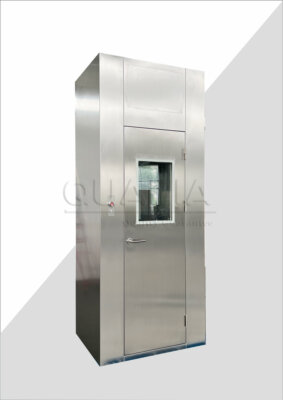
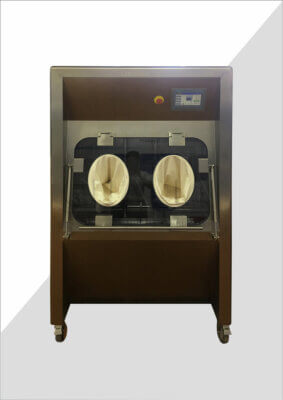
The clearest way to see where a lower-containment specification fails in a higher-containment environment is to look at what a static pass box does and does not do. A static unit relies on interlock doors, a smooth internal surface, and access control to limit cross-contamination. It has no active air management: no HEPA filtration, no directional airflow, no continuous pressure on the barrier. In environments where procedural controls are accepted and the agent risk is low, that is a reasonable and cost-effective design. In a BSL-3 environment, it is a weak point — not because the hardware is defective, but because it was designed for a different risk profile.
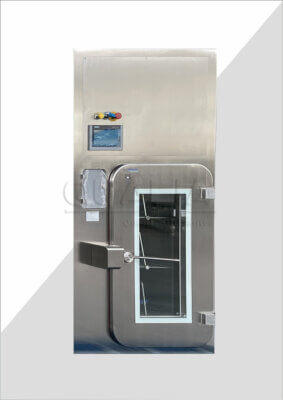
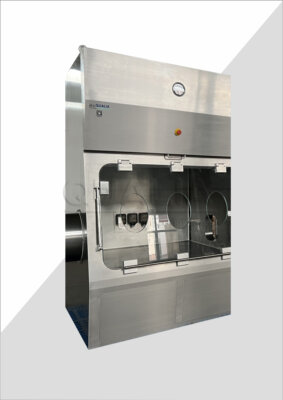
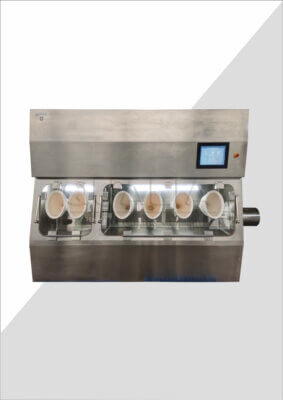
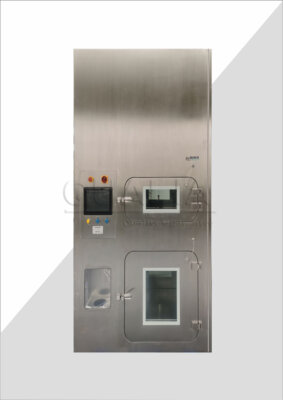
Dynamic pass boxes with H14 HEPA filtration change the operational logic. ISO Class 3 air quality inside the chamber and clean air velocity in the range of 0.36–0.54 m/s are design-input thresholds that distinguish these units from static designs; they are not regulatory minimums, but they reflect the level of active air control needed to support aseptic transfer and higher containment integrity. Combined with 304/316L stainless steel construction, coved corners that eliminate hard-to-clean crevices, and double-layer tempered glass windows, these units are built around the assumption that decontamination will be required and must be fully effective when it happens.
| Особливість | Lower Containment (Static) | Higher Containment (Dynamic/Airtight) |
|---|---|---|
| Фільтрація повітря | No HEPA filters; relies on passive cleanliness | H14 HEPA filters achieving ISO Class 3 air quality |
| Швидкість повітря | None; no active air circulation | 0.36–0.54 m/s clean air speed |
| Material & finish | Basic stainless steel; tight surfaces but corners may exist | 304/316L stainless steel with coved corners; double-layer tempered glass window |
| Door seals | Simple gasket seals | Mechanical and inflatable double sealing rings to prevent gas permeation |
| Typical application | Lower-risk transfers where procedural controls are adequate | BSL-3/4 transfers requiring validated containment and clean air |
The mistake that surfaces most often at procurement is treating the feature list as a compliance checklist rather than a functional decision. A specifier who adds interlocks and upgrades to 316L stainless steel has addressed two real concerns — simultaneous door access and material compatibility — but has not resolved the question of whether air cleanliness and barrier integrity are actively maintained during transfer. Those are not the same decision, and conflating them at the specification stage creates a product that looks right on paper but performs below what the application requires.
Decontamination strategies tied to release risk
The most common oversight in pass box specification for high-containment environments is not the door hardware or the surface finish — it is the absence of a credible answer to a simple question: how is the contaminated load rendered safe before it leaves the suite? This is not a new audit concern; it surfaces consistently at commissioning and re-inspection precisely because it is easy to defer during design. The assumption that an SOP will cover it holds in lower-risk contexts where procedural controls are accepted. In BSL-3 and BSL-4 applications, that assumption is difficult to defend.
UV light is the decontamination method most often present in standard pass box designs, and it has a real function at lower risk levels. Up to 99% microbial load reduction is achievable — but that figure depends on lamp condition, exposure geometry, and exposure time, none of which are verified in real time for the specific load being transferred. There is no in-chamber confirmation that the items inside the pass box have received adequate exposure. For transfers where release safety must be demonstrable, UV should be treated as a supplementary measure rather than a primary decontamination control.
VHP — vaporized hydrogen peroxide — integrated through dedicated injection and verification ports in the pass box chamber is the mechanism that enables validated kill assurance. The injection port delivers the sporicidal agent to the chamber and its contents; the verification port confirms exposure before release is authorized. This is not a regulatory mandate applied uniformly across all pass box applications, but it is the engineering solution that answers the decontamination question in a way that can be documented, verified, and defended at audit. For BSL-3 and BSL-4 transfer programs that require proof of sterility before material exits the suite, a VHP-integrated pass box is not an upgrade — it is the minimum adequate design.
| Метод знезараження | Efficacy Claim | How Release Safety Is Verified | Where It Fits |
|---|---|---|---|
| UV light | Up to 99% microbial load reduction | No in-chamber load verification; relies on exposure time and lamp condition | Lower-risk transfers where procedural controls are accepted |
| VHP (vaporized hydrogen peroxide) | Validated kill assurance when paired with injection and verification ports | Dedicated injection/verification ports allow pre-release sterilization of chamber and load | BSL-3/4 high-containment transfers that demand proven sterility before removal |
The decision friction here is timing: the decontamination method has to be chosen before the pass box is specified, because retrofitting VHP capability into a unit that was not designed for it is rarely practical. The injection and verification ports, the chamber geometry, and the material compatibility requirements for VHP exposure are all design-stage decisions. Treating decontamination as a commissioning problem instead of a design problem is one of the more recoverable mistakes in a lower-risk project and one of the least recoverable in a high-containment one.
Facility integration points that affect biosafety performance
A pass box that is correctly specified but poorly integrated into the facility often performs below its design intent — not because the unit is deficient, but because the surrounding conditions undermine what the hardware is supposed to do. Three integration points consistently generate this kind of gap, and all three are easier to address during design than after installation.
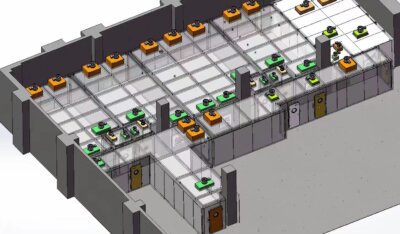
Positioning is the first. A pass box placed away from the sample preparation bench or primary high-use equipment forces operators to carry materials further through the suite, which increases the number of gowning cycles, the frequency of door openings, and the probability of a containment breach driven by fatigue or workflow pressure. Proximity to centrifuges and other routine workstations is a design criterion, not an aesthetic preference. When it is treated as a secondary consideration during layout — something to resolve after HVAC, electrical, and equipment positioning are fixed — the pass box often ends up where the wall has space for it rather than where the workflow actually needs it.
Structural support is the second integration point, and it produces some of the more disruptive post-installation corrections. Thin cleanroom wall partitions are frequently not designed to carry the weight of a mounted pass box. The solution — a floor-mounted support stand — is straightforward when planned, but it requires coordination between the pass box specification, the wall construction specification, and the support structure design. When those are resolved in separate conversations, the installer arrives on site to find a partition that cannot take the load, and the support stand becomes a change order. Where the wall is adequate, a correctly dimensioned flange seals the gap between the pass box and the wall surface; that detail also has to be specified and coordinated before installation, not assumed.
Interlock validation is the third, and it is the one most likely to be treated as a functional assumption rather than a verified condition. The purpose of an interlocked pass box is to prevent simultaneous opening of both doors, which would eliminate the pressure barrier between zones. If the interlock is never tested under representative conditions before the facility goes live, its function under actual use — vibration, repeated cycling, temperature variation — is unknown. Confirming that both doors cannot open simultaneously is a required pre-operational check, and documenting that check is a defensibility item if containment performance is ever questioned.
| Фактор інтеграції | Вимоги | Biosafety Risk If Overlooked |
|---|---|---|
| Position in lab | Near sample-prep benches and high-use equipment (e.g., centrifuges) | Extra operator traffic and gowning cycles increase breach probability |
| Структурна підтримка | Floor-mounted support stand for thin cleanroom walls; otherwise flange seals gap | Wall deflection or seal failure breaks containment barrier |
| Interlock validation | Confirm both doors cannot open simultaneously | Pressure cascade loss and bidirectional airflow if interlock fails |
Each of these three integration factors carries the same downstream consequence if overlooked: a containment gap that the pass box hardware itself cannot compensate for after installation. The engineering controls in the unit work only when the physical and operational environment they were designed for is actually present.
Validated kill assurance as the threshold between standard and advanced designs
There is a point in the specification process where the question stops being “which pass box features does this application need” and becomes “has this application crossed the threshold where validated kill assurance is required before material release.” That threshold is not a guideline preference — it is a functional boundary that separates two different procurement categories, two different commissioning scopes, and two different lifecycle cost profiles. Identifying it early is what prevents a late-stage redesign.
The measurable design threshold that distinguishes an airtight high-containment pass box from a standard unit is leakage rate. A chamber rated at less than 0.5% vol/h at −500 Pa pressure provides a quantifiable containment barrier that can be tested, documented, and defended. A standard pass box does not offer this. That difference matters not because leakage rate is a universally mandated specification, but because it is the physical property that makes the rest of the containment claim credible. A unit with good seals, coved corners, HEPA filtration, and a VHP injection port still has to demonstrate that the barrier holds at the pressures the facility operates under. The leakage rate figure is how that demonstration is made. For detailed guidance on what distinguishes BSL-3 from BSL-4 containment requirements more broadly, the differences between these two containment levels directly inform how that threshold applies to transfer hardware.
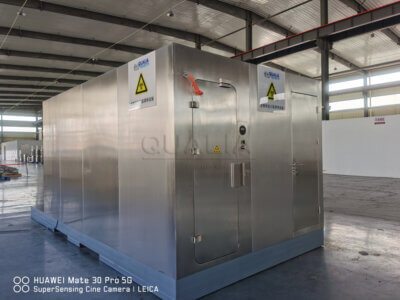
Where validated kill assurance cannot be verified — because the unit lacks VHP integration, because the chamber geometry does not support uniform agent distribution, or because the leakage rate has never been measured — the unit is not appropriate for BSL-3/4 use regardless of how many individual features it shares with a compliant design. This is a threshold condition, not a performance shortfall. It is also where the tradeoff between a simpler, lower-cost unit and an airtight decon-capable design becomes non-negotiable: if the biorisk assessment requires proof that contaminated material was rendered safe before leaving the suite, the application has already decided which category the pass box belongs in. The only remaining question is whether the specification reflects that decision.
The practical consequence of missing this threshold in procurement is not just a specification correction — it is a commissioning delay while the facility cannot demonstrate compliant material release, followed in many cases by a retrofit that the original wall, support structure, and HVAC routing were not designed to accommodate. That sequence is expensive and time-consuming in direct costs and entirely avoidable if the decontamination requirement is treated as a design-stage engineering decision rather than an operational one. A скринька для перепусток з біобезпеки chosen without first resolving this question will almost always need to be replaced rather than upgraded when the gap surfaces.
The core judgment in specifying a pass box for a biosafety laboratory is not which features to include — it is whether the application requires the transfer boundary to be a verified containment barrier or a controlled access point. That distinction shapes everything downstream: the sealing design, the decontamination method, the structural integration requirements, and ultimately what can be demonstrated to an auditor when material release documentation is requested.
Before procurement, three things should be confirmed: whether the biorisk assessment permits procedural decontamination controls or requires engineering-validated kill assurance; whether the planned installation location aligns with workflow, structural capacity, and pressure cascade direction; and whether the interlock and leakage performance of the specified unit can be tested and documented before the facility goes operational. If any of those three conditions is unresolved, the procurement decision is premature — and the cost of resolving it later will be higher than the cost of resolving it now.
Поширені запитання
Q: What happens if the biorisk assessment is still in progress when the facility design needs to be finalized?
A: Pass box procurement should be paused until the biorisk assessment resolves the decontamination requirement. The assessment outcome — whether procedural controls are acceptable or validated kill assurance is required — is the input that determines which pass box category is appropriate. Specifying hardware before that question is answered risks selecting a unit that has to be replaced rather than upgraded, because the structural, HVAC, and wall integration decisions made around a standard unit often cannot accommodate an airtight VHP-capable design retrofit.
Q: Is a dynamic pass box with H14 HEPA filtration sufficient for BSL-3 use, or does VHP integration always need to be included?
A: It depends on the transfer direction and the release condition, not the containment level alone. A dynamic pass box supports clean inward transfer effectively — HEPA filtration and controlled airflow protect the environment inside the suite from particulate introduction. Where the requirement is outbound release of potentially contaminated material, HEPA filtration does not answer the decontamination question. VHP integration becomes necessary specifically when the biorisk assessment requires proof that the load was rendered safe before leaving the suite; if only inbound clean transfer is occurring, a dynamic unit without VHP may be adequate for that defined scope.
Q: How should interlock validation be sequenced relative to broader facility commissioning?
A: Interlock testing should be completed and documented before the pressure cascade is confirmed as stable, not after. The interlock’s function — preventing simultaneous door opening — directly protects the pressure differential between zones. If interlock performance is only assumed during early commissioning and tested later, any anomalies discovered at that stage require the facility to re-verify pressure cascade performance under corrected conditions. Treating it as a pre-operational check that feeds into, rather than follows, pressure differential verification avoids that rework sequence.
Q: When does a procedural decontamination SOP remain a defensible control rather than a documentation gap?
A: A procedural SOP holds where the biorisk assessment has explicitly evaluated the transfer consequence and concluded that the agent, exposure route, and release scenario do not require engineering-validated kill assurance. That evaluation has to be documented, agent-specific, and tied to the actual transfer scenarios in the facility — not carried over from a generic template. Where the SOP is the primary control, it should also specify who verifies compliance for each transfer event. Without that documented assessment and verification step, an auditor has no basis for accepting the procedural control as adequate, regardless of how detailed the SOP itself is.
Q: Does a higher-specification pass box eliminate the need to align placement with the facility pressure cascade, or does integration still need to be coordinated separately?
A: A higher-specification pass box does not substitute for correct placement — it assumes it. The leakage rate, sealing performance, and decontamination capability of an airtight unit are design properties that function correctly only when the chamber is installed in alignment with the pressure cascade direction the unit was configured for. If the pass box is positioned at a wall where the pressure differential runs opposite to the intended transfer direction, or where the HVAC routing does not support the required negative pressure on the hazardous side, the engineering controls built into the unit cannot compensate. Chamber specification and facility integration are parallel decisions, not sequential ones.
Пов'язаний вміст:
- Скринька для перепусток з біологічної безпеки: Типи та посібник з вибору для застосування BSL
- Пропускний пункт у фармацевтиці: вимоги GMP та посібник з конфігурації
- Лабораторна перепустка: Конфігурація для дослідницьких та випробувальних центрів
- Бокс для пропуску в чисте приміщення: Вимоги до вибору та інтеграції
- Типи прохідних боксів у фармацевтиці: статичний, динамічний УФ або VHP?
- Фармацевтична перепустка: Технічні характеристики та сертифікація класів
- Перепустка в мікробіологічній лабораторії: Особливості запобігання забрудненню
- Камери перенесення в ізоляторах для тестування стерильності
- Статична перепустка для чистих приміщень: Вимоги до блокування та класифікації