
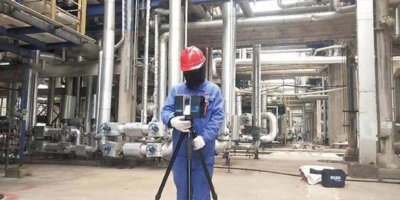
Storingen in de afzuiging in BSL-3 en BSL-4 laboratoria kondigen zich zelden aan. Een omzeiling van de filterpakking, een kanaalverbinding die nooit goed is afgedicht of een regelinterconnectie die bij de installatie verkeerd is aangesloten, kan jarenlang blijven bestaan terwijl de routinedrukwaarden er normaal uitzien - in één gedocumenteerd geval is een venturi-klep achterstevoren geïnstalleerd en is de besturing ervan tien jaar lang niet geïntegreerd geweest met het HVAC-systeem voordat het probleem werd gevonden. De kosten komen later aan de oppervlakte: een filtervervanging die technici blootstelt aan niet gekwantificeerde risico's, een regelgevende audit die scangegevens eist die het inbedrijfstellingspakket nooit heeft gegenereerd, of een uitschakeling die wordt geactiveerd door een brandalarm dat het afzuigsysteem halverwege het gebruik raakt. De beslissing die het grootste deel van dit risico oplost, ligt bij de acceptatie, waar de reikwijdte van wat moet worden aangetoond - geïnstalleerde filterintegriteit, behuizing en kanaallekkage, BIBO-toegang en service-isolatie - ofwel duidelijk is gedefinieerd ofwel aan interpretatie wordt overgelaten. Aan het eind van dit artikel zult u beter in staat zijn om te beoordelen of een afzuigacceptatiepakket echt verdedigbaar is of alleen op papier compleet is.
Bewijs van integriteit van geïnstalleerde HEPA-filter
Een testcertificaat van een fabrieksfilter bevestigt dat een filter volgens de specificaties werkt op een testbank. Het bevestigt niet dat hetzelfde filter, na verzending en installatie in een kanaalbehuizing onder veldomstandigheden, een gelijkwaardige insluiting levert. Het verschil is van belang omdat de storingen die optreden bij installatie in het veld - compressieschade aan de pakking, scheuren in het medium door verkeerd gebruik of omzeiling van het frame door onjuiste plaatsing - geen zichtbare indicator opleveren en geen alarm genereren. Het geïnstalleerde filter kan structureel intact lijken terwijl het lekt aan de rand van de afdichting.
In-situ testmethoden pakken deze leemte direct aan. Een scan met een aërosolfotometer waarbij een DOP- of PAO-uitdagingsaërosol stroomopwaarts van het geïnstalleerde filter wordt ingebracht, zal lekken detecteren in het filtermedium, de pakking en de afdichtingen van het frame onder de werkelijke geïnstalleerde omstandigheden. Voor hydrofobe HEPA-filters uit autoclaven kan een waterintrusietest (WIT) worden uitgevoerd terwijl het filter nog op zijn plaats zit, wat vooral waardevol is op locaties waar het verwijderen van het filter zelf een verontreinigingsrisico zou veroorzaken. Drukvervaltests van de behuizing en het omliggende kanaalgedeelte bevestigen de integriteit van de afdichting zonder dat er aërosolen in het systeem hoeven te komen.
| Testmethode | Wat het detecteert | In-situ mogelijkheden | Typische toepassing |
|---|---|---|---|
| Aërosolfotometerscan (DOP-test) | Lekkage bij filtermedium, pakking, afdichtingen frame | Ja, met upstream challenge aerosol | HEPA-afzuigfilters in BSL-3/4-kanalen |
| Waterintrusietest (WIT) | Speldenprikken en middelgrote schade door binnendringend water | Ja, voor hydrofobe filters | Autoclaaf HEPA filters gevalideerd zonder verwijdering |
| Drukvervaltest | Integriteit van behuizing en afdichting door drukverlies | Ja, met sectie-isolatie | Algemene lekverificatie van HEPA-behuizing |
In het kader van het Amerikaanse Federal Select Agent Program (FSAP) voor BSL-4 faciliteiten is certificering van de integriteit van HEPA-filters vereist bij de eerste ingebruikname, jaarlijks en na grote systeemwijzigingen of het oplossen van grote problemen - en deze vereiste strekt zich uit over bedrijfsventilatieopeningen, drukontlastingsopeningen, kameruitstroom- en ontluchtingsleidingen, HVAC-ventilatiefilters van laboratoriumleidingen en filters van ontsmettingssystemen. Dit is een programmatisch kader dat specifiek is voor bepaalde door agentia gereguleerde contexten, geen universeel mandaat voor alle BSL-3/4 jurisdicties, maar het illustreert de reikwijdte waarmee een verdedigbaar pakket van bewijsmateriaal met betrekking tot de installatievoorwaarde rekening moet houden.
| Filtercomponent / systeem | Vereiste controlefrequentie | Wat moet worden geverifieerd |
|---|---|---|
| Bedieningsopeningen (BSL-4) | Jaarlijks | Certificering integriteit HEPA-filter |
| Overdrukventielen (BSL-4) | Jaarlijks | Certificering integriteit HEPA-filter |
| Kameruitstroom/ventilatie (BSL-4) | Jaarlijks | Certificering integriteit HEPA-filter |
| Filters voor ontluchtingsleidingen van HVAC-leidingen in laboratoria | Jaarlijks | Geschikte middelen en acceptatiecriteria |
| Filters voor ontsmettingssystemen | Jaarlijks | Geschikte middelen en acceptatiecriteria |
| HVAC operationele parameters (algemeen) | Initieel, jaarlijks, na grote veranderingen, na het oplossen van grote problemen | Verificatie van operationele parameters |
De praktische implicatie voor acceptatie is eenvoudig: als de inbedrijfstellingsrecord alleen fabriekscertificering bevat en geen scan van de geïnstalleerde toestand of WIT-resultaat, kan het acceptatiepakket niet aantonen dat het filter dat op de testbank presteert hetzelfde filter is dat het uitlaatgastraject onder praktijkomstandigheden beschermt.
Lekkagecontroles van uitlaatkanalen en behuizing
Lekkagecontroles van kanalen en behuizingen worden vaak beperkt tot fysieke druktests - blaas een kanaalsectie op, meet het verval, geslaagd of niet geslaagd. Dat gaat voorbij aan de klasse van defecten die waarschijnlijk aanwezig zijn in een nieuwe installatie. De drie foutpatronen die gedocumenteerd zijn in echte BSL-3 evaluaties zijn geen lekkende verbindingen of gaatjes in kanaalwanden; het zijn een klep die in de verkeerde stromingsrichting geïnstalleerd is, regelverbindingen die nooit bedraad zijn en sensoren die nooit gekalibreerd zijn na installatie. Alle drie bleven onopgemerkt omdat de ruimtedruk op een andere manier gehandhaafd leek te worden.
De implicatie voor de reikwijdte van de lekkageverificatie is dat de geïnstalleerde controles verder moeten gaan dan het fysiek testen van de kanaaldruk en ook de bevestiging van de besturingsintegratie en de verificatie van de sensorkalibratie moeten omvatten. Een druktest van de behuizing bevestigt dat de behuizing fysiek is afgedicht. Het kan niet bevestigen dat de klep in die behuizing correct reageert op een systeemvraag of dat de differentiële druksensor die de stroomafwaartse ruimte bewaakt, een nauwkeurige uitlezing geeft. Beide voorwaarden beïnvloeden of een lekkagegebeurtenis tijdens bedrijf kan worden gedetecteerd.
| Verborgen mislukking | Waarom het onopgemerkt blijft zonder geïnstalleerde controle | Invloed op de lekkagecontrole van afzuigkanalen/behuizing |
|---|---|---|
| Venturi-ventiel achterstevoren geïnstalleerd | De richting van de luchtstroom kan normaal lijken; er wordt geen alarm geactiveerd | Mogelijke terugslag of lekkage blijft verborgen |
| Venturi-ventielbesturing niet aangesloten op HVAC-besturingssysteem | De ruimtedruk kan op andere manieren worden gehandhaafd; kleppen moduleren niet | Controlefouten tijdens dynamische gebeurtenissen kunnen de insluiting in gevaar brengen, lekkagecontroles missen de hoofdoorzaak |
| Drukverschilsensoren in de ruimte defect of niet gekalibreerd | Aflezingen kunnen plausibel lijken of geen alarm waarschuwt voor storing | Onvermogen om negatieve druk te bevestigen; lekkage of omkering van het kanaal wordt niet opgemerkt |
| Temperatuur-, RV-, luchtstroom- en druksensoren niet gekalibreerd sinds installatie | Geen routinematige in-situ kalibratieverificatie; standaardwaarden geaccepteerd | Leakage assessment relies on false data; containment evidence is unreliable |
These cases are not presented as typical outcomes — most installations do not carry all three failure patterns simultaneously. But they illustrate a structural problem: without installed-condition verification that includes functional control checks and sensor calibration confirmation, the leakage assessment rests on data that may not reflect actual system state. For exhaust systems in BSL-3 and BSL-4 applications, that gap has a direct consequence: a containment event or a negative-pressure loss may occur without any sensor registering the deviation.
For related context on how these failure risks apply across supply and exhaust air paths, the discussion in BIBO voor BSL-3 Afvoer- vs Toevoerlucht: Waar insluiting echte waarde toevoegt covers where the risk profile diverges and where BIBO housing placement adds protective value.
BIBO maintenance access in acceptance scope
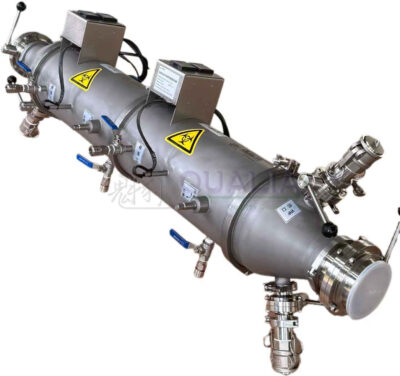
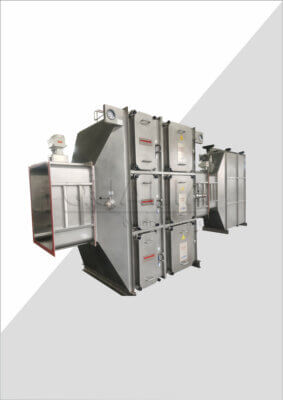
Bag-in/bag-out housing is specified for BSL-3 exhaust systems under NIH guidelines precisely because the alternative — direct filter removal from a contaminated duct section — creates an exposure pathway that the rest of the containment system is designed to prevent. Under that framework, BIBO housing is a mandatory design element for exhaust-side HEPA filters in NIH-governed BSL-3 facilities, though the specific mandate applies to that programmatic context rather than universally across all BSL-3 regulatory authorities.
What is a practical recommendation that should apply more broadly: if a BIBO housing is installed, its acceptance scope must demonstrate that the housing actually functions as a safe-change mechanism. That means the acceptance package should confirm that the bag-ring and bag-attachment sequence is operational, that the upstream isolation mechanism closes reliably before the bag is breached, and that the bag-out path does not create a secondary contamination point. A BIBO housing with an isolation valve that binds under differential pressure, or a bag attachment collar that requires excessive force to seat under field conditions, does not provide the safe-change protection it was specified to deliver — regardless of what the factory test record shows.
The downstream consequence of leaving BIBO access outside the acceptance scope is that the first real filter change becomes an improvised event. Maintenance staff encounter a housing they have not operated under acceptance conditions, work through problems in a contaminated zone, and potentially deviate from the intended bag-change sequence under time pressure. Including BIBO access verification in acceptance converts that first-change risk into a confirmed and documented procedure. Qualia Bio’s Bag-in-Bag-Out systems are designed with this operational continuity in mind, with housing geometry and isolation mechanisms intended to support field verification at commissioning.
Safe isolation before filter service
Safe isolation before a filter change is the operational precondition that makes BIBO access meaningful, and it is also the element most likely to be underdocumented in an acceptance package. The acceptance record may confirm that the BIBO housing functions and that the filter passes an in-situ scan, but if the procedure for safely de-energizing the exhaust section, isolating it from the active containment zone, and confirming that state before the bag is breached is not defined and verified, the acceptance package is incomplete.
Two risk factors specific to BSL-3 exhaust systems are worth anticipating in isolation planning. First, building fire alarm systems can trigger an automatic HVAC and exhaust shutdown in some facility configurations, which means that if a filter service is underway when a fire alarm is activated — whether real or accidental — the exhaust system may lose controlled airflow in a partially open state. Acceptance criteria should verify that the isolation procedure accounts for this scenario, either through a lockout protocol that prevents alarm-triggered shutdowns during controlled filter service or through a defined response procedure that covers the transition. Second, a documented gap in real BSL-3 facilities has been that maintenance staff did not adequately understand how the laboratory HVAC system actually operated — not how it was designed to operate, but how it behaved under the conditions they would encounter during service. Safe isolation planning that exists only in the commissioning engineer’s file does not close that gap.
The practical acceptance check is whether maintenance staff can demonstrate the isolation sequence against the installed system, not against a schematic. If that demonstration has not occurred, the isolation procedure is theoretical.
Factory evidence versus installed-condition proof
Factory certification is a necessary starting point. A HEPA filter without a factory test certificate has no baseline for installed-condition comparison. A valve without a factory functional test has no confirmation that it operated correctly before installation damage or wiring error was introduced. The problem is not that factory evidence is unreliable; it is that factory evidence is limited to the conditions under which it was generated, and installation introduces a distinct set of failure modes that factory testing cannot detect by design.
| Verification area | What factory evidence alone provides | Why installed‑condition testing is necessary | Hidden failure example from real cases |
|---|---|---|---|
| Integriteit HEPA-filter | Laboratory test certificate for filter medium and housing | Installation can cause gasket leaks, medium tear, or bypass; in‑situ scan/WIT confirms actual state | Filter leak at gasket or medium tear undetected until installed test |
| Duct and housing leakage | Factory pressure/leak test of housing assembly | Installation joints, damper mispositioning, or backdraft can create leakage paths not present at factory | Venturi valve installed backwards for 10 years without detection |
| Control interconnections | Bench test of valve and actuator functionality | Wiring errors or integration omissions may not be apparent; controls may appear to work but not respond to system demands | Venturi valve controls not interconnected to HVAC system for 10 years |
| Sensorkalibratie | Factory calibration certificate | Sensors can drift or be damaged during installation; without in‑situ verification, all control and leakage decisions rest on false data | All space sensors uncalibrated since installation, differential pressure sensor failed |
The most consequential column in this comparison is the hidden failure examples column. The venturi valve installed backwards and the control interconnections left unwired both represent failures that had already passed factory testing — the valve presumably functioned correctly in the factory orientation, and the actuator presumably responded to a bench signal before wiring integration was omitted. The failures were not factory failures. They were installation failures that only installed-condition testing would have caught.
The acceptance implication is proportionate: factory certification is a necessary but insufficient basis for exhaust containment approval. An acceptance package that relies entirely on factory filter certificates, factory housing pressure test results, and factory valve functional records cannot demonstrate that the installed system delivers the containment the factory tests predicted. ISO 14644-3:2019, which governs cleanroom test methods including installed filter leak testing, provides a relevant technical framework for the in-situ scan methodology that bridges the factory-to-field gap for HEPA performance verification.
Approval threshold for exhaust containment evidence
Static pressure readings are not sufficient to establish exhaust containment acceptance. A space that reads at the correct negative differential pressure under steady-state conditions may not maintain that differential through a fan failure, a power transfer event, or a system restart — and those are precisely the conditions under which containment is most likely to be challenged in a real maintenance or emergency scenario.
The FSAP framework for BSL-4 facilities provides a useful model for thinking about measurable acceptance thresholds. Under that framework, HVAC operational verification under failure conditions must demonstrate that no positive pressurization event escapes the containment boundary after a fan failure, a transfer to backup power, and a transition back to normal power — and that no airflow reversal from containment areas escapes the boundary during those transitions. These are pass/fail criteria that cannot be evaluated from a static pressure log. They require scenario-tested verification under installed conditions.
| Failure scenario | Required acceptance threshold |
|---|---|
| Fan failure, transfer to backup power, transition back to normal power | No positive pressurization event escapes the containment boundary |
| HVAC operational verification under failure conditions in BSL‑4 | No airflow reversal from containment areas that escapes the containment boundary |
These specific thresholds originate in a BSL-4 programmatic context and should not be applied uncritically as universal pass/fail criteria across all BSL-3 facilities or regulatory frameworks. But the underlying principle — that acceptance thresholds should be defined in terms of what the system must demonstrate under dynamic failure conditions, not only under steady-state operation — is sound regardless of jurisdiction. An exhaust containment acceptance package that can only show steady-state compliance leaves the question of failure-mode performance unanswered. For a BSL-3 or BSL-4 exhaust system, that is not a defensible gap.
The commissioning scope described in BIBO Checklist inbedrijfstelling: FAT-, SAT-, IQ- en OQ-punten die over het hoofd worden gezien covers specific OQ points that align with this kind of failure-scenario verification, including items that are frequently absent from standard commissioning packages.
The most common weakness in BSL-3 and BSL-4 exhaust acceptance packages is not a missing document — it is a category of evidence that was never scoped. Factory filter certificates and housing test records answer a narrow question about pre-installation state. They do not answer whether the installed filter is seated and sealed, whether the housing joints and control interconnections hold under field conditions, whether the BIBO mechanism functions as a safe-change path, or whether the exhaust system maintains containment through a power transition or alarm event. Each of those questions requires installed-condition evidence, and each represents a failure mode that can persist undetected until a maintenance event or an audit forces it to the surface.
Before approving an exhaust acceptance package, confirm that it addresses both parts of the threshold: filtration integrity under installed conditions and documented service access. If either component is absent — no in-situ scan or WIT result, no confirmed BIBO operational verification, no defined and demonstrated isolation procedure — identify which installed-condition tests are missing and whether the project schedule allows them to be completed before initial operation. The cost of adding them at commissioning is substantially lower than the cost of retrofitting evidence after a containment challenge or a regulatory hold.
Veelgestelde vragen
Q: Does the installed-condition testing scope described here apply equally to BSL-3 facilities not governed by NIH or FSAP frameworks?
A: Not automatically — the specific mandates cited (FSAP annual HEPA certification, NIH BIBO requirements) are programmatic obligations tied to select agent regulation and NIH-governed facilities. However, the underlying failure modes they address — gasket bypass, installation damage, hidden control wiring errors — are not jurisdiction-specific. A BSL-3 facility outside those frameworks still faces the same installation-introduced risks, so the installed-condition evidence scope remains technically justified even where it is not formally mandated. The absence of a regulatory requirement does not mean the gap is acceptable; it means the facility owner carries the risk directly.
Q: Once the acceptance package is approved, what should happen before the first real filter change is scheduled?
A: Maintenance staff should perform a supervised run-through of the complete isolation and bag-change sequence against the installed system before any contaminated filter is due for replacement. Acceptance confirms the hardware functions; it does not confirm that the people who will service the system understand how it behaves under field conditions. A documented gap in real BSL-3 facilities has been that maintenance personnel understood the design intent but not the actual system behavior. A pre-service walkthrough converts the acceptance record into operational familiarity before exposure risk is present.
Q: At what point does adding more installed-condition testing stop improving containment assurance and become diminishing returns?
A: The practical threshold is whether each additional test addresses a failure mode that cannot be detected through another means already in the package. An in-situ aerosol scan, a housing pressure decay check, a BIBO operational verification, a control integration functional test, and a failure-scenario pressurization test each address a distinct failure class. Once the package contains evidence covering installed filter integrity, housing and duct physical sealing, control interconnection function, sensor calibration, and dynamic failure-mode performance, additional testing of the same failure modes adds documentation volume without adding detection capability. The risk of under-scoping — missing a hidden installation failure — remains substantially higher than the risk of over-scoping at commissioning.
Q: How does in-situ HEPA filter testing compare to replacing the filter outright as an alternative way to resolve uncertainty about installation condition?
A: Filter replacement resolves the question of whether the current filter medium is intact, but it does not address gasket seating, frame bypass, or housing joint integrity — and it introduces its own installation risk on the replacement unit. In-situ scan or WIT testing is more informative because it tests the complete installed assembly under field conditions, including the seal perimeter and housing interface that replacement cannot improve if the housing geometry is contributing to the leak. Replacement without a post-installation in-situ test simply transfers the uncertainty to the new filter. Where a filter is found to be leaking at the medium during scanning, replacement followed by a confirmatory scan is appropriate; replacement alone is not an equivalent substitute for installed-condition evidence.
Q: Is steady-state negative pressure monitoring sufficient to catch a containment failure between scheduled certification intervals?
A: No — steady-state differential pressure monitoring detects loss of negative pressure, but it cannot detect the failure modes most likely to be present in a compromised exhaust system between certifications. A gasket bypass on an installed HEPA filter, a housing joint that leaks at elevated static pressure during a filter change event, or a BIBO isolation valve that binds under differential pressure will not register as a pressure deviation during normal operation. These failures surface only when the system is mechanically stressed — during a filter service, a power transition, or a high-demand operating scenario. Routine pressure monitoring is a necessary operational control, but it is not a substitute for periodic installed-condition integrity testing at the filter, housing, and control levels.