

Most sizing problems with pass boxes are not discovered during specification — they are discovered when cleanroom panels are already installed and the unit will not fit the wall opening, or when a trolley cannot cross the threshold, or when a maintenance technician cannot reach the interior without partial disassembly. By that stage, the correction is not a product swap; it is a structural modification that delays commissioning and may require redrawing the layout. The decision that prevents this is treating internal chamber volume as only one of three or four independent variables that must each be confirmed before an order is placed. What follows gives you the judgment to verify all of them in sequence.
Payload geometry that should drive chamber sizing
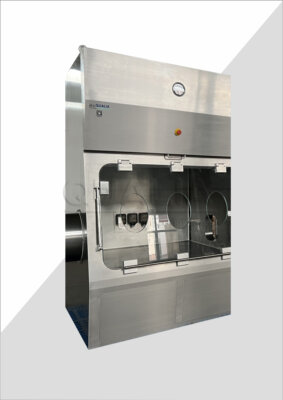
Internal chamber volume is the right starting point, but it only answers one question: will the intended load fit inside the chamber? Standard static pass box internal configurations run in cubic increments — 500, 600, 700, and 800 mm — and dynamic (active airflow) units share the same internal size options. That equivalence is useful early in planning: you can commit to an internal volume without first resolving whether the unit will use active HEPA filtration or rely on UV or chemical decontamination, which keeps the sizing decision from being blocked by an unrelated specification debate.
The practical discipline is to define the actual payload before selecting from that range. The relevant variables are the largest single item that will transit the chamber, the packaging or tray format it arrives in, and whether that item travels vertically, horizontally, or on a cart. A 600 mm internal cube passes most lab consumable transfers comfortably; a bioreactor bag, a nested tray system, or any load that cannot be reoriented may drive the selection to 700 or 800 mm. Getting that assessment wrong in the downward direction — selecting a smaller internal volume to reduce cost or footprint — is a transfer workflow problem that cannot be corrected after installation without replacing the unit.
One early check that is often skipped: confirm usable internal depth, not just the nominal cubic dimension. Door gaskets, interlock hardware, and UV lamp or HEPA filter projections reduce effective interior clearance. The published cubic figure is the cavity before those intrusions are accounted for, so any payload with tight dimensional tolerance against the stated internal size should be physically verified against the actual usable envelope before ordering.
Opening and wall-envelope dimensions that both matter
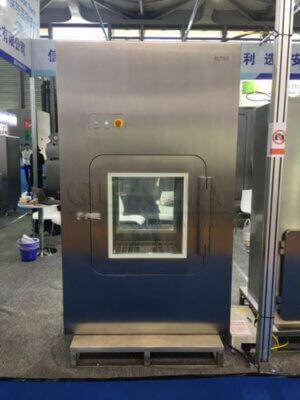
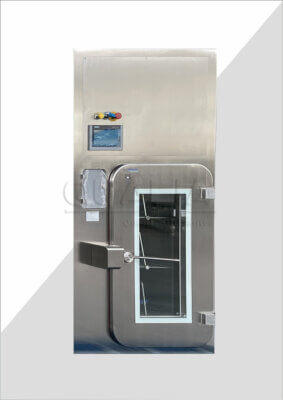
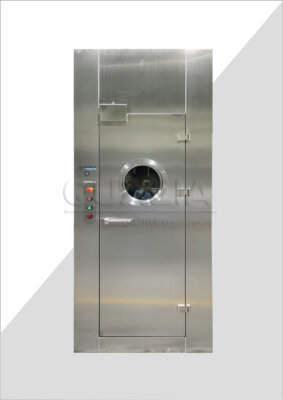
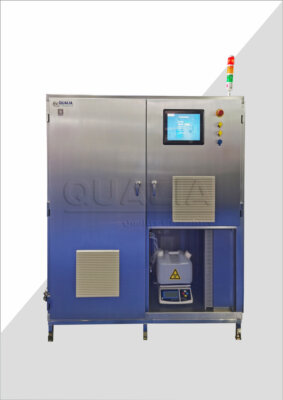
Internal volume and external footprint are independent variables. A unit can have a 600 mm internal cube and still require a wall cutout and surrounding clearance envelope that has no proportional relationship to that internal figure. This divergence is most visible in VHP pass boxes, where the built-in hydrogen peroxide generator and support systems can push the external envelope to 1150 × 650 × 1800 mm around a 600 mm internal chamber. A spec sheet that lists only the internal dimension gives no usable information about what the wall or the surrounding floor area must accommodate.
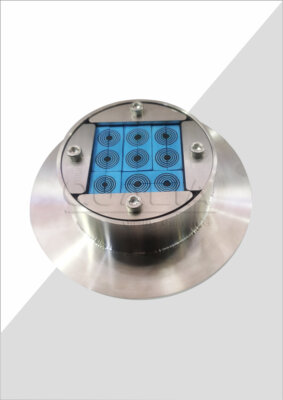
The consequence of not confirming these figures before panel installation is that the wall cutout is already fixed at the wrong size. Enlarging a modular cleanroom panel cutout post-installation is not a minor adjustment — it typically means sourcing a replacement panel and revisiting the structural framing around it. For specimen-scale pass boxes at the other end of the size range, wall openings can be as narrow as 292 × 279 mm with a depth of 44 to 140 mm; confirming the exact cutout against the panel thickness at that dimension is equally critical, even though the numbers are smaller.
Wall load capacity adds a third variable that is independent of both internal volume and external footprint. Flanges seal the pass box to the wall face, but sealing and supporting are different functions. If the partition is a thin modular panel that cannot carry the unit’s weight, the flange accomplishes nothing structurally, and a floor-mounted support stand becomes necessary — a configuration change that affects both the floor plan and the wall connection detail.
| Dimension / Requirement | Qué confirmar | Riesgo si se pasa por alto |
|---|---|---|
| Wall opening dimensions | Exact cutout size required (e.g., specimen pass box opening 292 x 279 mm, depth 44–140 mm) | Unit does not fit wall cutout; installation delayed |
| External envelope vs internal volume | Overall external dimensions, especially for models like VHP pass boxes where external can be much larger (e.g., internal 600 mm cubic vs external 1150 x 650 x 1800 mm) | Insufficient clearance and footprint; integration impossible |
| Wall load capacity and support | Wall type can bear the unit weight; thin partitions require a separate support stand (flanges seal only if wall supports the load) | Structural issues, last‑minute site modifications, or compromised seal |
All three rows in that comparison represent distinct confirmation steps. Missing any one of them produces a different type of installation failure, and none of the three is visible on a drawing that lists only internal chamber dimensions.
Oversizing tradeoffs for cleaning and integration
Selecting a larger internal size to gain transfer flexibility is a reasonable trade, but the cost is not only unit price. Weight scales significantly across the standard size range, and that weight increase changes the structural problem at the wall. A 500 mm internal unit runs approximately 80 kg; a 700 mm internal unit reaches approximately 141 kg. That 61 kg difference often exceeds the load rating of a standard modular cleanroom partition, which means a size increase that looked like a minor upgrade during specification can force a shift to floor-mounted configuration — a change that ripples back into layout drawings, panel connection details, and commissioning sequencing.
| Internal Size (cubic mm) | Approx. Weight (kg) | Key Installation and Cleaning Considerations |
|---|---|---|
| 500 | 80 | Lightest unit; easier handling and lower structural demand. Even at this size, stainless steel 304/316L with coved corners simplifies cleaning. |
| 600 | 116 | Moderate weight; requires robust wall support. Larger surface area increases contamination potential—304/316L and coved corners become more important. |
| 700 | 141 | Heaviest unit; reinforced mounting or floor‑mounted support may be needed. Largest surface area is hardest to clean; proper material and corner design are critical. |
The cleaning burden also scales with chamber size in a way that is easy to underestimate during selection. A larger internal surface area carries more contamination risk, requires more cleaning agent, and takes longer to validate. Stainless steel 304 or 316L construction with coved internal corners makes that work manageable; without coved corners, junctions between walls and the floor of the chamber create recesses that are difficult to wipe completely and harder to defend during environmental monitoring audits. This is not a regulatory mandate unique to a specific standard — it is a practical design criterion that becomes increasingly consequential as the chamber gets larger. At 500 mm internal, a flat-cornered chamber is inconvenient to clean; at 700 mm internal, the same design becomes a genuine contamination control liability.
The hidden tradeoff, then, is not simply flexibility versus cost. It is flexibility versus structural support complexity, versus cleaning time and validation burden, versus installation logistics. Each step up in internal size should be justified by a confirmed payload requirement, not by a general preference for capacity margin.
Layout coordination issues that delay installation
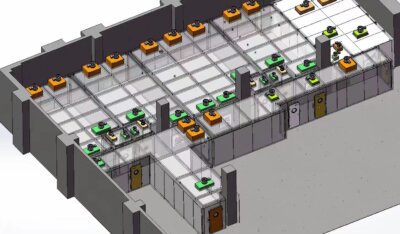
The most common cause of installation delay is not a product defect — it is a specification gap that surfaces on site. Wall type and wall thickness must be defined at the time of order, not as field-resolved details. The pass box connection detail depends on whether the partition is a modular cleanroom panel system, a drywall assembly, or a sandwich panel construction; each has different flange requirements, different structural capacity, and different cutout tolerances. Treating this as something the installation crew will work out on site produces exactly the kind of last-minute fit problem that pushes commissioning past its scheduled date.
The floor-mounting question belongs in the same early coordination conversation. If the wall cannot support the unit’s weight — whether because of panel type, panel thickness, or load rating — a floor-mounted version with an adjustable support stand is available. But that is a fundamentally different installation configuration with different floor area requirements and a different connection geometry at the wall face. Discovering mid-installation that floor mounting is necessary means revising the layout drawing, potentially relocating adjacent equipment, and reordering modified components. None of that is fast, and all of it is avoidable if wall load capacity is assessed before the panel system is installed.
Para biosafety pass boxes integrated into BSL-3 or controlled containment environments, this coordination window is especially narrow. Structural framing and panel installation often precede equipment delivery by weeks, which means the wall cutout is committed before the unit arrives. If the ordered unit’s external envelope or flange configuration does not match what was framed, the only practical options are unit replacement or structural modification — neither of which fits a commissioning schedule built around a confirmed delivery date. The mitigation is straightforward: confirm external dimensions, wall type, and mounting configuration at the point of order, not at the point of delivery.
Usable load path fit as the final sizing threshold
Internal volume confirms that the load will fit inside the chamber. It does not confirm that the load can actually enter, transit, and exit under real handling conditions. Those are determined by a separate set of design features that must be verified against the intended transfer workflow before a size selection can be considered complete.
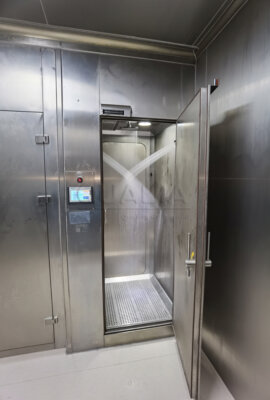
A trolley-ready design allows rolling carts to pass directly through the chamber, which changes the ergonomic and contamination control logic entirely — instead of unpacking and repacking loads at the pass box doors, the entire cart transits. A threshold-free entry eliminates the floor step at the chamber base, which matters for any load that cannot be lifted cleanly over an obstruction, including wheeled carts, heavy containers, and equipment on dollies. A three-door wall connection provides access from more than one direction, which may be necessary in multi-corridor layouts or where the transfer workflow is not strictly linear. None of these features are implied by the internal volume specification, and none of them are visible on a drawing that shows only chamber dimensions.
| Load Path Feature | Descripción | Qué verificar |
|---|---|---|
| Trolley‑ready design | Allows rolling carts to pass directly through the chamber | Confirm if the workflow uses carts or wheeled equipment |
| Threshold‑free entry | Eliminates floor step for uninterrupted base clearance | Verify whether loads require a completely flush transition |
| 3‑door wall connections | Provides additional access points for multi‑direction transfers | Check if transfer operations need more than a single pass‑through path |
| Custom sizing | Match specific wall thickness, opening dimensions, and material‑handling layouts | Assess whether standard internal dimensions and door configurations are adequate for the intended load |
When standard internal dimensions and door configurations cannot support the actual handling workflow — because the load is too large, the cart geometry is incompatible, or the wall connection count is insufficient — custom sizing is available. This should be treated as the appropriate route when standard configurations have been evaluated and confirmed inadequate, not as a shortcut around the standard size evaluation. For workflows that combine manual transfers with trolley-based equipment movement, a Caja de pases VHP with custom internal layout and threshold-free design may be the only configuration that supports both transfer modes without compromising either containment integrity or handling ergonomics. The point is that internal volume sets the outer boundary of what is possible; load path features determine what is actually workable.
If a selected size cannot accommodate the intended load and still fit the wall envelope, the service envelope, and the transfer workflow simultaneously, it has not cleared the threshold for selection — regardless of how well it matches the nominal internal dimension requirement.
Sizing a pass box for cleanroom integration is a multi-variable confirmation problem, not a single-dimension lookup. Internal chamber volume is the necessary starting point, but it must be followed by independent verification of wall opening dimensions, external envelope footprint, wall load capacity, and load path features before a selection can be finalized. Each of those variables can independently invalidate a choice that looked correct at the internal-volume stage, and most of them cannot be corrected after cleanroom panels and structural framing are in place.
The practical pre-order checklist is short but specific: confirm the usable internal dimensions against the actual payload geometry, confirm the external envelope and wall cutout against the installed or planned panel system, confirm the wall load rating against the unit weight at the selected size, and verify trolley compatibility, threshold design, and door count against the real handling workflow. If any one of those confirmations cannot be completed with available information, that gap — not the nominal internal size — is what determines whether the selection is ready to proceed.
Preguntas frecuentes
Q: What happens if standard pass box sizes don’t match the actual transfer workflow — is custom sizing a practical option or a last resort?
A: Custom sizing is a practical and appropriate route when standard configurations have been evaluated and confirmed inadequate, not a workaround. If the intended load geometry, cart dimensions, or multi-mode transfer workflow cannot be supported by any standard internal size and door configuration combination, custom dimensions with tailored threshold and door count specifications are available. The key discipline is completing the standard size evaluation first so the customisation brief is based on confirmed gaps, not assumed ones.
Q: At what point in the cleanroom construction schedule does pass box sizing need to be finalised to avoid structural rework?
A: Sizing and configuration must be locked before structural framing and panel installation begin, not at equipment delivery. Wall cutouts and framing are typically committed weeks ahead of unit arrival. If the external envelope, flange configuration, or mounting type conflicts with what was framed, the only options are unit replacement or structural modification — neither fits a normal commissioning schedule. Confirming external dimensions, wall type, and floor versus wall mounting at the point of order is the only reliable way to keep those two timelines aligned.
Q: Does moving up one internal size — say from 600 mm to 700 mm — always require switching to a floor-mounted configuration?
A: Not always, but the risk is significant enough to verify before ordering. A 700 mm internal unit weighs approximately 141 kg, compared to roughly 116 kg at 600 mm. Whether that difference forces a floor-mounted configuration depends on the load rating of the specific partition type in the installation. Modular cleanroom panels frequently cannot carry the heavier unit, but reinforced or structural partitions may. Wall load capacity must be assessed against the actual unit weight at the selected size — assuming the existing mounting configuration carries over from a smaller unit is one of the more common causes of mid-installation redesign.
Q: Is a VHP pass box’s external footprint roughly proportional to its internal chamber size, or is the difference large enough to change how the wall opening is planned?
A: The difference is large enough to change wall planning entirely and should never be assumed proportional. A VHP unit with a 600 mm internal cube can have an external envelope of 1150 × 650 × 1800 mm due to the built-in hydrogen peroxide generator and support systems. Planning wall cutouts or surrounding floor area based on the internal dimension alone will produce a misfit that cannot be resolved without structural modification. External envelope dimensions must be confirmed directly from the product specification and reconciled against the cleanroom layout before panels are installed.
Q: How should a team weigh the cleaning and validation burden of a larger chamber against the transfer flexibility it provides?
A: The flexibility gain only justifies the larger size if there is a confirmed payload requirement that cannot be met at the smaller size — not a preference for capacity margin. Each step up in internal size increases cleaning time, raises contamination risk across a larger surface area, and adds validation burden. Without coved internal corners and appropriate stainless steel construction, that burden compounds further. The practical test is whether the actual transfer workflow — defined by real load geometry and handling method — cannot be supported by the next size down. If it can, the flexibility argument does not outweigh the cleaning, structural, and logistics costs of going larger.