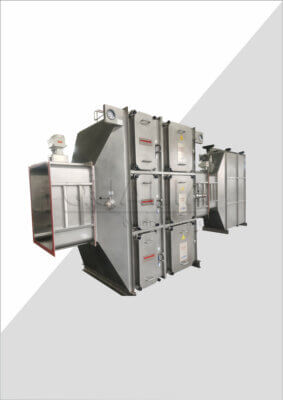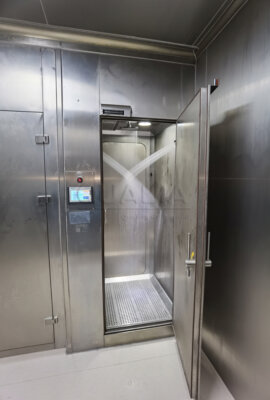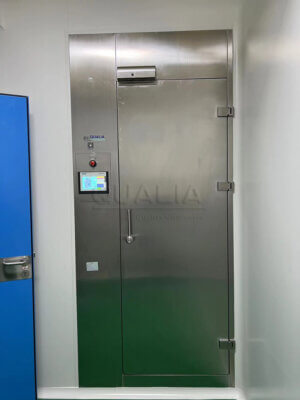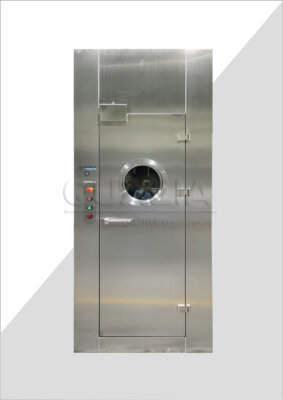

Specifying a pass box for a classified transfer point looks straightforward until commissioning reveals that the chamber installed between a corridor and an ISO 5 filling suite was sized, sealed, and tested as though both rooms share the same cleanliness level. The retrofit cost — wall modifications, extended downtime, and a delayed qualification protocol — consistently exceeds the savings that came from choosing a static unit at procurement. The decision that prevents this is not about unit cost; it is about whether the transfer opening itself can degrade the receiving room’s classified condition during the door-open period. Readers who work through the sections below will be better equipped to judge whether active HEPA supply is a genuine engineering requirement for their transfer point or an unnecessary cost for their specific room pair.
Room classification gaps around the transfer opening
The classification of both rooms sharing a wall determines whether active airflow is an engineering necessity or an avoidable expense. Where both rooms are qualified to the same ISO class, a static pass box with door interlocks controls contamination adequately and costs less to commission, maintain, and requalify. The case for active HEPA supply only becomes defensible once a classification difference exists across the wall — specifically when the receiving room holds a higher classification than the sending side.
That boundary condition matters because door interlocks alone cannot prevent particulate ingress during the open period when the pressure differential is unfavorable or the concentration gradient across the opening is steep. A static unit relies on the facility’s pressure cascade to do the protective work; if the cascade is not configured to hold the cleaner room positive relative to the corridor or ante-room at the transfer point, ingress is likely rather than merely possible during loading.
The practical implication is that the decision should be made at the layout stage, not at equipment procurement. By the time a room-by-room classification schedule is approved, the correct pass box type is already implied — and changing it after architectural drawings are frozen forces rework that touches wall framing, electrical supply for the fan motor, and HEPA filter service access provisions, all of which require lead time that late-stage changes rarely accommodate.
Airflow modes expected from a dynamic chamber
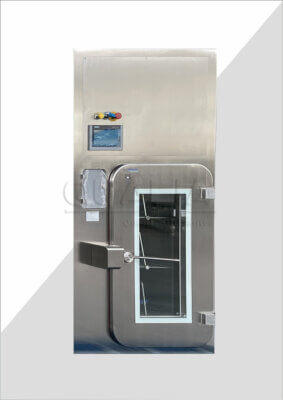
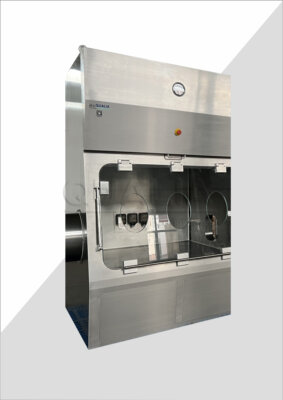
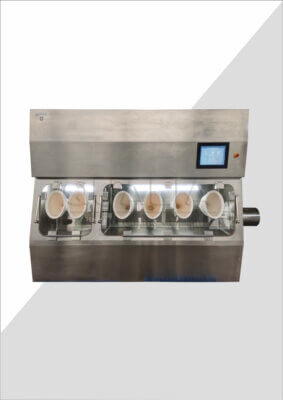
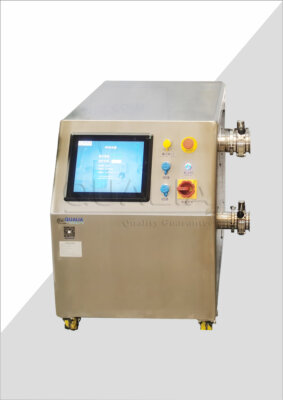
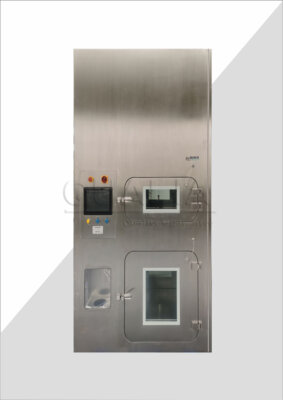
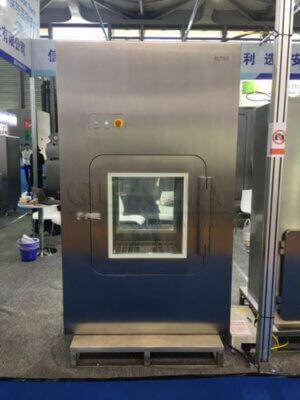
A dynamic pass box operates as a self-contained air-handling unit: a built-in fan draws air through a pre-filter, passes it through an H14 HEPA filter, and delivers it into the transfer chamber in a downward unidirectional pattern. Because the system recirculates internally, no external ducting to a central air-handling unit is required. That self-contained design simplifies installation in terms of ductwork, but it does not eliminate the need for careful integration with the room’s existing pressure cascade.
The downflow velocity inside the chamber is typically maintained in the range of 0.36 to 0.45 m/s. This figure functions as a measurable validation target: it is specific enough to test against and meaningful enough to anchor the acceptance criteria during commissioning. A velocity outside this range — whether too low to provide effective particle sweep or turbulent enough to re-entrain contaminants — is detectable only if a smoke study or velocity mapping is performed at the transfer opening, not just at the chamber centerline.
This is the point where a common procurement assumption creates downstream problems. Teams sometimes treat the internal fan as a general cleanliness upgrade and conclude that smoke studies or airflow pattern verification at the transfer opening are optional. In practice, the fan establishes a pressure condition inside the chamber, but the behavior at the boundary between the chamber and the receiving room during door-open is what matters for classified-zone protection. Skipping smoke studies during qualification leaves leakage paths or turbulence at the transfer opening undetected until an audit or an excursion event surfaces the problem.
The time-delayed purge cycle built into most dynamic units adds another process variable that must be incorporated into transfer protocols. After a door closes, the fan continues to run for a defined purge period before the interlock allows the opposite door to open. This flush cycle removes contaminants introduced during loading, but it also extends cycle time. Transfer procedures that do not account for this delay create pressure on operators to override or rush the cycle — a behavior that should be addressed in the standard operating procedure rather than discovered during a process deviation investigation.
Filter access constraints that affect installation
The HEPA filter inside a dynamic pass box is not a consumable that can be treated as an afterthought during facility design. It requires periodic integrity testing, annual or biannual replacement depending on loading conditions, and ongoing differential pressure monitoring. Each of these requirements has a physical access implication that must be resolved before the unit is installed, not after.
The three constraints that produce the most rework when left unaddressed are consistent enough to treat as a pre-installation checklist.
| Constraint | Risiko, wenn es übersehen wird | Was zu bestätigen ist |
|---|---|---|
| DOP/PAO test port accessibility | Omission delays commissioning and requalification | Ports are accessible for routine integrity testing |
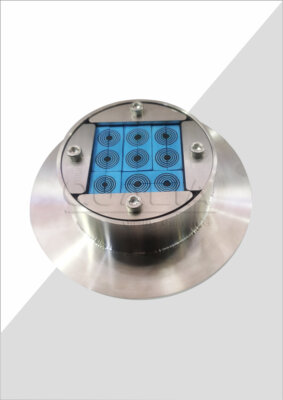
| Wall cut-out flange sealing | Improper sealing bypasses HEPA, compromising room pressure differentials | Sealing method meets airtightness specification |
| Service access for filter replacement | Inaccessible filters force costly wall modifications or downtime | Clearance and access panels planned in early architectural layout |
The flange sealing condition deserves specific attention because it connects two separate failure risks. An improperly sealed wall cut-out creates a bypass path that routes unfiltered air around the HEPA element and into the pressure boundary between the two rooms. The consequence is not just particulate contamination inside the chamber; it is a potential disruption to the room differential pressure that the facility’s HVAC system was validated to maintain. That kind of cross-system interaction is difficult to trace during troubleshooting because the symptom — a pressure excursion in the classified room — does not obviously point to a pass box seal as the root cause.
Service clearance for filter replacement is the constraint most often absent from early architectural layouts. Pre-filters graded at G4 are typically changed more frequently than the H14 HEPA; both require enough clearance to withdraw the filter element without damaging adjacent surfaces or requiring tools that are unsuitable for a classified environment. If clearance is not confirmed during the layout stage, the installed unit may technically function but be impossible to service without modifying the wall, which triggers a requalification of the room boundary.
Alarm and monitoring points needed for qualification
A dynamic pass box carries a qualification burden that a static unit does not. The monitoring and control points built into the unit are not optional convenience features; they collectively define the evidence base needed to demonstrate that the chamber performed as specified during the transfer — and that it continues to perform the same way during periodic requalification.
Each monitoring point maps to a specific qualification function, and gaps in coverage create gaps in the evidence record that regulators and internal quality teams will identify during review.
| Monitoring / Control Point | Funktion | Qualification Relevance |
|---|---|---|
| Downflow velocity alarm | Alerts when velocity deviates from 0.36–0.45 m/s setpoint | Demonstrates continuous airflow control |
| Filter loading alarm | Indicates rising differential pressure across HEPA | Triggers maintenance before filtration degrades |
| Differenzdruckmessgerät | Displays real-time HEPA filter status | Supports operator condition checks |
| Door-open alarm (1‑minute timeout) | Activates if door remains open more than one minute | Prevents prolonged exposure compromising containment |
| Door interlock during UV/purge cycles | Locks both doors during decontamination | Ensures safety and prevents operator error |
| HEPA integrity, air velocity, recovery tests | Validate filter and clean‑up performance per ISO 14644‑3 | Required for initial and periodic qualification protocol |
The validation protocol required to qualify a dynamic pass box references ISO 14644-3 as the testing framework for HEPA filter integrity testing (using DOP or PAO aerosol challenge), downflow velocity measurement, and clean-up recovery testing. These are not supplementary checks; they are the minimum technical evidence set needed to support the initial qualification and justify the continued use classification assigned to the unit. Teams that treat them as post-installation items rather than pre-commissioning requirements routinely find that test port access was not confirmed in advance, creating the exact filter access problem described in the previous section.
The door-open alarm with its one-minute timeout and the interlock behavior during UV or purge cycles function as safety controls, but their qualification relevance is practical: if either fails during commissioning testing, the unit cannot be released for classified-zone service until the fault is resolved. Including alarm function testing in the Factory Acceptance Test checklist, rather than discovering the gap at Site Acceptance, keeps the commissioning timeline from compressing against the facility’s startup schedule.
Classified-zone protection as the threshold for active HEPA supply
Active HEPA supply in a transfer chamber is warranted when the act of opening a door to load or unload material can degrade the receiving room’s qualified condition. That is the core engineering threshold, and it is defined by the relationship between the two rooms at the wall, not by any property of the unit itself.
| Receiving Room Classification | Recommended Pass Box | Justification / Condition |
|---|---|---|
| ISO 5 or ISO 6 | Dynamic (active HEPA supply) | Transient contamination during door‑open must be actively controlled; even same‑class transfers may require protection |
| ISO 7 or ISO 8 | Static may be acceptable if no classification gap and material risk is low; dynamic if receiving room is cleaner than sending room or risk exists | Lower sensitivity; passive interlock may suffice unless risk of particulate ingress is elevated |
For ISO 5 and ISO 6 environments, a static pass box’s reliance on door interlocks and the facility pressure cascade is likely insufficient when a classification gap exists. During the door-open period, the interlock prevents simultaneous opening of both doors, but it does not actively displace the air mass that enters the chamber from the less-clean side. Without active downflow to purge that air before the inner door opens, the receiving room is exposed to a contaminant slug. The severity depends on the concentration differential and the duration of door-open, but the condition is plausible enough — and the consequence for an ISO 5 filling environment severe enough — that accepting the risk is difficult to defend in a design review. A Biosicherheits-Pass-Box with active HEPA supply eliminates this exposure by maintaining a positive, filtered condition inside the chamber throughout the transfer cycle.
For ISO 7 and ISO 8 receiving rooms, the judgment is less absolute. If both rooms share the same classification and the material being transferred does not carry elevated contamination risk, a static unit may be technically adequate. The threshold shifts toward active supply once the receiving room is cleaner than the sending room or once the material transfer frequency is high enough that cumulative door-open exposure becomes a meaningful risk driver. Treating ISO class alone as the decision criterion is a simplification; material risk, transfer frequency, and the facility’s validated pressure cascade all belong in the same assessment.
The failure mode that static installations encounter in cross-classification scenarios is not always visible in routine monitoring. Particle counters in the receiving room may not capture the transient excursion that occurs during a brief door-open period, especially if sampling is not continuous or if the sample point is remote from the transfer opening. That detection gap means the problem can persist through multiple transfers before it appears in data — and by that point it is typically framed as a process deviation rather than a design deficiency, which makes it harder and more expensive to correct. Teams specifying pass boxes for classified transfer points between rooms of different ISO classes should also consider whether decontamination capability is a requirement for their biosafety application; a VHP-Pass-Box addresses both active air supply and surface decontamination in a single chamber where the containment risk profile demands it.
The classification relationship across the wall is the first thing to confirm, and it should be confirmed before any other specification decision is made for a transfer point. Once a classification gap is established, active HEPA supply transitions from a cost option to a design requirement — and with it comes a set of embedded obligations around filter integrity testing, motor and filter service access, alarm monitoring, and recovery testing that must be resourced from the start of the project, not discovered at commissioning.
The practical pre-procurement check is not whether a dynamic unit can fit in the wall opening, but whether the architectural layout already accounts for DOP/PAO test port access, service clearance for filter withdrawal, and flange sealing that preserves the room pressure boundary. If those provisions are absent from the current drawings, the cost of a dynamic pass box has not yet been fully estimated — and the gap between the quoted unit price and the true installed cost is where most project teams encounter avoidable rework.
Häufig gestellte Fragen
Q: Does a dynamic pass box still add value if the facility’s pressure cascade already holds the receiving room strongly positive?
A: Not necessarily — if the validated pressure differential is sufficient to prevent ingress during the door-open period at a same-classification transfer point, a static unit may remain adequate. The active HEPA chamber becomes genuinely necessary when the pressure cascade alone cannot compensate for a classification gap at the opening, or when transfer frequency is high enough that cumulative door-open exposure represents a meaningful contamination risk regardless of baseline differential pressure. Confirming the cascade condition at the specific wall location, not just across the suite generally, is the check that resolves this.
Q: After the dynamic pass box is installed and the room pair is qualified, what is the first operational obligation that teams typically underestimate?
A: The first sustained obligation is HEPA filter differential pressure trending combined with scheduled DOP or PAO integrity retesting — not just visual inspection or alarm acknowledgement. Filter loading degrades both velocity and filtration efficiency gradually, so monitoring differential pressure across the HEPA element between formal integrity tests is the practical early-warning mechanism. Teams that treat integrity testing as a purely periodic event without ongoing differential pressure review tend to miss gradual performance decline until it produces a qualification excursion.
Q: At what point does a VHP pass box become the more appropriate choice over a standard dynamic unit with active HEPA supply?
A: When the containment risk profile requires surface decontamination of the material or the chamber interior — not just particulate control — a VHP-capable chamber becomes the more appropriate specification. Active HEPA supply addresses airborne particle concentration during the transfer cycle but does not inactivate biological surface contamination. If the receiving room is a containment suite handling live biological agents, or if the material being transferred has a surface contamination risk that cannot be resolved upstream, decontamination capability belongs in the same chamber rather than as a separate upstream step.
Q: How should transfer frequency factor into the decision when the ISO class difference is only one level, such as ISO 6 sending into ISO 7?
A: High transfer frequency shifts the threshold toward active supply even when the classification gap is modest. Each door-open event introduces a transient contamination exposure, and at low frequency the receiving room’s recovery capacity and the facility’s pressure cascade may absorb those events without measurable impact. Once transfers occur multiple times per shift, the cumulative exposure duration becomes a design-level risk driver rather than an incidental one, and continuous or event-based active airflow provides a more defensible engineering control than relying entirely on interlock discipline and pressure recovery between cycles.
Q: Is the commissioning burden for a dynamic pass box manageable within a standard cleanroom qualification timeline, or does it typically extend the schedule?
A: It extends the schedule if DOP or PAO test port access, motor service clearance, and flange sealing confirmation have not been resolved before installation begins. When those provisions are built into the architectural layout from the start, the qualification protocol — HEPA integrity testing, velocity mapping, recovery testing per ISO 14644-3, and alarm function verification — can be sequenced within a normal Site Acceptance phase. The schedule compression that teams encounter almost always traces back to access and sealing gaps discovered after the unit is in the wall, which forces physical rework before qualification testing can begin.
Verwandte Inhalte:
- Biosicherheits-Pass-Box: Typen und Auswahlhilfe für BSL-Anwendungen
- Transferkammern in Isolatoren für Sterilitätstests
- Handschuhfach-Isolatoren: Verbesserung der Sicherheit im Labor
- Pharmazeutische APR-Türdichtungen | Reinraumanwendungen & Normen
- Vorgefertigte Reinräume nach ISO 7 und ISO 8: Anforderungen an Luftstrommuster und Luftwechselrate für pharmazeutische Verpackungen
- Pass-Through Air Showers: Effiziente Übergänge
- ISO 14644 und biologische Sicherheitswerkbänke: Normen für saubere Luft
- Verständnis der pneumatischen APR-Türdichtungstechnologie
- OEB4/OEB5 Handschuhfach-Isolatoren: Umgang mit potenten Stoffen