Positioning a personnel shower at the wrong point in a doffing sequence is one of the more consequential layout errors in high-containment facility design — not because the hardware is complex, but because the function being claimed changes entirely depending on where in the exit sequence the shower sits. A shower installed after a chemically treated suit is removed performs a different contamination-control function than one used to rinse PPE surfaces still under positive pressure. When that distinction is not documented clearly in the SOP and reflected in the room layout, biosafety committees may reject the control claim, stall SOP approval, or require physical redesign of the airlock sequence before commissioning can proceed. What follows will help biosafety officers, facility engineers, and QA teams judge whether a water shower-out fits their approved exit sequence and what that decision requires of the surrounding infrastructure.
Shower-Out Use Depends On The Approved Exit Sequence
The personnel water shower at BSL-4 exit is not a discretionary add-on or a comfort measure — it is a defined procedural step embedded within a sequenced exit protocol that separates chemically treated suit decontamination from the subsequent personal shower. That separation is operationally significant. The chemical treatment step addresses external contamination on the suit surface. The personnel shower that follows addresses the individual after the suit is removed. These two steps serve different contamination-control purposes, and the water shower only belongs in the protocol at the point where personal hygiene, not surface decontamination, is the control objective.
For BSL-3 facilities, the decision is less automatic. CDC BMBL guidance frames shower-out requirements at BSL-3 as agent- and site-specific, not universal. That means the exit sequence at BSL-3 depends on what the risk assessment has determined, which may or may not include a mandatory personnel shower. The downstream consequence of getting this wrong is that an approved exit SOP may be built around a shower-out control that cannot be defended for the specific agent in use — or conversely, a facility may be designed without a shower where the risk assessment would have required one.
The practical design implication is that the exit sequence must be approved before the shower is specified, not after. If the sequence is still under discussion, the shower location, drainage routing, and pressure-zone placement are all provisional. Locking in shower hardware before the SOP is approved by the institutional biosafety committee creates the risk of a room layout that does not match the agreed protocol.
PPE Removal State Changes The Shower Claim
What a water shower actually contacts depends on what the person is wearing when they enter it. That fact changes the defensibility of the control claim in ways that are often underappreciated during early facility planning.
If a worker enters the shower while still wearing outer PPE — whether a pressure suit, coverall, or outer gloves — the shower is acting on PPE surfaces, not on the person. That is not a personnel shower-out in the conventional sense; it is a surface rinse of protective clothing. Calling it a shower-out in SOPs or biosafety committee submissions when the function is a suit rinse misrepresents what the control achieves. The consequence is not just semantic. A biosafety committee reviewing the SOP will evaluate whether the stated control matches the actual physical sequence, and a mismatch between the two is a common basis for procedural revision requests or rejection.
Conversely, if the worker enters the shower after removing outer PPE layers in a defined doffing area, the shower is genuinely addressing the individual — body surfaces, hair, any residual skin exposure risk after glove and garment removal. This is the function that aligns with the personnel shower-out described in BSL-4 exit protocols, and it is the function that the water shower hardware is designed to support. The distinction matters for how the shower is described in the URS, how the transition from contaminated to clean is defined in the room sequence, and ultimately how the control is characterized during inspection.
A useful review check: before drafting the URS, confirm whether the personnel enters the shower in full PPE, partial PPE, or after outer-layer removal — then ensure that the SOP language and the control claim are written for the actual state, not an assumed one.
Water Systems Simplify Chemistry But Still Need Controlled Transitions
Compared to chemical shower systems, water-only personnel showers appear operationally simpler. There is no chemical preparation, concentration monitoring, contact time validation, or effluent treatment specific to the decontaminant chemistry. For facilities where the approved exit sequence calls for a personnel shower after PPE has already been chemically treated or removed, the water shower is a legitimate fit — and its relative simplicity is a real operational advantage.
The risk is that this apparent simplicity leads project teams to underestimate the infrastructure requirements that a water shower still demands. Drainage from a shower positioned within or adjacent to a containment zone is not a standard floor drain condition. The transition between contaminated and clean drainage must be planned, and in some facility configurations that means the shower drainage is treated as potentially contaminated effluent regardless of whether the PPE was removed before entry. That has implications for drain line routing, decontamination provisions, and maintenance access — none of which are resolved by the fact that the system uses water rather than a chemical agent.
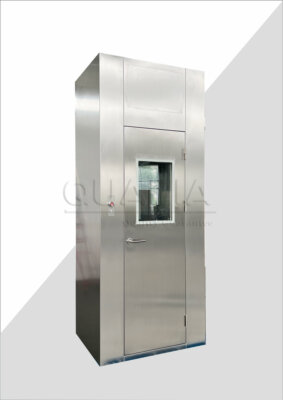
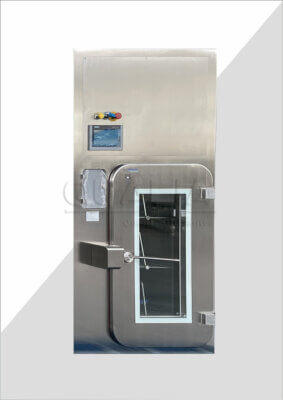
Privacy is also a non-trivial infrastructure requirement. A personnel shower-out is not a utility rinse station; it is a functional space that requires appropriate enclosure, a defined clean-side exit, and access to clean clothing or PPE for the post-shower transition. Facilities that plan shower space as an afterthought — a corner of the airlock with a showerhead installed — often discover during commissioning that the room does not meet the practical requirements of the approved exit procedure. Cleaning access to the shower itself is a maintenance consideration that should be addressed in the equipment specification, not left to the facilities team to resolve post-installation. For hardware designed specifically for these requirements, Douche equipment in high-containment configurations addresses these transition and drainage conditions at the product level rather than requiring field adaptation.
Room Sequencing Links Doffing And Pressure Boundaries
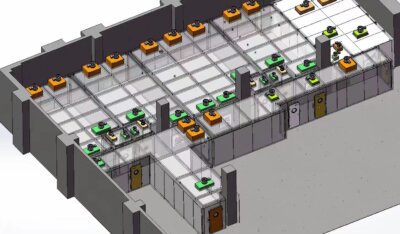
The shower cannot be placed independently of the airlock sequence. According to WHO Laboratory Biosafety Manual design guidance, BSL-3 and BSL-4 laboratories use sequential airlock chambers with interlocked self-closing doors to maintain separation between contaminated and clean zones. The shower-out, wherever it sits in the exit sequence, must be integrated into that interlocking logic — which means its physical location is not a standalone decision.
The pressure boundary is the binding constraint. BSL-4 laboratories are maintained at negative pressure relative to surrounding areas, and that differential must not be compromised at the point where personnel exit. A shower positioned at the wrong stage of the airlock sequence can create a condition where the door to the clean side opens before the person has completed the transition — or where the sequencing logic allows simultaneous access to contaminated and clean zones. Neither of these is a hypothetical failure mode; both have been identified as airlock interlocking problems during commissioning of high-containment facilities.
The doffing sequence and the shower location must be designed together. If doffing occurs in a defined room before the shower, that room needs its own pressure characterization and interlocking relative to both the clean corridor and the shower space. If the shower is within a combined doffing and shower room, the ventilation and pressure relationships in that space need to be resolved for all states of occupancy — suited entry, partially doffed, post-shower, and exit. Resolving those states during layout is substantially easier than addressing them during commissioning, when interlocking logic is already built and drain lines are fixed. Modular BSL-3/4 laboratory configurations that integrate these relationships at the design stage, such as BSL-3/BSL-4 Module Laboratorium systems, reduce the risk of sequencing conflicts that arise when shower-out rooms are added as afterthoughts to a base facility layout.
Risk Assessment Must Support Shower-Out Instead Of Chemical Treatment
Selecting a water shower-out over chemical treatment, or alongside it, must be traceable to a documented risk assessment rather than assumed because the agent is classified at a given biosafety level. CDC BMBL is explicit that biosafety level assignment — including exit controls — is the product of risk analysis of the specific agent, not a mechanical application of level-based rules. A shower-out that cannot be traced to that analysis is a control claim without a documented foundation, which creates a defensibility problem during biosafety committee review and regulatory inspection.
The four factors that WHO and CDC guidance consistently identify as drivers of personnel decontamination requirements are agent pathogenicity, infectious dose, host range, and the availability of post-exposure countermeasures. Each of these affects whether a personnel water shower is the appropriate exit control, whether chemical treatment of PPE surfaces must precede it, or whether both steps are required in sequence. The biosafety officer must work through each factor explicitly before the exit sequence — and therefore the shower specification — is finalized.
| Factor in Risk Assessment | Relevance to Shower-Out Requirement | Wat bevestigen? |
|---|---|---|
| Agent pathogenicity | Higher pathogenicity typically demands more stringent personnel decontamination to reduce escape risk. | That risk analysis explicitly links pathogenicity level to the need for a full personnel shower. |
| Infectious dose | A low infectious dose may justify a shower-out even when outer PPE appears intact. | Whether the agent’s dose-response profile has been evaluated for residual body-surface contamination. |
| Host range | Broader host range (including humans) can elevate the requirement for personal exit controls. | That host-range data is weighted in the decision to separate chemical suit treatment from personnel shower. |
| Countermeasures (treatment/vaccine availability) | Effective post-exposure countermeasures may reduce reliance on personnel shower-out; their absence strengthens the case. | That the risk assessment documents countermeasure status and its effect on the shower-out determination. |
What the table does not show is the audit consequence of skipping this process. A facility that specifies a water shower because it is operationally simpler, without documented justification in the risk assessment, will have difficulty defending the control selection if an inspector or biosafety committee asks why chemical treatment was not used or why both steps were not required. That question is most likely to arise after an exposure event, an audit of the institutional biosafety program, or a regulatory inspection tied to select agent or export control obligations. Documenting the risk assessment basis for shower-out before construction begins is the difference between a defensible control and a retrofit conversation.
For further context on how risk group classification and shower requirements interact at BSL-3, see CDC Bioveiligheid in microbiologische en biomedische laboratoria: Vereisten voor het douchen van personeel voor agentia van risicogroep 3.
The clearest pre-decision check for any facility team evaluating shower-out is this: the SOP must exist before the hardware is specified, and the SOP must be traceable to a risk assessment before the SOP is approved. If either of those steps is reversed — hardware selected before the exit sequence is agreed, or sequence agreed before the risk assessment is documented — the facility is building toward a gap that will surface during IBC review, commissioning, or inspection.
What teams should confirm before advancing the shower specification is whether the approved exit sequence defines where PPE is removed relative to where the shower is entered, whether the shower drainage and pressure relationships have been resolved within the airlock layout, and whether the risk assessment explicitly addresses the four factors that govern whether a personnel shower-out is the appropriate control for the agent in use. Those confirmations take the shower decision from an equipment selection into a defensible containment control.
Veelgestelde vragen
Q: Does the water shower BSL personnel exit requirement apply if the facility operates at BSL-3 but handles agents with BSL-4 transmission risk?
A: The shower-out requirement depends on the agent-specific risk assessment, not the facility classification alone. CDC BMBL is explicit that BSL-3 exit controls are agent- and site-specific, so a BSL-3 facility handling an agent with elevated transmission characteristics may be required by its risk assessment to include a mandatory personnel shower-out — while another BSL-3 facility working with a different agent may not. The biosafety officer must complete the risk analysis against pathogenicity, infectious dose, host range, and countermeasure availability before assuming the classification determines the control.
Q: Once the IBC approves the exit SOP, what is the next step before the shower specification is finalized?
A: The immediate next step is resolving the airlock pressure relationships and doffing room placement against the approved sequence — not issuing the equipment specification. IBC approval confirms the procedural control, but it does not resolve whether the shower drainage, interlocking logic, and pressure differentials in the surrounding rooms are designed to match that sequence. Those layout conditions must be confirmed before hardware dimensions, drain line routing, and clean-side exit placement are fixed, because changes to any of them after construction begins carry significant redesign cost.
Q: At what point does a water shower-out stop being a defensible control and require a chemical treatment step instead?
A: A water shower-out stops being independently defensible when the approved risk assessment determines that agent survival on PPE surfaces after exit represents a residual contamination risk that personal hygiene alone cannot address. For agents where the infectious dose is extremely low, where no post-exposure countermeasure exists, or where environmental persistence on suit materials is documented, biosafety committee review is likely to require chemical treatment of the suit surface as a prior step rather than treating the personnel shower as the primary control. The water shower may still be required after chemical treatment, but it cannot substitute for it when surface decontamination is the risk driver.
Q: Is a water-only personnel shower operationally simpler to validate and maintain than a chemical shower system?
A: Water-only systems eliminate the chemical-specific validation burden — concentration monitoring, contact time verification, and decontaminant effluent handling are not required — which does reduce ongoing operational complexity. However, the validation scope for the shower itself is not zero. Drainage from a containment-zone shower may still be classified as potentially contaminated effluent depending on the facility’s risk assessment, which means drain line routing, maintenance access, and effluent treatment provisions must still be specified and documented. The simplification is real but applies to chemistry management, not to the containment infrastructure around the shower.
Q: If budget or space is constrained, is it acceptable to use a shared doffing and shower room rather than separate spaces?
A: A combined doffing and shower room is structurally acceptable if — and only if — the ventilation, pressure relationships, and interlocking logic within that space are resolved for every occupancy state: suited entry, partial doffing, active showering, and clean-side exit. The risk with combined spaces is not the combination itself but the tendency to under-specify the pressure and drainage conditions for transitional states, which creates interlocking conflicts discovered at commissioning. If the facility team cannot resolve the pressure characterization for all occupancy states during layout, separating the spaces is the lower-risk design path.
Gerelateerde inhoud:
- Neveldouche vs Luchtdouche voor decontaminatie van BSL-3-personeel: Welk ontsmettingsprotocol is geschikt?
- Chemical Shower vs Water Shower vs Mist Shower for BSL Personnel Exit: Selection Guide for High-Containment Labs
- BSL Personnel Exit Decontamination: When a Shower Is a Containment Control, Not a Cleanroom Accessory
- CDC Bioveiligheid in microbiologische en biomedische laboratoria: Vereisten voor het douchen van personeel voor agentia van risicogroep 3
- Personnel Entry and Exit Acceptance Criteria for BSL-4 Facilities: Shower, Suit Room and Door Logic
- Vereisten voor neveldouches volgens BMBL 5e editie: Wat BSL-3 Exit Protocols moeten bevatten
- Neveldouchesystemen: Een technische referentie voor BSL-3 en BSL-4 personeelontsmetting
- Chemical, Water and Mist Shower Scope for BSL-3, BSL-4 and Enhanced Containment Suites
- Neveldoucheontwerp voor BSL-4 laboratoria: Verbeterde inperkingsspecificaties voorbij BSL-3 normen