Facilities that add a mist or chemical shower to a BSL-3 exit corridor without revising the doffing sequence, waste routing, or emergency SOP often discover the gap only during commissioning review or an unannounced audit—at which point the installation is complete, but the protocol is not. That sequence of events creates a specific problem: the physical upgrade is defensible, but the operational envelope around it is not, and requalifying the exit process after fit-out is considerably more expensive than designing it correctly before construction. The decision that matters is not whether mist or chemical decontamination is more protective in the abstract, but whether a documented, agent-specific exit contamination scenario exists that the current water shower and procedural controls cannot adequately address. Understanding where that threshold sits—and what regulatory and risk assessment logic supports crossing it—is what allows biosafety officers, QA teams, and facility engineers to justify or decline an upgrade on defensible grounds.
Enhanced BSL-3 Starts With A Changed Risk Scenario
An enhanced BSL-3 designation is not a fixed equipment list applied uniformly across agent classes. It is the output of a site-specific and agent-specific risk assessment that identifies what has changed relative to standard BSL-3 conditions—and then translates that change into physical and procedural controls. The exit shower decision sits inside that logic, not outside it.
CDC guidance for work with HPAI H5N1 viruses containing the HA from the A/goose/Guangdong/1/96 lineage provides a concrete example of how a pathogen-specific risk determination generates a specific exit requirement. For that agent class, the recommended baseline is a gown-in, shower-out protocol using a water shower—not a chemical or mist system. That requirement is not the product of a general preference for shower-out exits; it reflects the aerosol transmission risk associated with that specific pathogen lineage under the procedural conditions of a BSL-3 enhanced laboratory. The water shower is the minimum, and it is justified by the risk profile of that agent at that containment level.
What this means for upgrade planning is precise: if your facility is moving to an enhanced BSL-3 configuration, the first question is not which shower type to install, but what has changed. Was it the agent, the procedure, the aerosol-generating step, the PPE specification, or the institutional risk acceptance criteria? The WHO Laboratory Biosafety Manual (4th Edition) frames biorisk management as a continuous assessment process, not a one-time classification event—which means any change to the risk scenario is itself a trigger for reviewing whether the exit control remains appropriate. A facility that bypasses this framing and moves directly to specifying a chemical shower has inverted the decision sequence and will struggle to justify the upgrade if the underlying risk scenario does not clearly demand it.
Shower Upgrades Need Matching SOP Updates
Installing a more capable exit decontamination system without simultaneously updating the operational procedures that surround it is the single most common source of incomplete exit protocols in enhanced BSL-3 facilities. The shower itself may function correctly, but the doffing sequence, waste stream handling, and emergency response procedures often remain aligned to the predecessor system—creating a mismatch that is difficult to defend during review and impossible to validate cleanly.
CDC guidance on liquid effluent management in BSL-3 enhanced laboratories illustrates one specific version of this gap. Shower and toilet effluents are conditionally exempt from decontamination requirements—but only when appropriate primary containment practices are demonstrably in place. That exemption is not a blanket permission; it is a contingent judgment. If a facility upgrades to a chemical shower and the disinfectant residuals from that system now flow into the same drain line as the conditionally exempt shower effluent, the effluent management SOP must be reviewed to determine whether the conditional exemption still applies, or whether the chemical addition changes the effluent classification. Leaving the original SOP in place while adding a chemical shower to the system is the kind of gap that a qualified person or external auditor is likely to identify immediately.
The PPE decontamination requirement adds a separate obligation that must be explicitly integrated into any upgraded exit protocol. CDC guidance is clear that PPE must be decontaminated by an effective and validated method—autoclave or sprayed disinfectant with documented efficacy against the relevant agent—before a worker leaves the containment area. This is a distinct step from the personnel shower, not a redundancy that the shower eliminates. Any SOP revision accompanying a shower upgrade must treat these as sequential, independently documented controls. Omitting or merging them in the SOP creates a validation gap because the two controls serve different contamination scenarios: the PPE decontamination addresses surface contamination on garments and equipment, while the shower addresses skin and residual surface exposure to the individual. A mist or chemical shower does not render the validated PPE decontamination step unnecessary; it changes what happens after that step, not before it.
Mist Or Chemical Systems Add Utility And Training Burden
Mist and chemical shower systems offer a different mechanism of decontamination than a water shower—broader surface coverage, faster agent contact time, and the option to use a validated disinfectant against specific pathogens—but none of those advantages are unconditional. Each adds a corresponding burden that is often underestimated at the specification stage and fully apparent only during commissioning and operational use.
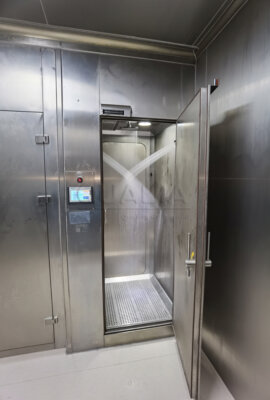
The utility side is genuine. A mist shower system operating with a disinfectant agent can produce finer droplet coverage across complex PPE surfaces than a conventional water stream, which is particularly relevant when exit decontamination needs to address crevices, respirator seals, or glove junctions that a water shower may not fully saturate. A chemical shower using a formulated disinfectant adds an active antimicrobial step that a water shower by design does not provide. If the risk assessment identifies a credible exit contamination scenario involving viable agent on PPE surfaces following an aerosol-generating procedure, these systems address a mechanism that water alone cannot.
The burden side is less often stated clearly before procurement. Chemical storage and inventory management become active operational requirements, including compatibility assessment between the disinfectant and the PPE materials in use—a point the WHO PPE guidance addresses in the context of decontamination compatibility. Effluent from a chemical shower may require collection, neutralization, or disposal treatment depending on the disinfectant chemistry, and that effluent pathway needs to be mapped against local environmental and regulatory requirements before installation, not after. Staff training must cover the disinfectant in use, the contact time, the correct flow volume, and the doffing sequence within the shower—all of which require documented requalification when the chemical agent, concentration, or doffing procedure changes. Validation of a chemical shower exit system is also more complex than a water shower: the decontamination cycle must be challenged against the target agent or an appropriate surrogate, contact time must be verified under realistic use conditions, and requalification intervals must be defined. These are not prohibitive burdens, but they are recurring ones. A facility that adds a chemical shower without budgeting for chemical management, effluent planning, and requalification cycles will find the system operationally undersupported within the first year.
Stakeholder Justification Should Avoid Overgeneralizing BSL-3
One of the most consistent problems in upgrade justification is the claim that “BSL-3 requires” a mist or chemical shower—a statement that neither the CDC nor the WHO supports as a categorical rule, and one that tends to collapse under any competent technical review. When that framing is used with institutional leadership, safety committees, or regulators, it invites an immediate counterpoint: existing guidance for well-characterized BSL-3 enhanced work—including CDC recommendations for HPAI H5N1 of avian origin—identifies a water shower as the required exit control, without reference to mist or chemical systems. The absence of a mist shower requirement from that guidance does not mean mist systems are inappropriate in BSL-3 enhanced settings; it means that water shower, combined with validated PPE decontamination, is considered sufficient when the agent risk profile supports that conclusion.
The correct justification architecture starts from the risk assessment, not from the equipment catalog. ISO 35001:2019 provides a biorisk management framework that treats control selection as a risk-proportionate decision—the type, intensity, and combination of controls are outputs of the risk assessment, not inputs to it. An upgrade to mist or chemical decontamination is defensible when the risk assessment names a specific contamination scenario—a particular agent, a specific procedure, a known failure mode in the current exit protocol—that the existing water shower cannot adequately address. It is difficult to defend when it is presented as a precautionary improvement that makes a BSL-3 laboratory “more compliant” or “more aligned with best practice” without a documented gap.
This distinction also matters for internal stakeholder alignment. Biosafety officers and QA teams who present the upgrade as risk-assessment-driven will have an easier conversation with facility management and procurement than those who frame it as a regulatory mandate, because the former can be defended with a specific document trail and the latter cannot. The implication is practical: before any upgrade proposal goes to stakeholders, the site-specific risk assessment should already contain the contamination scenario that makes the upgrade necessary. If it does not, the risk assessment needs to be updated before the procurement justification is written—not after the equipment is specified.
Upgrade Readiness Requires A Specific Exit Contamination Case
An upgrade decision becomes operationally and regulatorily defensible only when there is a named exit contamination scenario in the facility’s risk assessment that the current exit control cannot adequately manage. That scenario may be agent-driven, procedure-driven, or driven by a change in the risk envelope—but it must exist as a specific documented case, not as a general improvement rationale.
The distinction between avian-origin HPAI H5N1 and mammalian-transmissible HPAI H5N1 illustrates where that threshold shifts.
| Exit Contamination Scenario | Regulatory Guidance | Required Exit Decontamination |
|---|---|---|
| HPAI H5N1 (avian-origin, non-mammalian-transmissible) | CDC BSL‑3 Enhanced: gown‑in, shower‑out; shower effluent decontamination not required if primary containment is in place | Water shower plus validated PPE decontamination |
| Mammalian‑transmissible HPAI H5N1 | NIH Guidelines for Research Involving Recombinant Nucleic Acids: additional containment enhancements beyond standard BSL‑3 enhanced | Water shower may be insufficient; consider upgrade to mist or chemical decontamination per site‑specific risk assessment |
For non-mammalian-transmissible HPAI H5N1, the CDC-recommended exit control is a water shower combined with validated PPE decontamination—and shower effluent decontamination is not required when primary containment practices are in place. That is a defined risk package, and a facility operating within it does not need to justify a mist or chemical exit system on biosafety grounds alone. The NIH guidelines for mammalian-transmissible HPAI H5N1 represent a regulatory step-change: additional containment enhancements beyond the standard BSL-3 enhanced baseline are required, which creates a documented trigger for evaluating whether the water shower baseline remains sufficient. That evaluation—not the NIH guideline itself—is what generates the case for an upgraded exit system.
The planning implication is directional: facilities working with agents that carry a realistic potential for regulatory reclassification, or that are actively designing for worst-case expansion of their agent portfolio, should pre-assess their exit protocol against the trigger scenarios that would require an upgrade. A facility that discovers mid-project that its approved risk assessment does not account for the mammalian-transmissible scenario—and that the exit shower already under fabrication is a water-only system—faces a retrofit problem that is more expensive and time-consuming than having identified that gap in the design phase. Upgrade readiness, in practical terms, is the capacity to name the specific exit contamination case before the project reaches commissioning.
The clearest conclusion from this analysis is that the upgrade decision cannot be separated from the risk assessment that precedes it. A mist or chemical exit system is not an improvement over a water shower in the abstract; it is a response to a specific documented gap in what the water shower can address. When that gap exists—identified through agent-specific hazard characterization, review of aerosol-generating procedures, or regulatory reclassification of the work scope—the upgrade has a defensible foundation that will hold under commissioning review, audit, and internal scrutiny. When the gap is not documented, the upgraded system adds operational burden without a commensurate compliance return.
Before specifying an exit decontamination upgrade, the facility’s risk assessment should already name the contamination scenario, the PPE decontamination integration plan should be confirmed, and the effluent and chemical management obligations of the new system should be mapped to existing infrastructure. If any of those three inputs is absent, the upgrade is not yet ready—the documentation work is not complete, and the equipment specification is ahead of the process that justifies it.
Veelgestelde vragen
Q: Our facility is moving to enhanced BSL-3 but hasn’t finalized a site-specific risk assessment. Can we still plan a mist or chemical shower upgrade?
A: No — the risk assessment must be completed first. An exit shower upgrade is only defensible when it addresses a specific contamination gap that the risk assessment identifies. Proceeding without it risks installing a system that cannot be justified during commissioning review or an audit, and retroactive documentation is significantly more expensive than getting the sequence right before specifying equipment.
Q: Once our risk assessment identifies a gap that justifies a mist or chemical shower, what is the very next step before selecting equipment?
A: Confirm that the existing PPE decontamination protocol — such as autoclave or validated sprayed disinfectant — remains in place and is explicitly integrated into the upgraded exit sequence. A mist or chemical shower does not replace this step; it follows it. Drafting the revised doffing and decontamination SOP at this point ensures the upgrade addresses both surface contamination removal and personnel decontamination without creating a validation gap.
Q: Our BSL-3 lab handles multiple agents with different risk profiles. Does the exit shower upgrade decision need to cover all of them, or can it be based on the highest-risk pathogen?
A: The upgrade is driven by the specific agent that creates the documented contamination gap. However, if the exit corridor serves multiple suites, the facility risk assessment must also evaluate whether the chemical or mist protocol for that agent could interfere with the exit sequence for other agents — for example, through PPE material incompatibility or residue that affects downstream work. The justification remains agent-specific, but the operational plan must account for the shared exit path.
Q: Should we choose a mist shower or a chemical shower for our BSL-3 exit upgrade?
A: The decision depends on the contamination scenario your risk assessment identifies. A mist shower is designed to improve physical coverage of complex PPE surfaces — such as respirator seals and glove junctions — that a water stream may not fully reach. A chemical shower adds an active antimicrobial step against a specific agent, requiring a validated disinfectant. If your gap is incomplete rinse coverage, a mist system may be sufficient; if the assessment demands verified agent kill on PPE, a chemical system is the stronger choice. Both bring training, effluent, and requalification obligations.
Q: How do we know if the ongoing chemical storage, effluent, and requalification burden of a mist or chemical shower is worth it for our facility?
A: The burden is only justifiable when the risk assessment documents an exit contamination scenario that the current water shower plus validated PPE decontamination cannot adequately manage — and when the consequences of that scenario, such as potential agent release or non-compliance with evolving regulations, are clearly greater than the operational cost of the upgrade. If your existing water-based protocol already satisfies applicable CDC or WHO guidance for your agents, the added burden brings no commensurate biosafety return.